


The 89-member delegation of the Czech Republic, headed by Czech Senate President Milos Vystrcil, on Friday evening departed Taiwan, ending their six-day visit.
Vystrcil met many liberal-minded and creative people during his stay, he said, adding that he hopes the visit would not only deepen ties between the Czech Republic and Taiwan, but also bring about investment opportunities for the two sides.
He looked forward to Taiwanese carriers starting direct flights between the nations and for Taiwan to export high-value-added products to the Czech Republic, he said.
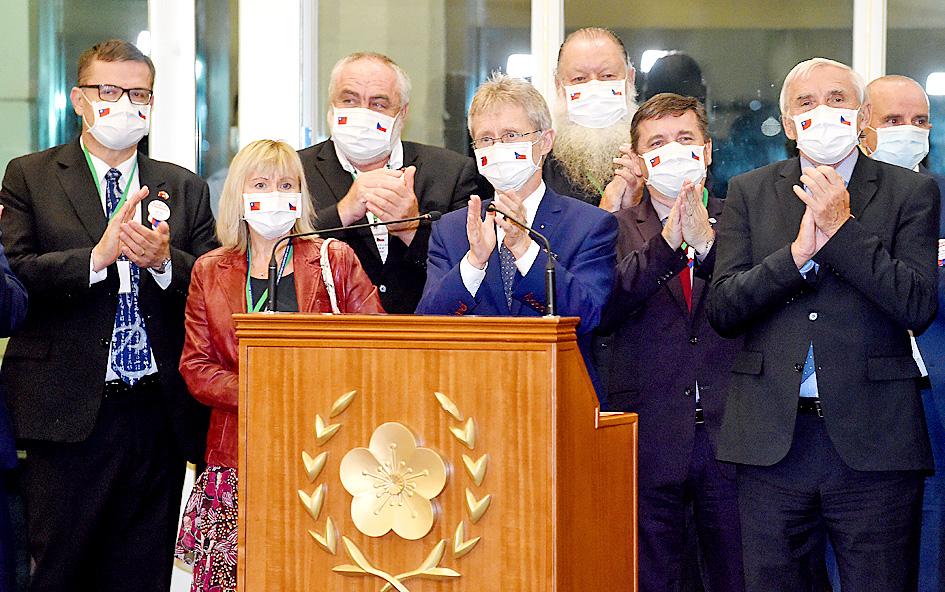
Photo: Chu Pei-hsiung, Taipei Times
The nations agree on the importance of promoting freedom and democracy, Vystrcil said, adding that he enjoyed his stay in Taiwan.
Vystrcil and the delegation, which included eight Czech senators and Prague Mayor Zdenek Hrib, flew to Taiwan on Sunday last week for the landmark visit, despite strong condemnation from China.
During the visit, the group of representatives of Czech political, business, science and cultural sectors signed three memorandums of understanding with Taiwanese companies to enhance cooperation.
The visit also resulted in the Czech Republic allowing Taiwanese state-run banks to open branches in the country and China Airlines to operate direct flights there.
On Thursday, while meeting with Vystrcil, President Tsai Ing-wen (蔡英文) said that the visit had been a fruitful one, and praised the delegation for making an important first step in breaking down barriers, even though the nations do not have official diplomatic ties.
Such an exchange tells “all our friends in Europe and around the world that friends upholding the same beliefs, regardless of whether they are Czech or Taiwanese, will not succumb to oppression and will continue to bravely ensure our voices are heard,” she said.
During his stay, Vystrcil also met several other top Taiwanese officials, and spoke at the Legislative Yuan and National Chengchi University in Taipei.
He on Tuesday received a Congressional Diplomacy Honorary Medal from the legislature, making him the first legislative head from a country with which Taiwan has no diplomatic relations to receive the recognition since it was created in 2007.

Considering that most countries issue more than five denominations of banknotes, the central bank has decided to redesign all five denominations, the bank said as it prepares for the first major overhaul of the banknotes in more than 24 years. Central bank Governor Yang Chin-lung (楊金龍) is expected to report to the Legislative Yuan today on the bank’s operations and the redesign’s progress. The bank in a report sent to the legislature ahead of today’s meeting said it had commissioned a survey on the public’s preferences. Survey results showed that NT$100 and NT$1,000 banknotes are the most commonly used, while NT$200 and NT$2,000

The Centers for Disease Control (CDC) yesterday reported the first case of a new COVID-19 subvariant — BA.3.2 — in a 10-year-old Singaporean girl who had a fever upon arrival in Taiwan and tested positive for the disease. The girl left Taiwan on March 20 and the case did not have a direct impact on the local community, it said. The WHO added the BA.3.2 strain to its list of Variants Under Monitoring in December last year, but this was the first imported case of the COVID-19 variant in Taiwan, CDC Deputy Director-General Lin Ming-cheng (林明誠) said. The girl arrived in Taiwan on

South Korea is planning to revise its controversial electronic arrival card, a step Taiwanese officials said prompted them to hold off on planned retaliatory measures, a South Korean media report said yesterday. A Yonhap News Agency report said that the South Korean Ministry of Foreign Affairs is planning to remove the “previous departure place” and “next destination” fields from its e-arrival card system. The plan, reached after interagency consultations, is under review and aims to simplify entry procedures and align the electronic form with the paper version, a South Korean ministry official said. The fields — which appeared only on the electronic form

The Ministry of Foreign Affairs (MOFA) is suspending retaliation measures against South Korea that were set to take effect tomorrow, after Seoul said it is updating its e-arrival system, MOFA said today. The measures were to be a new round of retaliation after Taiwan on March 1 changed South Korea's designation on government-issued alien resident certificates held by South Korean nationals to "South Korea” from the "Republic of Korea," the country’s official name. The move came after months of protests to Seoul over its listing of Taiwan as "China (Taiwan)" in dropdown menus on its new online immigration entry system. MOFA last week


 RSS
RSS