


The Centers for Disease Control (CDC) yesterday urged pregnant women to maintain good hand hygiene and avoid eating raw food after it reported a case of listeriosis in a newborn, who might have contracted the disease from her mother after she ate contaminated food during the pregnancy.
Epidemic Intelligence Center Deputy Director Guo Hung-wei (郭宏偉) said that the nation’s first case of neonatal listeriosis reported this year was an infant born in northern Taiwan late last month with shortness of breath.
“Examination results showed that she had contracted listeriosis,” Guo said. “The mother had eaten salad and sashimi in May and June, so doctors think there is a high possibility that the infant was infected through vertical transmission from her mother.”
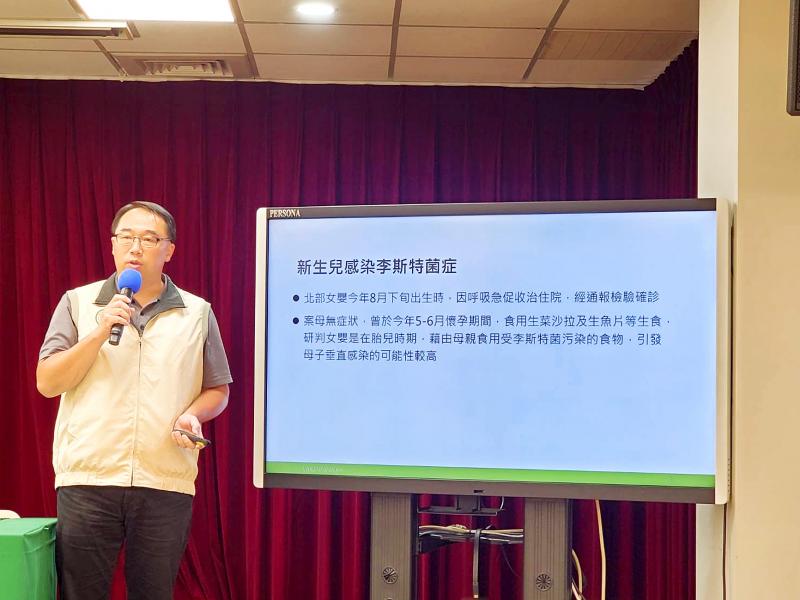
Photo: Lin Hui-chin, Taipei Times
So far this year Taiwan has reported 97 cases of listeriosis, lower than in the same period in 2018, which had 121 cases, and last year, which had 129 cases, he said.
Since the CDC designated listeriosis a category 4 notifiable communicable disease in 2018, 430 cases have been reported, with about the same number of female and male patients, he said.
However, people aged 65 or older accounted for 57 percent of the cases, he said.
There were four cases of neonatal listeriosis among them, and nine cases of premature delivery, miscarriage or stillbirth due to Listeria infection, Guo said.
CDC physician Lin Yung-ching (林詠青) said that Listeria bacteria can be found in soil, water and elsewhere in the environment, while people can be infected by eating contaminated food.
In rare cases, neonatal listeriosis can occur through vertical transmission of the bacteria from mother to fetus, Lin said.
“Food with higher risk of Listeria contamination include deli meat, sashimi, raw vegetables and unpasteurized milk or food made with unpasteurized milk,” he said.
The bacteria can survive in temperatures as low as about 4°C, he said, adding that food should be heated to 72°C to kill the bacteria.
People with a weak immune system should avoid eating raw food, he said.
“People with a healthy immune system might have no symptoms or only mild gastrointestinal symptoms — such as nausea, vomiting, diarrhea or fever — after eating food contaminated with Listeria, but they can usually recover on their own,” he said.
However, people with higher risks of serious illness, including elderly people, infants, pregnant women and people with a weak immune system, might develop septicemia, a central nervous system infection or other severe symptoms, Lin said.
The center urges pregnant women to avoid eating raw food and to maintain good hand hygiene to prevent listeriosis, and if people experience a fever, headache, nausea, vomiting or other symptoms after eating raw food, they should seek medical attention as soon as possible, he said.

Considering that most countries issue more than five denominations of banknotes, the central bank has decided to redesign all five denominations, the bank said as it prepares for the first major overhaul of the banknotes in more than 24 years. Central bank Governor Yang Chin-lung (楊金龍) is expected to report to the Legislative Yuan today on the bank’s operations and the redesign’s progress. The bank in a report sent to the legislature ahead of today’s meeting said it had commissioned a survey on the public’s preferences. Survey results showed that NT$100 and NT$1,000 banknotes are the most commonly used, while NT$200 and NT$2,000

The Centers for Disease Control (CDC) yesterday reported the first case of a new COVID-19 subvariant — BA.3.2 — in a 10-year-old Singaporean girl who had a fever upon arrival in Taiwan and tested positive for the disease. The girl left Taiwan on March 20 and the case did not have a direct impact on the local community, it said. The WHO added the BA.3.2 strain to its list of Variants Under Monitoring in December last year, but this was the first imported case of the COVID-19 variant in Taiwan, CDC Deputy Director-General Lin Ming-cheng (林明誠) said. The girl arrived in Taiwan on

South Korea is planning to revise its controversial electronic arrival card, a step Taiwanese officials said prompted them to hold off on planned retaliatory measures, a South Korean media report said yesterday. A Yonhap News Agency report said that the South Korean Ministry of Foreign Affairs is planning to remove the “previous departure place” and “next destination” fields from its e-arrival card system. The plan, reached after interagency consultations, is under review and aims to simplify entry procedures and align the electronic form with the paper version, a South Korean ministry official said. The fields — which appeared only on the electronic form

The Ministry of Foreign Affairs (MOFA) is suspending retaliation measures against South Korea that were set to take effect tomorrow, after Seoul said it is updating its e-arrival system, MOFA said today. The measures were to be a new round of retaliation after Taiwan on March 1 changed South Korea's designation on government-issued alien resident certificates held by South Korean nationals to "South Korea” from the "Republic of Korea," the country’s official name. The move came after months of protests to Seoul over its listing of Taiwan as "China (Taiwan)" in dropdown menus on its new online immigration entry system. MOFA last week


 RSS
RSS