


A Paiwan community in Pingtung County’s Mudan Township (牡丹) is angry and disappointed after a set of totems carved by a local artist were altered during restoration.
The totems, carved by Hua Heng-ming (華恆明), had depicted Paiwan men and women with their lower bodies uncovered. Feeling that the totems in their original form were indecent, the contractor covered their lower halves with colorful skirts.
After learning about the change, Hua said he felt “deeply hurt.”
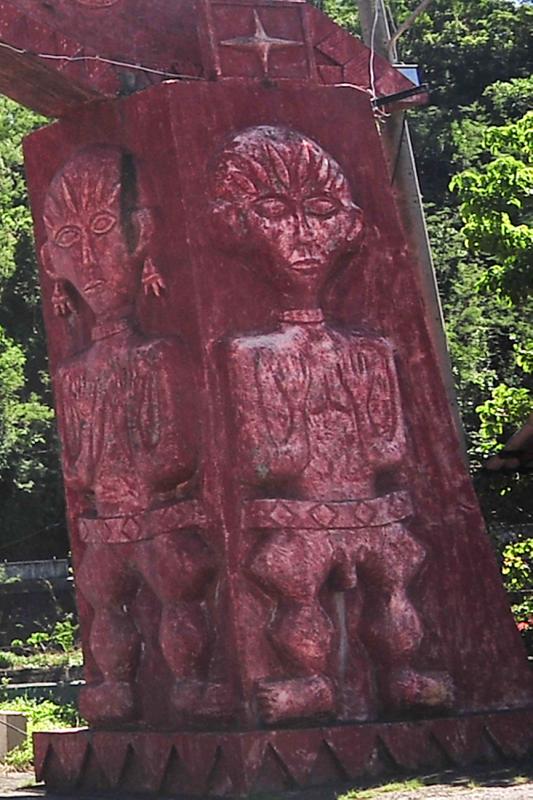
Photo copied by Tsai Tsung-hsien, Taipei Times
“The contractor made the change on his own, saying that the display of genitals was ‘vulgar,’” the Mudan Township Office said, adding that it would hold a town meeting to gather opinions, and would ask the contractor to restore the totems to their original form based on the community’s demands.
Located at the entrance of the road leading to the township’s reservoir, the totems form the sides of an arched entryway and are made with reinforced concrete painted to look like wood.
The entryway was built in 1999, and continues to be one of Hua’s best-known works.
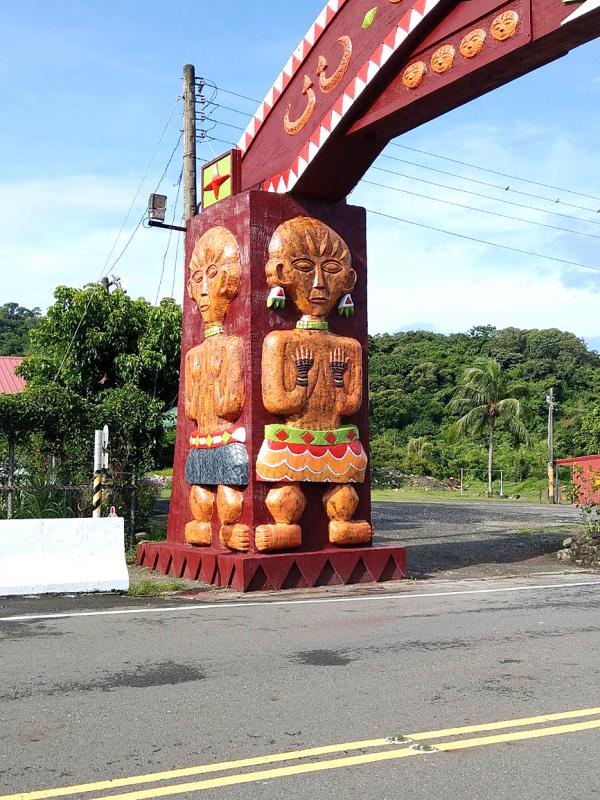
Photo: Tsai Tsung-hien, Taipei Times
The use of bright colors in the restoration, along with the addition of skirts has destroyed the special characteristics of the work, and has removed their cultural connection with Paiwan ancestry, Hua said.
“[The contractor] made these major changes and did not even inform me — the original artist,” he said.
The original entryway had become a landmark for tourists, and also held significance for the Paiwan community, which was relocated for the construction of the reservoir, he said.
The use of the original wood color and the depictions of the Sun God in the archway are signs of respect to Paiwan ancestors, and the archway was built to call on those ancestors to protect the community, he said, adding that it was the equivalent of temples built by Han Taiwanese.
Temples also cannot be modified at will, and changing the archway has caused worry and discontent among the community’s elderly, he said.
The added skirts are also not the type of clothing Paiwan would wear, and adding them to the totem made a mockery of Paiwan culture, he said.
The township office had secured permission from the Pingtung County Government to repaint the entryway in its original color, but the contractor ignored the request and added his own changes, office secretary Tsai Chung-jen (蔡重仁) said.
The office would have the archway restored properly, he said, adding that he apologized to Hua over the mishap.

LOUD AND PROUD Taiwan might have taken a drubbing against Australia and Japan, but you might not know it from the enthusiasm and numbers of the fans Taiwan might not be expected to win the World Baseball Classic (WBC) but their fans are making their presence felt in Tokyo, with tens of thousands decked out in the team’s blue, blowing horns and singing songs. Taiwanese fans have packed out the Tokyo Dome for all three of their games so far and even threatened to drown out home team supporters when their team played Japan on Friday. They blew trumpets, chanted for their favorite players and had their own cheerleading squad who dance on a stage during the game. The team struggled to match that exuberance on the field, with
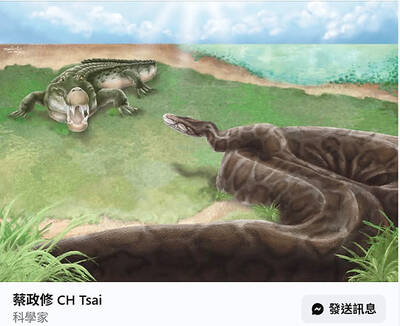
Taiwanese paleontologists have discovered fossil evidence that pythons up to 4m long inhabited Taiwan during the Pleistocene epoch, reporting their findings in the international scientific journal Historical Biology. National Taiwan University (NTU) Institute of Ecology and Evolutionary Biology associate professor Tsai Cheng-hsiu (蔡政修) led the team that discovered the largest snake fossil ever found in Taiwan. The single trunk vertebra was discovered in Tainan at the Chiting Formation, dated to between 400,000 and 800,000 years ago in the Middle Pleistocene, the paper said. The area also produced Taiwan’s first avian fossil, as well as crocodile, mammoth, saber-toothed cat and rhinoceros fossils, it said. Discoveries

Taiwanese paleontologists have discovered fossil evidence that pythons up to 4m long inhabited Taiwan during the Pleistocene epoch, reporting their findings in the international scientific journal Historical Biology. National Taiwan University (NTU) Institute of Ecology and Evolutionary Biology associate professor Tsai Cheng-hsiu (蔡政修) led the team that discovered the largest snake fossil ever found in Taiwan. A single trunk vertebra was discovered in Tainan at the Chiting Formation, dated to between 800,000 to 400,000 years ago in the Middle Pleistocene, the paper said. The area also produced Taiwan’s first avian fossil, as well as crocodile, mammoth, sabre-toothed cat and rhinoceros fossils, it said. Discoveries

Whether Japan would help defend Taiwan in case of a cross-strait conflict would depend on the US and the extent to which Japan would be allowed to act under the US-Japan Security Treaty, former Japanese minister of defense Satoshi Morimoto said. As China has not given up on the idea of invading Taiwan by force, to what extent Japan could support US military action would hinge on Washington’s intention and its negotiation with Tokyo, Morimoto said in an interview with the Liberty Times (sister paper of the Taipei Times) yesterday. There has to be sufficient mutual recognition of how Japan could provide


 RSS
RSS