


Legislator Mark Ho (何志偉) of the Democratic Progressive Party (DPP) yesterday led legislators from across party lines in forming the Taiwan Arts and Culture Promotion Circle in a bid to promote the local arts and culture scene.
The group’s constitution says its purpose is to assist in the development of local arts and culture, while promoting artistic and cultural literacy; increase the importance that officials and members of the public give to art education and improve its quality; and invigorate the nation’s art market, ensuring sustainable development.
Art, in its essence, is an expression of the freedom of speech, Ho said at a founding meeting at the Legislative Yuan in Taipei.
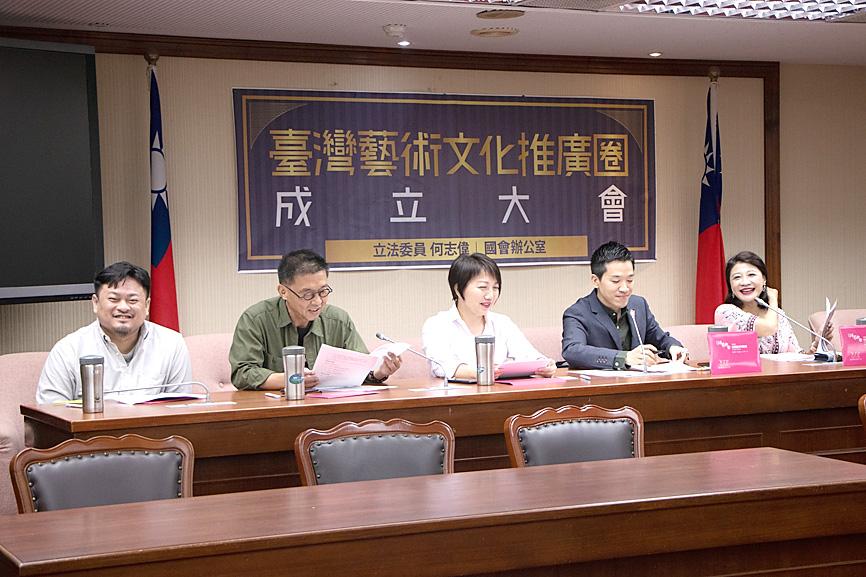
Photo courtesy of Mark Ho’s office
Ho added that he hopes the nation would attract a greater share of the global art auction market.
This year, the Ministry of Culture is expected to push for amendments to the Act on Encouraging and Rewarding Cultural and Art Enterprises (文化藝術獎助條例), which would allow auctioned works of art to be taxed separately, no longer including income from auctioned works as artists’ personal income, he said.
In addition to pushing the passage of the amendments, he urged the ministry to look at examples of online auctions set up by institutions and artists in other nations.
Ho encouraged people to attend the fifth edition of Art Expo Taiwan, to be held at the Taipei World Trade Center from Sept. 10 to Sept. 13.
More than 25 lawmakers joined the circle, including New Power Party Legislator Claire Wang (王婉諭); DPP legislators Yu Tien (余天) and Wu Chi-ming (吳琪銘); and Chinese Nationalist Party (KMT) Legislator Lee Guei-min (李貴敏).
Ho is circle chair, while DPP legislators Fan Yun (范雲), Lin Chu-yin (林楚茵), Hsu Chih-chieh (許智傑) and Hung Sun-han (洪申翰), who also attended the meeting, are vice chairpersons.
Citing her experience as a university professor for more than 10 years, Fan said she believes that the younger generation is more capable in art and culture and in technology than her generation.
Twenty years ago, Taiwan had a booming art auction market, but some “incorrect” policy choices led auction houses to move to Hong Kong and Shanghai, Lin said.
The effects of the COVID-19 pandemic and the national security legislation imposed on Hong Kong are presenting Taiwan with new opportunities, she said.

Considering that most countries issue more than five denominations of banknotes, the central bank has decided to redesign all five denominations, the bank said as it prepares for the first major overhaul of the banknotes in more than 24 years. Central bank Governor Yang Chin-lung (楊金龍) is expected to report to the Legislative Yuan today on the bank’s operations and the redesign’s progress. The bank in a report sent to the legislature ahead of today’s meeting said it had commissioned a survey on the public’s preferences. Survey results showed that NT$100 and NT$1,000 banknotes are the most commonly used, while NT$200 and NT$2,000

The Centers for Disease Control (CDC) yesterday reported the first case of a new COVID-19 subvariant — BA.3.2 — in a 10-year-old Singaporean girl who had a fever upon arrival in Taiwan and tested positive for the disease. The girl left Taiwan on March 20 and the case did not have a direct impact on the local community, it said. The WHO added the BA.3.2 strain to its list of Variants Under Monitoring in December last year, but this was the first imported case of the COVID-19 variant in Taiwan, CDC Deputy Director-General Lin Ming-cheng (林明誠) said. The girl arrived in Taiwan on

South Korea is planning to revise its controversial electronic arrival card, a step Taiwanese officials said prompted them to hold off on planned retaliatory measures, a South Korean media report said yesterday. A Yonhap News Agency report said that the South Korean Ministry of Foreign Affairs is planning to remove the “previous departure place” and “next destination” fields from its e-arrival card system. The plan, reached after interagency consultations, is under review and aims to simplify entry procedures and align the electronic form with the paper version, a South Korean ministry official said. The fields — which appeared only on the electronic form

The Ministry of Foreign Affairs (MOFA) is suspending retaliation measures against South Korea that were set to take effect tomorrow, after Seoul said it is updating its e-arrival system, MOFA said today. The measures were to be a new round of retaliation after Taiwan on March 1 changed South Korea's designation on government-issued alien resident certificates held by South Korean nationals to "South Korea” from the "Republic of Korea," the country’s official name. The move came after months of protests to Seoul over its listing of Taiwan as "China (Taiwan)" in dropdown menus on its new online immigration entry system. MOFA last week


 RSS
RSS