

People should be on the alert for masks on some e-commerce sites that are falsely labeled as being made in Taiwan, a pharmaceutical association in Taipei said on Thursday.
This week, more than 140,000 imported masks with false labels were seized by the Customs Administration, the Taiwan Pharmaceutical Marketing and Management Association said.
People should buy masks from reputable brick-and-mortar stores, where they can verify the product’s origin, association president Kao Meng-hsi (高孟熙) said.
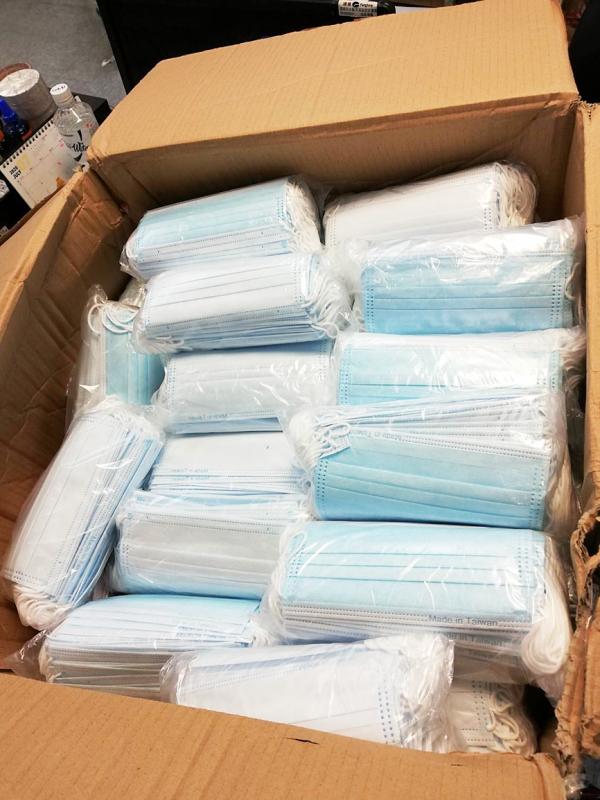
Photo courtesy of Taipei Customs
Masks that are properly packaged are safer than those sold in transparent plastic bags with no label, he added.
Buyers should find the Chinese National Standard (CNS) number on the package, as well as the manufacturer’s name and contact information, pharmacist Shen Tsai-ying (沈采穎) said.
Boxes of masks should be labeled “CNS14774,” indicating that the product has been approved for medical use, Shen said, adding that not all masks are made to that standard, as some are only meant to protect against dust and other types of atmospheric pollution.
The CNS number indicates “compliance of product quality with national standards and the compliance of manufacturers’ quality management systems with the requirements of ISO 9000 series of standards,” the Web site of the Bureau of Standards, Metrology and Inspection says.
The issue of mask quality and origin arose after the Customs Administration seized 7,350 imported masks on Monday and another 132,781 masks the following day — all falsely labeled “Made in Taiwan.”
The masks were shipped via courier from China or Hong Kong and had documents falsely listing Taiwan as the origin, Taipei Customs officers said on Wednesday.
The Customs Administration said that since Aug. 1, it has been checking the postal system and courier services more rigorously for counterfeit masks, as people have been importing cheap masks to resell at a markup.
Government approval is required to import masks for use in medical facilities or resale, the Customs Administration said, adding that masks made in Taiwan are of higher quality than those produced in China.
Furthermore, Taiwan prohibits the importation of foreign-made goods that have been falsely labeled to misrepresent the country of manufacture, either through text or representative markings, the Customs Administration said.
The unlimited sale of surgical masks resumed in Taiwan in June, after months of rationing by the government, which was requisitioning the bulk of the domestic supply for medical use amid the COVID-19 pandemic. Taiwan had since increased production to meet local demand and also to supply overseas markets.
A total of 400 foreign “high- level” professionals have been naturalized as Republic of China (Taiwan) citizens over the past decade as the government has eased nationality rules to attract talent from a wider range of fields, the Ministry of the Interior said yesterday. The 400th high-level professional, who works in the electronics industry, was approved for ROC citizenship on Aug. 26, the MOI said. The MOI quoted the newly naturalized citizen as saying that Taiwan is a leader in fields such as semiconductors, electronics manufacturing, artificial intelligence development and energy technology. He also said
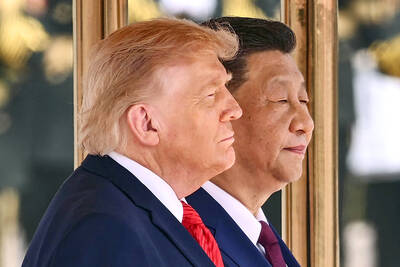
China has warned that it could cancel a planned US-China leaders’ summit if Washington approves new arms sales to Taiwan, a Japanese media outlet quoted sources as saying yesterday. US President Donald Trump, “apparently eager to showcase some diplomatic achievements ahead of November’s midterm congressional elections, places great importance on holding the summit with Chinese President Xi Jinping (習近平),” Japan’s Kyodo News reported. “While preparing for Xi’s upcoming trip, China has restated its position that the Taiwan issue is a ‘red line’ in bilateral relations,” the report said. The report said that when Xi met with Trump in Beijing in May, Xi said
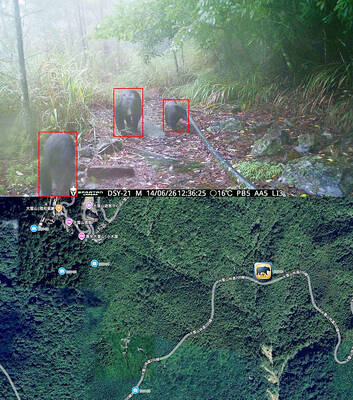
RARE PEEK: The footage released showed one of the bears staying in a cave for as long as 70 days, providing the first record of Formosan black bear’s overwintering The Forestry and Nature Conservation Agency yesterday released tracking records of released Formosan black bears for the first time, showing that they get much closer to human settlements than previously thought. The agency said it had captured two bears, Da Qu-ali (達古阿里) and Aziman (阿里曼), in indigenous villages in Hualien County and began to track them with a camera-mounted satellite collar after releasing them back into the wild. The results confirmed that the bears have moved from deep mountain areas into lowland hills closer to human communities, leading to an increase in human-bear conflicts, it said. The agency has introduced artificial intelligence-assisted early
DIPLOMATIC TOUR: Chinese President Xi Jinping began a series of overseas visits last month to Kyrgyzstan, Egypt and India, aimed at securing leverage, an official said Recent Chinese diplomatic and military moves are aimed at creating pressure ahead of a planned meeting between Chinese President Xi Jinping (習近平) and US President Donald Trump, National Security Council adviser Huang Chung-yen (黃重諺) said. Trump when visiting China in May extended an invitation to Xi to visit Washington on Sept. 24. China is yet to officially announce plans for Xi’s visit to the US. In an interview with the Liberty Times (sister paper of the Taipei Times) on Thursday, Huang said Xi’s overseas visits, China’s “gray zone” activities along the First Island Chain and efforts to expand its trade surplus with the


 RSS
RSS