


The Taiwan Railways Administration (TRA) would propose an amendment to the Railway Act (鐵路法) to allow it to dispose of its own properties nationwide and set the pricing scheme for railway tour packages, TRA Director-General Chang Cheng-yuan (張振源) said yesterday.
“Under the Railway Act and the National Property Act (國有財產法), we have very limited authority to decide what we can do with our own assets and properties. As such, we are seeking to amend the Railway Act to rectify the situation,” Chang said in a speech at a ceremony to honor 68 model workers at the agency.
The proposed amendment would also give the agency the flexibility to set ticket prices for railway tour packages, so that they would not be constrained by caps imposed on fares for regular and express trains, he said.
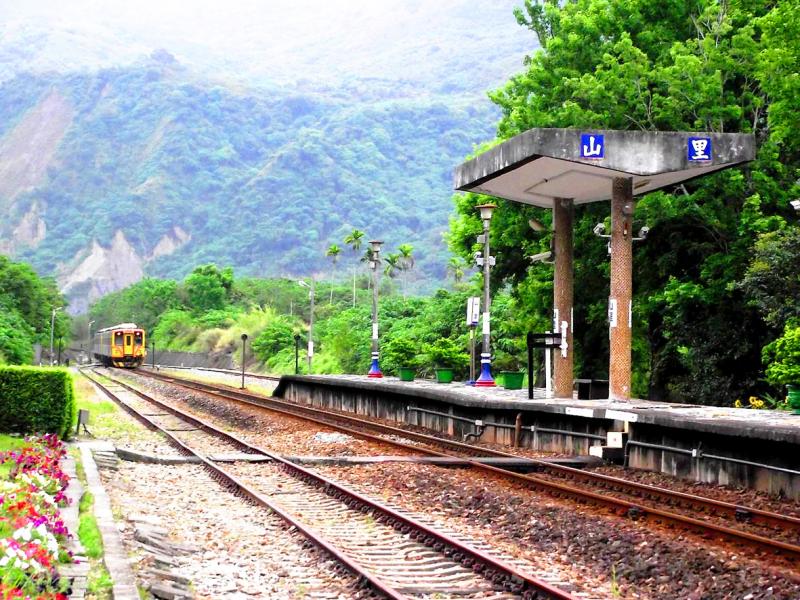
Photo courtesy of Taiwan Railways Administration
Chang, a former deputy minister of transportation and communications who in 2018 was transferred to the railway agency to reform it, also listed six other projects that the agency plans to execute in the coming years.
Under the TRA’s transit-oriented development plan, called the “Pearl Necklace Project” (珍珠串鍊計畫), the TRA would develop its assets within and around more than 200 railway stations across the nation, with the thousands of kilometers of tracks connecting them like a pearl necklace, he said.
“We hope the project would boost the agency’s financial soundness and eventually turn it from a debt-ridden organization into a profitable one,” he said.
If the agency turns profitable, top workers would each receive a pearl necklace as a gift, he added.
The agency’s structure would also be changed so that it can operate as a national corporation, Chang said, adding that it would ask the Executive Yuan to adjust the pay scale for TRA workers.
Following the deadly Puyuma Express derailment in 2018, which killed 18 people and injured 215 people, the agency has been working to reinforce the safety of the railway system and improve facilities for passengers, he said.
The agency would also launch a second wave of an aesthetic makeover of the train services — including railway stations, train cabins, corporate image, and cultural and creative products, he said.
“We are seeking to expand the sales of our mealboxes by including more partners in our franchising plan. We have worked with Taiwan FamilyMart Co to present eight new products featuring pork chop and other key ingredients in the TRA mealboxes. We are scheduled to introduce six new products this month,” he said.
To elevate the quality of railway tours, Chang said the agency would roll out five new tourism train services, including a luxurious sleeping car service.

Considering that most countries issue more than five denominations of banknotes, the central bank has decided to redesign all five denominations, the bank said as it prepares for the first major overhaul of the banknotes in more than 24 years. Central bank Governor Yang Chin-lung (楊金龍) is expected to report to the Legislative Yuan today on the bank’s operations and the redesign’s progress. The bank in a report sent to the legislature ahead of today’s meeting said it had commissioned a survey on the public’s preferences. Survey results showed that NT$100 and NT$1,000 banknotes are the most commonly used, while NT$200 and NT$2,000

The Centers for Disease Control (CDC) yesterday reported the first case of a new COVID-19 subvariant — BA.3.2 — in a 10-year-old Singaporean girl who had a fever upon arrival in Taiwan and tested positive for the disease. The girl left Taiwan on March 20 and the case did not have a direct impact on the local community, it said. The WHO added the BA.3.2 strain to its list of Variants Under Monitoring in December last year, but this was the first imported case of the COVID-19 variant in Taiwan, CDC Deputy Director-General Lin Ming-cheng (林明誠) said. The girl arrived in Taiwan on

ANNUAL EVENT: Two massive Pokemon balloons are to be set up in Daan Park, with an event zone operating from 10am to 6pm This year’s Taipei Floral Picnic is to be held at Daan Park today and tomorrow, featuring an exclusive Pokemon Go event, a themed food market, a coffee rave picnic area and stage performances, the Taipei Department of Information and Tourism said yesterday. Two massive Pokemon balloons are to be set up in the park as attractions, with an exclusive event zone operating from 10am to 6pm, it said. Participants who complete designated tasks on-site would have a chance to receive limited-edition souvenirs, it added. People could also try the newly launched game Pokemon Pokopia in the trial area, the department said. Three PokeStops are

South Korea is planning to revise its controversial electronic arrival card, a step Taiwanese officials said prompted them to hold off on planned retaliatory measures, a South Korean media report said yesterday. A Yonhap News Agency report said that the South Korean Ministry of Foreign Affairs is planning to remove the “previous departure place” and “next destination” fields from its e-arrival card system. The plan, reached after interagency consultations, is under review and aims to simplify entry procedures and align the electronic form with the paper version, a South Korean ministry official said. The fields — which appeared only on the electronic form


 RSS
RSS