


The Central Epidemic Command Center (CECC) yesterday said that there is no need to test all arrivals to the nation for COVID-19, a policy the Executive Yuan supports.
The center reported one new imported case, bringing the nation’s tally of confirmed cases to 477.
The new case is a Taiwanese man in his 60s who on July 25 returned from South Africa, said Centers for Disease Control (CDC) Deputy Director-General Chuang Jen-hsiang (莊人祥), who is also the CECC’s spokesman.
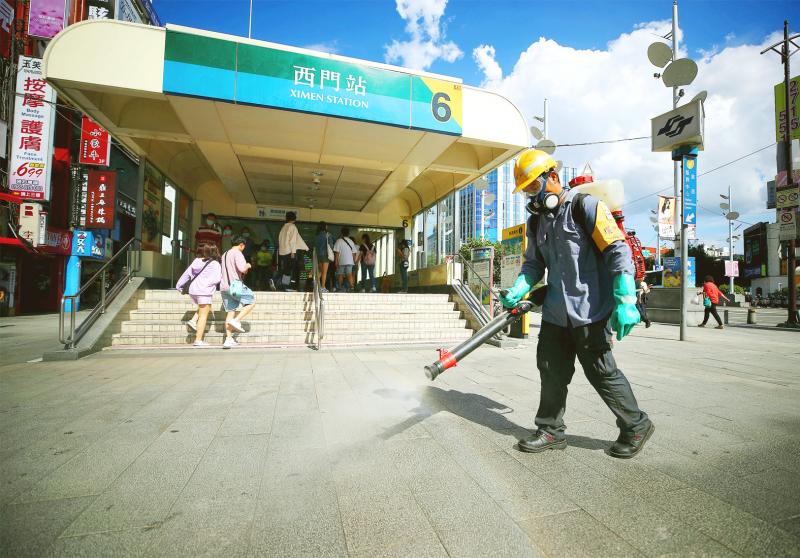
Photo: CNA
The man had returned to Taiwan on the same flight as cases Nos. 460 and 461, reported on July 27, Chuang said.
On July 24, the three had shared a taxi to the airport in South Africa, Chuang added.
Upon their arrival in Taiwan, the man did not show any symptoms and was sent to a disease prevention hotel, Chuang said.
On Monday, the man began experiencing diarrhea, muscle aches and fatigue, after which health authorities arranged for him to be tested, Chuang said.
The man has been hospitalized, and since he went directly to a disease prevention hotel upon his arrival and did not come into contact with friends or relatives, no one is shown as having had contact with him, the center said.
The center has identified 31 people as having had contact with case Nos. 460 and 461, and as of yesterday, two of them had shown suspected symptoms of COVID-19, including case No. 477, who tested positive for the disease, and another who tested negative, the center said.
National Taiwan University Hospital pediatrician Lee Ping-ing (李秉穎), a member of the CECC’s expert advisory panel, said the panel has discussed many of the recommendations it has received, including universal testing of all citizens and testing of all inbound travelers.
However, before implementing any policy, the center must consider its cost effectiveness, Lee said.
For example, lockdowns would be “very effective” in curbing the spread of disease, he said.
While at the start of the pandemic some people had suggested that the nation go into lockdown, he said in retrospect those suggestions were “unnecessary” given the situation in Taiwan.
The center estimates that it would cost NT$4.2 million (US$142,358) per day to test all arrivals, Lee said.
Meanwhile, the Executive Yuan yesterday also said the nation would not be adjusting its COVID-19 prevention strategy.
During a news conference after a Cabinet meeting, Executive Yuan spokesman Ting Yi-ming (丁怡銘) quoted Premier Su Tseng-chang (蘇貞昌) as saying that although some cases have led to recommendations of universal testing of incoming travelers, based on the analysis of CECC experts, communities in Taiwan are relatively safe compared with other nations.
The countries that have adopted COVID-19 screening upon arrival are areas where the situation is relatively severe, Ting said.
In comparison, Taiwan’s strategy — which is to test arrivals with symptoms, while those without symptoms have to undergo a 14-day at-home quarantine — has thus far produced good results, Ting quoted Su as saying.
Additional reporting by CNA

The Centers for Disease Control (CDC) yesterday reported the first case of a new COVID-19 subvariant — BA.3.2 — in a 10-year-old Singaporean girl who had a fever upon arrival in Taiwan and tested positive for the disease. The girl left Taiwan on March 20 and the case did not have a direct impact on the local community, it said. The WHO added the BA.3.2 strain to its list of Variants Under Monitoring in December last year, but this was the first imported case of the COVID-19 variant in Taiwan, CDC Deputy Director-General Lin Ming-cheng (林明誠) said. The girl arrived in Taiwan on

South Korea is planning to revise its controversial electronic arrival card, a step Taiwanese officials said prompted them to hold off on planned retaliatory measures, a South Korean media report said yesterday. A Yonhap News Agency report said that the South Korean Ministry of Foreign Affairs is planning to remove the “previous departure place” and “next destination” fields from its e-arrival card system. The plan, reached after interagency consultations, is under review and aims to simplify entry procedures and align the electronic form with the paper version, a South Korean ministry official said. The fields — which appeared only on the electronic form

A bipartisan group of US senators has introduced a bill to enhance cooperation with Taiwan on drone development and to reduce reliance on supply chains linked to China. The proposed Blue Skies for Taiwan Act of 2026 was introduced by Republican US senators Ted Cruz and John Curtis, and Democratic US senators Jeff Merkley and Andy Kim. The legislation seeks to ease constraints on Taiwan-US cooperation in uncrewed aerial systems (UAS), including dependence on China-sourced components, limited access to capital and regulatory barriers under US export controls, a news release issued by Cruz on Wednesday said. The bill would establish a "Blue UAS

The Ministry of Foreign Affairs (MOFA) is suspending retaliation measures against South Korea that were set to take effect tomorrow, after Seoul said it is updating its e-arrival system, MOFA said today. The measures were to be a new round of retaliation after Taiwan on March 1 changed South Korea's designation on government-issued alien resident certificates held by South Korean nationals to "South Korea” from the "Republic of Korea," the country’s official name. The move came after months of protests to Seoul over its listing of Taiwan as "China (Taiwan)" in dropdown menus on its new online immigration entry system. MOFA last week


 RSS
RSS