


The Ministry of Education (MOE) should investigate politicians whose education credentials have come under scrutiny to uphold the integrity of academia, Changhua County Councilor Huang Sheng-lu (黃盛祿) said on Thursday.
Huang’s comments followed allegations that Kaohsiung mayoral by-election candidate Jane Lee (李眉蓁) of the Chinese Nationalist Party (KMT) had plagiarized 96 percent of her master’s thesis.
Academia and politicians serve each other, as politicians need higher education to win greater support, while universities reap political and economic benefits from having alumni in politics, Huang said.
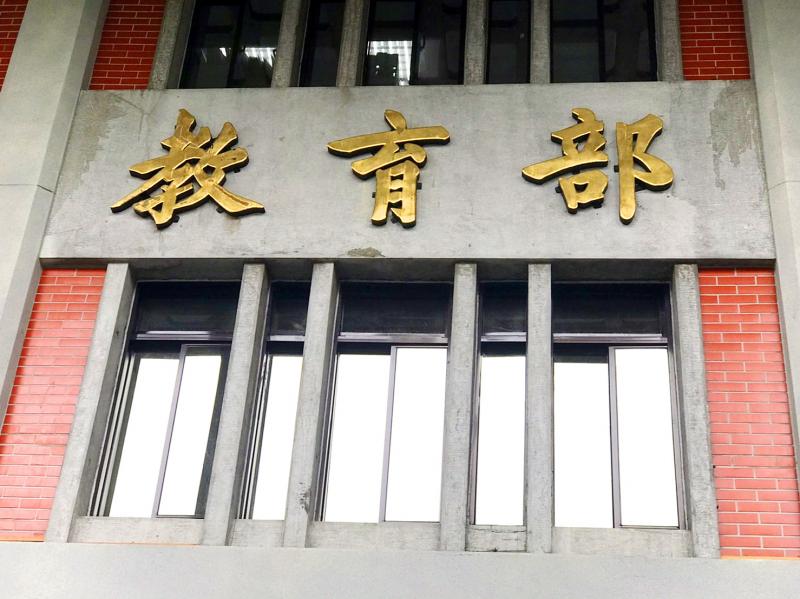
Photo: Rachel Lin, Taipei Times
Huang cited former KMT legislator Yu Yueh-hsia (游月霞) as an example, saying that she only had a vocational high school degree prior to serving as a lawmaker, and after her election, she earned a master’s degree in administrative management from National Changhua Normal University.
Union of Private School Educators president Yu Jung-hui (尤榮輝) said that Taiwan’s higher education system is showing signs of commercialization, especially in master’s degree courses offered to working people.
He said that the intent of the program — allowing people to pursue a degree while working — was good, but such programs run the risk of rubber-stamping academic degrees.
Universities are pandering to part-time students, lowering standards so they can more easily complete studies and obtain degrees, he said.
Working people have less time for studies or to write a thesis in addition to their full-time jobs, leading to the appearance of “essay mills,” where students turn in theses on topics that are incompatible with their subject of study or resorting to outright plagiarism, Yu Jung-hui said.
Schools need students and the students — who are often politicians, government officials and business executives — need the degree to “gold-plate” their credentials, he said.
Professors are prone to employ lax grading standards for these types of students, as politicians could expand their social network or provide economic benefits for their school or department, he said.
Yu Jung-hui said that these programs must institute tougher standards to prevent universities from helping to create fraudulent academic credentials and being seen as degree peddlers.
He added that the public and the ministry should address the deterioration of morals in higher education.
Over the past five years, there have been 17 incidents in which educational degrees have been revoked due to thesis plagiarism, the ministry said.
The university and professors should take responsibility for the issue, the ministry said, adding that how a university prevents incidents would be important when the ministry reviews universities’ applications for new colleges, student recruitment programs or government subsidies.
The ministry said that in the most extreme cases, it could refuse departments that have failed to institute measures to prevent plagiarism from applying for subsidies.
The ministry said that it is considering establishing a digital comparison system that would use the National Central Library’s archived theses database as a source, adding that the system could assist universities in identifying plagiarism.

Yangmingshan National Park authorities yesterday urged visitors to respect public spaces and obey the law after a couple was caught on a camera livestream having sex at the park’s Qingtiangang (擎天崗) earlier in the day. The Shilin Police Precinct in Taipei said it has identified a suspect and his vehicle registration number, and would summon him for questioning. The case would be handled in accordance with public indecency charges, it added. The couple entered the park at about 11pm on Thursday and began fooling around by 1am yesterday, the police said, adding that the two were unaware of the park’s all-day live

Fast food chain McDonald's is to raise prices by up to NT$5 on some products at its restaurants across Taiwan, starting on Wednesday next week, the company announced today. The prices of all extra value meals and sharing boxes are to increase by NT$5, while breakfast combos and creamy corn soup would go up by NT$3, the company said in a statement. The price of the main items of those meals, if ordered individually, would remain the same. Meanwhile, the price of a medium-sized lemon iced tea and hot cappuccino would rise by NT$3, extra dipping sauces for chicken nuggets would go up

Yangmingshan National Park’s Qingtiangang (擎天崗) nature area has gone viral after a park livestream camera observed a couple in the throes of intimate congress, which was broadcast live on YouTube, drawing large late-night crowds and sparking a backlash over noise, bright lights and disruption to wildlife habitat. The area’s livestream footage appeared to show a couple engaging in sexual activity on a picnic table in the park on Friday last week, with the uncensored footage streamed publicly online. The footage quickly spread across social media, prompting a tide of visitors to travel to the site to “check in” and recreate the

Minister of Digital Affairs Lin Yi-ching (林宜敬) yesterday cited regulatory issues and national security concerns as an expert said that Taiwan is among the few Asian regions without Starlink. Lin made the remarks on Facebook after funP Innovation Group chief executive officer Nathan Chiu (邱繼弘) on Friday said Taiwan and four other countries in Asia — China, North Korea, Afghanistan and Syria — have no access to Starlink. Starlink has become available in 166 countries worldwide, including Ukraine, Malaysia, the Philippines and Vietnam, in the six years since it became commercial, he said. While China and North Korea block Starlink, Syria is not


 RSS
RSS