


A body found yesterday in the Keelung River (基隆河) in Nangang District (南港) has been identified as that of a Taipei City Government employee under investigation for alleged corruption, and the city said it would help the family with funeral arrangements.
Taipei police and sanitary workers had received reports of a body in the river and the corpse was retrieved from under the Nanhu Bridge (南湖大橋).
Police identified the body as that of Tseng Hua-chung (曾華崇), a case officer in the Department of Urban Development’s Construction Management Office, through papers found in his clothing.
An autopsy would be conducted to determine the cause of death, they said.
Tseng and a colleague, Chou Tsung-chi (周宗錡), were placed under investigation for allegedly taking bribes of more than NT$90,000 in exchange for safety inspection approvals on elevators and lifts in the New CB Party KTV and a hypermart.
They were among 15 people listed as suspects in the probe.
Tseng and Chou are alleged to have received at least NT$54,000 per month from the companies in question.
After being questioned by prosecutors on Thursday last week, Tseng was released on NT$600,000 bail, and Chou was freed on NT$100,000 bail.
“Tseng was under much stress after he came under investigation and the news was reported by the media... The Taipei City Government express our regret and sorrow over his death and will help the family make arrangements,” Taipei City deputy spokeswoman Huang Ching-ying (黃瀞瑩) told reporters.
Family members said Tseng went to work on Wednesday, but they contacted police when he did not return home that night.
They said his death had come as a huge shock, as he was reportedly planning to see a lawyer on Wednesday to help him contest the bribery allegations.

LOUD AND PROUD Taiwan might have taken a drubbing against Australia and Japan, but you might not know it from the enthusiasm and numbers of the fans Taiwan might not be expected to win the World Baseball Classic (WBC) but their fans are making their presence felt in Tokyo, with tens of thousands decked out in the team’s blue, blowing horns and singing songs. Taiwanese fans have packed out the Tokyo Dome for all three of their games so far and even threatened to drown out home team supporters when their team played Japan on Friday. They blew trumpets, chanted for their favorite players and had their own cheerleading squad who dance on a stage during the game. The team struggled to match that exuberance on the field, with
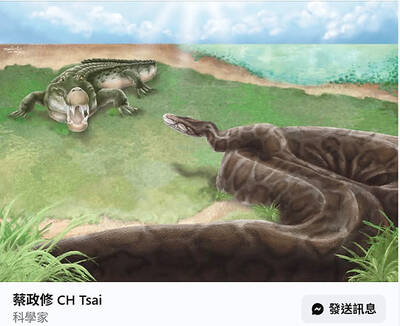
Taiwanese paleontologists have discovered fossil evidence that pythons up to 4m long inhabited Taiwan during the Pleistocene epoch, reporting their findings in the international scientific journal Historical Biology. National Taiwan University (NTU) Institute of Ecology and Evolutionary Biology associate professor Tsai Cheng-hsiu (蔡政修) led the team that discovered the largest snake fossil ever found in Taiwan. The single trunk vertebra was discovered in Tainan at the Chiting Formation, dated to between 400,000 and 800,000 years ago in the Middle Pleistocene, the paper said. The area also produced Taiwan’s first avian fossil, as well as crocodile, mammoth, saber-toothed cat and rhinoceros fossils, it said. Discoveries

Taiwanese paleontologists have discovered fossil evidence that pythons up to 4m long inhabited Taiwan during the Pleistocene epoch, reporting their findings in the international scientific journal Historical Biology. National Taiwan University (NTU) Institute of Ecology and Evolutionary Biology associate professor Tsai Cheng-hsiu (蔡政修) led the team that discovered the largest snake fossil ever found in Taiwan. A single trunk vertebra was discovered in Tainan at the Chiting Formation, dated to between 800,000 to 400,000 years ago in the Middle Pleistocene, the paper said. The area also produced Taiwan’s first avian fossil, as well as crocodile, mammoth, sabre-toothed cat and rhinoceros fossils, it said. Discoveries
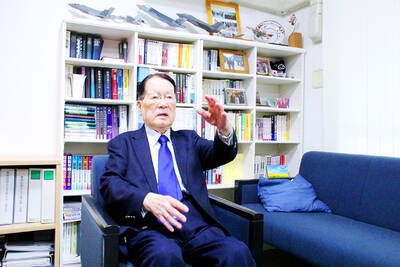
Whether Japan would help defend Taiwan in case of a cross-strait conflict would depend on the US and the extent to which Japan would be allowed to act under the US-Japan Security Treaty, former Japanese minister of defense Satoshi Morimoto said. As China has not given up on the idea of invading Taiwan by force, to what extent Japan could support US military action would hinge on Washington’s intention and its negotiation with Tokyo, Morimoto said in an interview with the Liberty Times (sister paper of the Taipei Times) yesterday. There has to be sufficient mutual recognition of how Japan could provide


 RSS
RSS