


The High Court yesterday rejected a request for a retrial of the case of air force staff sergeant Tsai Hsueh-liang (蔡學良), who died in 2008 of a gunshot wound to the head, with his family and supporters disputing military authorities’ initial claim that it was a suicide.
Tsai’s mother, Yu Jui-min (尤瑞敏), and advocates of judicial reform staged a protest outside the High Court in Taipei, decrying the court’s decision to overlook new evidence.
Yu has for the past 12 years fought to clear her son’s name and find out the truth behind his death. Tsai died during target practice on a shooting range on May 9, 2008.
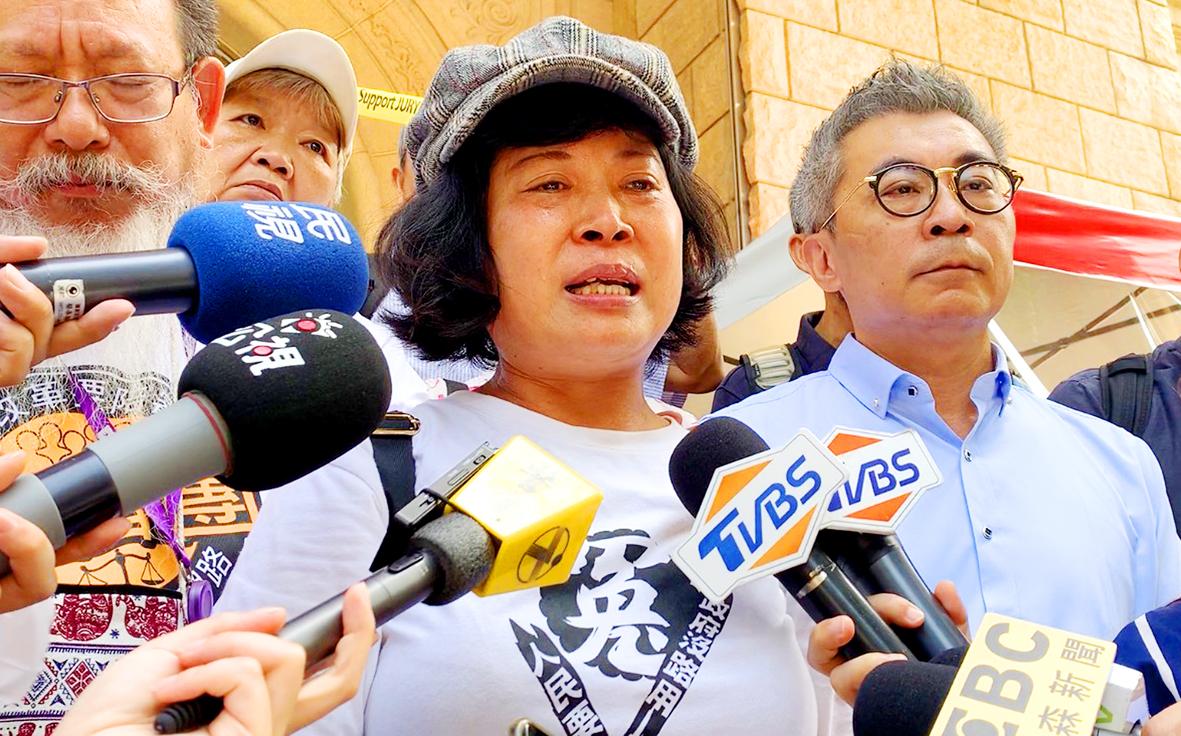
Photo: CNA
Yu and her lawyer on March 9 presented new evidence — a re-examination of the autopsy reports and ballistic tests by weapons experts and forensic doctors at National Taiwan University College of Medicine — and filed for a retrial with the High Court’s civil division.
The court rejected the request, saying the 30-day period for presenting new evidence to seek a retrial, as stated in the Code of Civil Procedures (民事訴訟法), had been exceeded.
Presiding Judge Chen Jung-cheng (陳容正) said that Tsai’s family had received the new test results on Jan. 16, but did not file a lawsuit until March 9.
Chen said that the judicial panel sympathizes with Tsai’s mother and her long struggle to appeal the case.
“The judicial panel understands and feels her pain and suffering over the death of her son... However, the request for a retrial does not conform with legal procedures, and has therefore been turned down,” Chen said.
Yu and her lawyer, Wu Yung-mao (吳永茂), disputed the High Court’s explanation, saying they had received the new autopsy and ballistic test results on Feb. 10 and filed for a retrial on March 9.
Several judicial reform advocates decried what they said was the callous and condescending tone adopted by Chen when announcing the decision on behalf of the judicial panel.
Breaking down in tears, Yu said that Chen could never imagine the pain and suffering she has experienced.
“This decision is very unfair and unreasonable. We cannot accept it,” she said.
“These past 12 years, we had to take on the painstaking task of finding the truth, of looking for new evidence. Why was it left to the victim’s family, and why do ordinary people have no right to request a judicial investigation?” Yu asked.
Former judge and prosecutor Chang Ching (張靜), an adviser to the Judicial Reform Foundation, decried the court’s decision.
“We had already asked for ballistic tests when the case first went to trial, but no judicial authorities, including the courts and prosecutors, would agree to conduct the ballistic tests we asked for,” Chang said.
Saying she was certain her son would not commit suicide, Yu sued the air force, seeking NT$6 million (US$202,662) in compensation, but lost in a ruling by a lower court, which concurred with the military that Tsai had committed suicide using his own provisioned T65 rifle.
In 2015, after reviewing the autopsy and weapons reports, the High Court concluded that Tsai was killed at close range by a handgun and ruled that it was death by accident.
It ordered the air force to pay NT$1.48 million in compensation to Yu.
However, Yu believes that her son was bullied by his colleagues, and that one of them shot him during the target practice.
Tsai at the time was serving at the 954th Brigade under the Air Defense Artillery Command near the air force base in Hualien County.

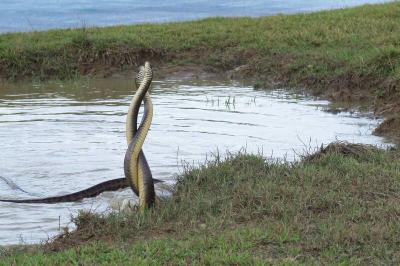
Kenting National Park service technician Yang Jien-fon (楊政峰) won a silver award in World Grand Prix Photography Awards Spring Season for his photograph of two male rat snakes intertwined in combat. Yang’s colleagues at Kenting National Park said he is a master of nature photography who has been held back by his job in civil service. The awards accept entries in all four seasons across six categories: architectural and urban photography, black-and-white and fine art photography, commercial and fashion photography, documentary and people photography, nature and experimental photography, and mobile photography. Awards are ranked according to scores and divided into platinum, gold and
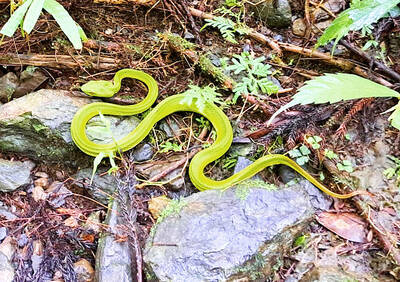
More than half of the bamboo vipers captured in Tainan in the past few years were found in the city’s Sinhua District (新化), while other districts had smaller catches or none at all. Every year, Tainan captures about 6,000 snakes which have made their way into people’s homes. Of the six major venomous snakes in Taiwan, the cobra, the many-banded krait, the brown-spotted pit viper and the bamboo viper are the most frequently captured. The high concentration of bamboo vipers captured in Sinhua District is puzzling. Tainan Agriculture Bureau Forestry and Nature Conservation Division head Chu Chien-ming (朱健明) earlier this week said that the
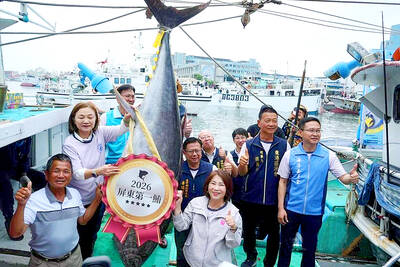
The first bluefin tuna of the season, brought to shore in Pingtung County and weighing 190kg, was yesterday auctioned for NT$10,600 (US$333.5) per kilogram, setting a record high for the local market. The auction was held at the fish market in Donggang Fishing Harbor, where the Siaoliouciou Island-registered fishing vessel Fu Yu Ching No. 2 delivered the “Pingtung First Tuna” it had caught for bidding. Bidding was intense, and the tuna was ultimately jointly purchased by a local restaurant and a local company for NT$10,600 per kilogram — NT$300 ,more than last year — for a total of NT$2.014 million. The 67-year-old skipper
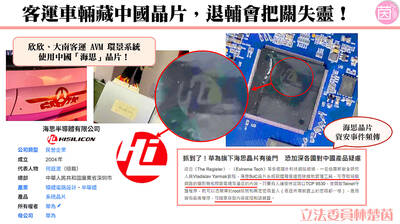
BREACH OF CONTRACT: The bus operators would seek compensation and have demanded that the manufacturer replace the chips with ones that meet regulations Two bus operators found to be using buses with China-made chips are to demand that the original manufacturers replace the systems and provide compensation for breach of contract, the Veterans Affairs Council said yesterday. Democratic Progressive Party Legislator Michelle Lin (林楚茵) yesterday said that Da Nan Bus Co and Shin-Shin Bus Co Ltd have fielded a total of 82 buses that are using Chinese chips. The bus models were made by Tron-E, while the systems provider was CYE Electronics, Lin said. Lin alleged that the buses were using chips manufactured by Huawei subsidiary HiSilicon Co, which presents a national security risk if the


 RSS
RSS