


All legislative caucuses have said that they are open to discussing naming issues concerning the national carrier China Airlines (CAL) and the nation’s passport cover at cross-caucus negotiations today to set the agenda for the next provisional legislative session.
The Democratic Progressive Party (DPP) caucus had asked for an extraordinary legislative session be held from today to July 22 to deliberate on the China Airlines and passport cover name-change drafts; the nominees for the National Communications Commission, the Control Yuan and Examination Yuan; drafts of an “irrigation and water conservancy associations act” and “act of citizen participation in criminal trial procedures”; and the budget for the second phase of the Forward-looking Infrastructure Development Program.
The DPP’s draft proposal regarding China Airlines says that the Ministry of Transportation and Communications must prioritize Taiwan’s national interests by enhancing the airline’s Taiwanese identity so that it is recognized globally, and that it must invite government agencies to decide on new Chinese and English names.
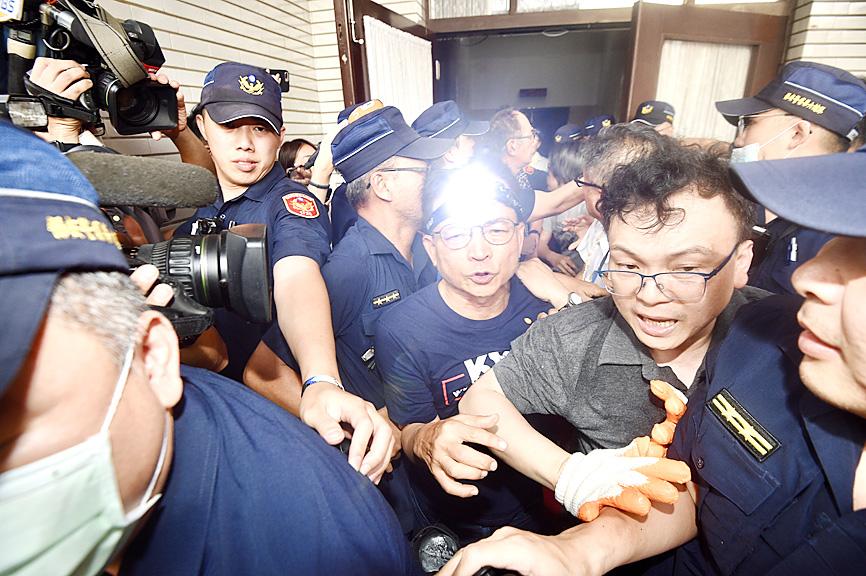
Photo: Peter Lo, Taipei Times
Taiwan Statebuilding Party (TSP) Legislator Chen Po-wei (陳柏惟), and DPP legislators Wang Ting-yu (王定宇), Lin Chun-hsien (林俊憲) and Lin I-chin (林宜瑾) said that the passport cover needs to be changed, as it is often confused with China’s passport.
Their proposal says that the government should immediately issue new passports, with the cover and personal information page simply reading “Taiwan” in English and Chinese.
Taiwanese nationals could choose between the new and old versions, the proposal says.
“When our citizens travel abroad ... they are often confused with people from China and are treated badly, because our passport has ‘Republic of China’ on the cover,” it says.
The use of “Taiwan” would uphold the personal dignity of Taiwanese and ensure that they can travel safely, the proposal says.
Chinese Nationalist Party (KMT) caucus whip Lin Wei-chou (林為洲) said that the law does not need to be amended for the name changes to be made, as government ministries could deal with them, so it is unnecessary for the DPP to introduce its proposals to the legislature.
However, the KMT caucus has a open mind and is willing to discuss the issues, Lin added.
Taiwan People’s Party caucus whip Lai Hsiang-ling (賴香伶) said that her caucus supports changing China Airlines’ name, but would require negotiations between all parties on how to go about it and what new name to use.
New Power Party (NPP) caucus whip Chiu Hsien-chih (邱顯智) said his caucus’ position is clear: Short, medium and long-term plans are needed to strengthen Taiwan’s identity.
He said he hoped that the issues could be discussed during the provisional session and concrete progress could be made, as he does not want to see the legislature still discussing them in 10 years’ time.
The NPP’s proposal says that China Airlines’ name must be changed, as it has always been confused with China’s national carrier, and it would be in the best interest of all of Taiwan’s 23 million citizens.
Meanwhile, more than 20 KMT lawmakers late yesterday afternoon broke unannounced through the main door of the legislative chamber and took over the podium.
They were demanding that President Tsai Ing-wen (蔡英文) withdraw her nomination of former Presidential Office secretary-general Chen Chu (陳菊) as Control Yuan president.
Outside the Legislative Yuan, a crowd of KMT supporters also gathered to lend their support.
Legislative Speaker You Si-kun called for calm and rational discussion, while Legislative Yuan Secretary-General Lin Chih-chia (林志嘉) said that law enforcement officers would not be called to remove the lawmakers, who still occupied the chamber as of press time last night.
Additional reporting by Hsieh Chun-lin and Lin Liang-sheng
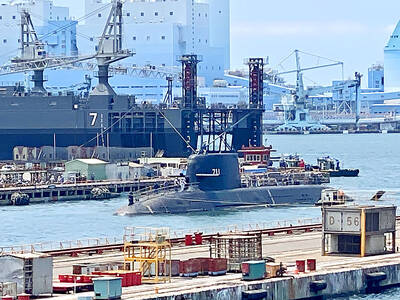
AGING: While Japan has 22 submarines, Taiwan only operates four, two of which were commissioned by the US in 1945 and 1946, and transferred to Taiwan in 1973 Taiwan would need at least 12 submarines to reach modern fleet capabilities, CSBC Corp, Taiwan chairman Chen Cheng-hung (陳政宏) said in an interview broadcast on Friday, citing a US assessment. CSBC is testing the nation’s first indigenous defense submarine, the Hai Kun (海鯤, Narwhal), which is scheduled to be delivered to the navy next month or in July. The Hai Kun has completed torpedo-firing tests and is scheduled to undergo overnight sea trials, Chen said on an SET TV military affairs program. Taiwan would require at least 12 submarines to establish a modern submarine force after assessing the nation’s operational environment and defense
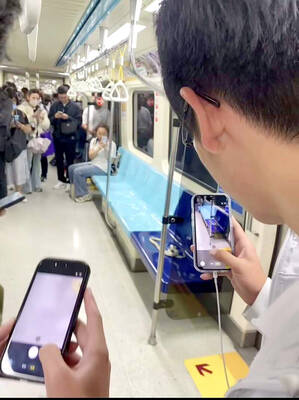
A white king snake that frightened passengers and caused a stir on a Taipei MRT train on Friday evening has been claimed by its owner, who would be fined, Taipei Rapid Transit Corp (TRTC) said yesterday. A person on Threads posted that he thought he was lucky to find an empty row of seats on Friday after boarding a train on the Bannan (Blue) Line, only to spot a white snake with black stripes after sitting down. Startled, he jumped up, he wrote, describing the encounter as “terrifying.” “Taipei’s rat control plan: Release snakes on the metro,” one person wrote in reply, referring
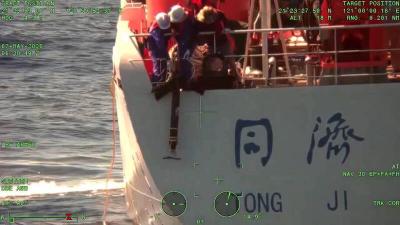
The coast guard today said that it had disrupted "illegal" operations by a Chinese research ship in waters close to the nation and driven it away, part of what Taipei sees a provocative pattern of China's stepped up maritime activities. The coast guard said that it on Thursday last week detected the Chinese ship Tongji (同濟號), which was commissioned only last year, 29 nautical miles (54km) southeast of the southern tip of Taiwan, although just outside restricted waters. The ship was observed lowering ropes into the water, suspected to be the deployment of scientific instruments for "illegal" survey operations, and the coast
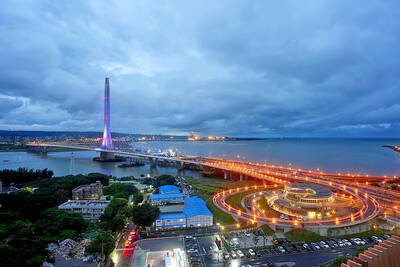
An inauguration ceremony was held yesterday for the Danjiang Bridge, the world’s longest single-mast asymmetric cable-stayed bridge, ahead of its official opening to traffic on Tuesday, marking a major milestone after nearly three decades of planning and construction. At the ceremony in New Taipei City attended by President William Lai (賴清德), Premier Cho Jung-tai (卓榮泰), Minister of Transportation and Communications Chen Shih-kai (陳世凱) and New Taipei City Mayor Hou Yu-ih (侯友宜), the bridge was hailed as both an engineering landmark and a long-awaited regional transport link connecting Tamsui (淡水) and Bali (八里)


 RSS
RSS