


While stereotypically considered a household pest that simply will not die, Hung Ting-yang’s (洪鼎揚) experience with Archimandrita tesselata, commonly called the peppered roach, might change a person’s mind.
The peppered roach originates in South America, is omnivorous and, as it is capable of growing to 7cm to 9cm long, is a giant compared with other roaches, which have an average length of about 4cm.
The peppered roach goes through six separate chrysalis stages and takes nine months to reach full maturity. Mature roaches have wings, but cannot fly and can only glide. They have an average lifespan of three years.
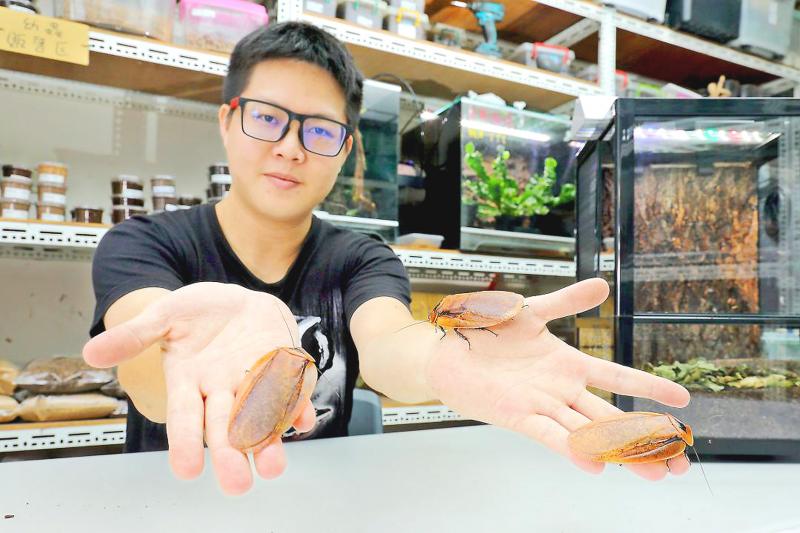
Photo: Lee Hui-chou, Taipei Times
As his parents were against letting him keep dogs or cats as a child, Hung said that he raised insects and has been infatuated with them ever since.
He was introduced to peppered roaches when he was visiting an exhibition overseas, Hung said.
“My first thought when seeing the roach was: ‘Cool!’” Hung said.
Hung said that he started looking up information about the roaches after returning to Taiwan, and after discovering that there were others in Taiwan who kept them as pets, he decided he would join them.
“Raising the peppered roach’s larvae is more like raising stag beetles. You observe their every little movement, arrange better environments for them and enjoy watching them become a chrysalis,” Hung said.
It is important to raise the roaches in a perpendicular case, or simulate an environment with trees, as gravity’s pull on the cocoon is an imperative step in the roach’s survival, he said.
The golden-flecked membranous wings of the peppered roach are beautiful when viewed under the light, Hung said.
He stressed that the owner must constantly monitor the humidity and temperature of their habitat, as Taiwan is hotter than their original habitat.
“I keep the air conditioner on all day,” Hung said, adding that the roaches find it difficult to escape, as they are unable to walk on smooth surfaces.
He said he is not concerned about the roaches breeding if they escape, as they have many natural enemies.
“I hope that more people will come to appreciate their beauty,” he added.
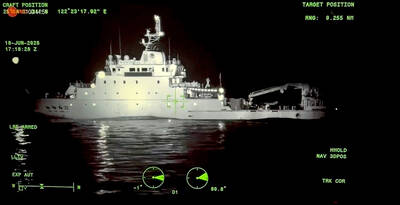
EXCUSES: Beijing is using government and research vessels as a pretext to harass the nation and enter its EEZ, and engage in ‘hegemonic expansion,’ the coast guard said The Coast Guard Administration yesterday said it drove away Chinese oceanographic research vessel Xiang Yang Hong 22 (向陽紅33) from restricted waters after warning it that it was in Taiwan’s exclusive economic zone (EEZ). The Chinese vessel entered restricted waters off the coast of Yilan County’s Suao (蘇澳) at 11:35pm on Thursday, the coast guard said, adding that it dispatched the Lanyu patrol vessel and the boat PP-10077 to shadow the Chinese ship and issue radio warnings ordering it to leave. China has no sovereignty over waters off Taiwan’s east coast, Lanyu’s crew told Xiang Yang Hong 22 over the radio, and demanded

BAIT AND SWITCH: Allowing KMT-run counties to sell to China while the threat of abrupt cancelations hangs overhead is another form of coercion, officials said Beijing is using agricultural purchase offers announced during the Straits Forum to deepen Taiwan’s dependence on the Chinese market, a Taiwanese official said yesterday as they criticized the Taitung County commissioner’s participation in the initiative. During the Straits Forum held in Xiamen on Saturday, Chinese officials announced a sales and purchase agreement for agricultural products from some counties led by the Chinese Nationalist Party (KMT). Taitung County Commissioner Yao Ching-ling (饒慶鈴), who was barred from attending the event in person by the Mainland Affairs Council, participated via video. Under the agreement, China would purchase atemoyas, pomeloes, tea and grouper harvested in Taitung,

SHIFTING FIRE: While the tempo of purely military exercises around Taiwan has gone down somewhat, Beijing is working to isolate Lai diplomatically from support abroad Chinese President Xi Jinping (習近平) is shifting tactics in his campaign to pressure Taiwan, ramping up diplomatic isolation of the nation while dialing down provocative displays of military aggression. Taiwan recorded a daily average of five Chinese military aircraft crossing the Taiwan Strait’s buffer line with China through May this year — half the number logged in the same period last year. In March, Beijing did not send a single fighter jet near Taiwan for seven days, the longest absence on record outside of typhoon season. In comparison, China sent 153 planes near Taiwan during one day at its peak in

Four Taiwanese universities have been ranked among the world's top 200 institutions in the Quacquarelli Symonds (QS) World University Rankings for next year, the highest Taiwan has ever placed in the category, with National Taiwan University (NTU) achieving its best performance at 54th globally and 17th in Asia. The four Taiwanese institutions in the global top 200 are NTU (54th), National Tsing Hua University (142nd), National Yang Ming Chiao Tung University (177th) and National Cheng Kung University (191st), the rankings showed. All four universities achieved their highest-ever global rankings this year, QS data showed. National Cheng Kung University entered the top 200 for


 RSS
RSS