


The Central Epidemic Command Center (CECC) yesterday announced one new imported case of COVID-19, a Taiwanese businessman in his 60s who was on the same flight as a couple returning from Bangladesh who tested positive on Monday.
Case No. 446 arrived in Taiwan on Saturday last week on a transfer flight from Malaysia, the center told a news conference.
He was on the same transfer flight with case Nos. 444 and 445, a 50-something Bangladeshi man and his 40-something Taiwanese wife, who had both been treated for COVID-19 while in Bangladesh, the center said.
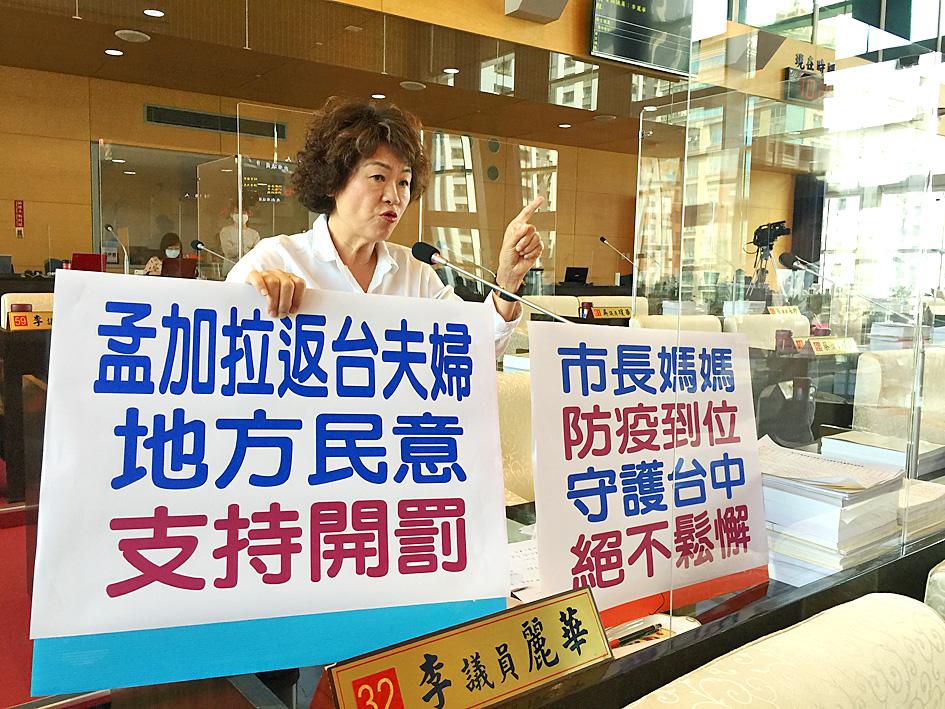
Photo: Su Meng-chuan, Taipei Times
The man was seated one row in front of the couple, it said.
He was asymptomatic upon entry, but health officials ran tests on the 11 Taiwanese businesspeople who took the same flight, given the high infection risks in Bangladesh, Centers for Disease Control (CDC) Deputy Director-General Chuang Jen-hsiang (莊人祥) said, adding that he was the only one who tested positive for the virus.
Case No. 446 is being isolated at a hospital, Chuang said, adding that the possibility he had contracted the virus in Bangladesh was high.
As of yesterday, the nation had 446 confirmed cases with seven fatalities, among which 355 were imported, 55 were local infections and 36 constitute an infection cluster from the navy’s Panshih (磐石) ship, the center’s data showed.
A total of 434 have been released from quarantine after treatment, and there have been no new domestic cases for 67 consecutive days, the data showed.
In related news, the Taichung Health Bureau yesterday said it would fine the Taiwanese woman who returned with her husband from Bangladesh after finding out that she had lied by telling disease prevention officials that they had worn masks and protective gowns on the flight from Malaysia to Taiwan.
The Taichung City Government was mulling a fine of between NT$60,000 and NT$300,000 for the couple, but after discussing it with the central government, fined the woman NT$150,000 to deter similar behavior.
The man had been working in Bangladesh since January and the woman since March before returning to Taiwan, the center said.
The man on May 23 developed a fever, coughing, a sore throat, muscle pain and an abnormal sense of smell, while the woman developed a fever two days later, Chuang said.
They were diagnosed with COVID-19 and hospitalized in Bangladesh on May 25 and May 28 respectively, he said.
The man’s symptoms had alleviated by May 26 and he tested negative twice for the novel coronavirus on May 28 and June 2, he added.
The woman tested negative only once, on June 2, but the hospital said it had too many patients and allowed her to leave, Chuang said.
They were discharged from the hospital on June 2 and remained at home in Bangladesh until Friday, when they left for Taiwan, he said.
The couple claimed to have worn masks and protective gowns during the flight, but an investigation indicated otherwise, increasing infection risks for other passengers and crew on board, as well as sparking alarm among people in Taichung, from where the woman hails, Chinese Nationalist Party (KMT) Taichung City Councilor Lee li-hua (李麗華) said, adding that she had received numerous complaints from residents.
Taichung Mayor Lu Shiow-yen (盧秀燕) urged residents not to panic, as the couple has not visited the city since returning to Taiwan.
The couple have been transferred to a hospital in northern Taiwan following the diagnosis, and would not leave until they have fully recovered.
Although the law does not require the couple to wear protective gowns on the flight back, they have an obligation to fully disclose their condition with disease prevention officials, Lu said.
While it is not yet certain if the Taiwanese businessman was infected by the couple, passengers on the same flight could have maintained proper social distancing if the couple had told the truth, the bureau said.
Additional reporting by Lee I-chia
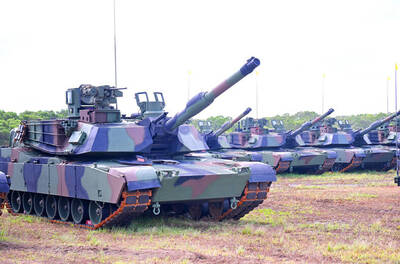
The manufacture of the remaining 28 M1A2T Abrams tanks Taiwan purchased from the US has recently been completed, and they are expected to be delivered within the next one to two months, a source said yesterday. The Ministry of National Defense is arranging cargo ships to transport the tanks to Taiwan as soon as possible, said the source, who is familiar with the matter. The estimated arrival time ranges from late this month to early next month, the source said. The 28 Abrams tanks make up the third and final batch of a total of 108 tanks, valued at about NT$40.5 billion

Two Taiwanese prosecutors were questioned by Chinese security personnel at their hotel during a trip to China’s Henan Province this month, the Mainland Affairs Council (MAC) said yesterday. The officers had personal information on the prosecutors, including “when they were assigned to their posts, their work locations and job titles,” MAC Deputy Minister and spokesman Liang Wen-chieh (梁文傑) said. On top of asking about their agencies and positions, the officers also questioned the prosecutors about the Cross-Strait Joint Crime-Fighting and Judicial Mutual Assistance Agreement, a pact that serves as the framework for Taiwan-China cooperation on combating crime and providing judicial assistance, Liang
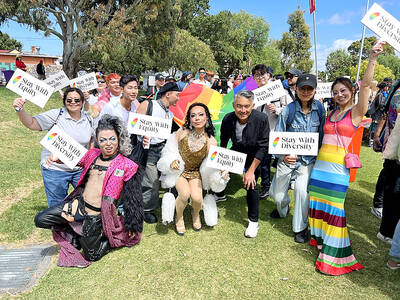
A group from the Taiwanese Designers in Australia association yesterday represented Taiwan at the Midsumma Pride March in Melbourne. The march, held in the St. Kilda suburb, is the city’s largest LGBTQIA+ parade and the flagship event of the annual Midsumma Festival. It attracted more than 45,000 spectators who supported the 400 groups and 10,000 marchers that participated this year, the association said. Taiwanese Designers said they organized a team to march for Taiwan this year, joining politicians, government agencies, professionals and community organizations in showing support for LGBTQIA+ people and diverse communities. As the first country in Asia to legalize same-sex
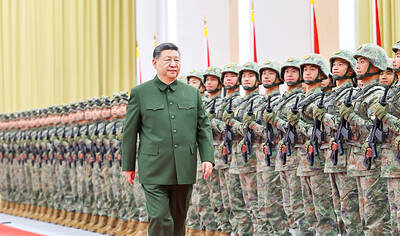
MOTIVES QUESTIONED The PLA considers Xi’s policies toward Taiwan to be driven by personal considerations rather than military assessment, the Epoch Times reports Chinese President Xi Jinping’s (習近平) latest purge of the Chinese People’s Liberation Army (PLA) leadership might have been prompted by the military’s opposition to plans of invading Taiwan, the Epoch Times said. The Chinese military opposes waging war against Taiwan by a large consensus, putting it at odds with Xi’s vision, the Falun Gong-affiliated daily said in a report on Thursday, citing anonymous sources with insight into the PLA’s inner workings. The opposition is not the opinion of a few generals, but a widely shared view among the PLA cadre, the Epoch Times cited them as saying. “Chinese forces know full well that


 RSS
RSS