


The National Taiwan University (NTU) Student Association yesterday accused the university of carrying out a smear campaign against its proposal to establish a transitional justice committee, after a university official said that the proposal would involve demolishing some landmark sites on campus.
NTU Alumni Center chief executive Liu Ning (劉寧) in a Line chat group consisting of NTU alumnus claimed that the proposed committee would demolish the Fu Bell and Fu Garden, two landmarks commemorating late NTU president Fu Si-nian (傅斯年), NTU Student Association president Tu Chun-ching (涂峻清) told a news conference in front of the Fu Bell.
Liu also created slogans such as “save the bell and our collective memories” in an attempt to urge alumnus to sign a petition against the proposal ahead of a school affairs meeting today, at which student representatives would officially table the proposal, Tu said.
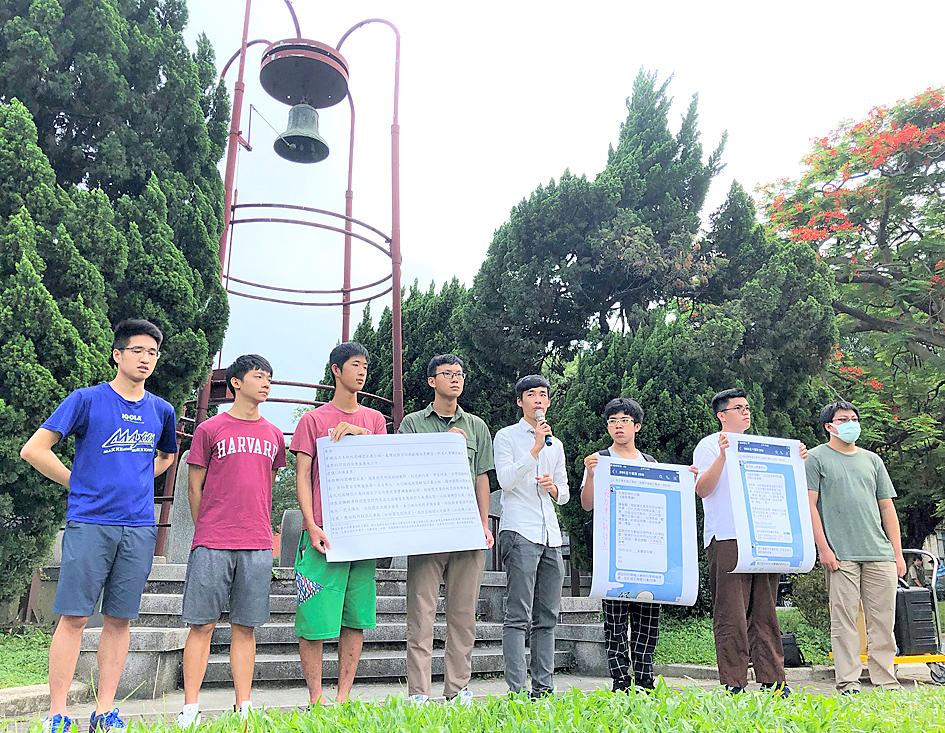
Photo: CNA
While the association has proposed establishing a transitional justice committee that would seek to uncover the truth about the development of the university, as well as draw up initiatives to remove objects or sites linked to totalitarianism, it has never mentioned anything about the Fu Bell or Fu Garden, he said.
The association believes that it is a smear tactic carried out by the university to obstruct its efforts to pursue transitional justice, Tu said, adding that the association demands an apology.
In response, NTU issued a statement saying that the petition was initiated by NTU alumnus, with no involvement from the university, and that it respects the association’s proposal.
The association has said that the committee would be composed of faculty with expertise in historical research, Gallery of NTU History representatives, student representatives and a professor from each of the university’s colleges.
The committee could serve as a coordinating body for efforts related to transitional justice, as students could only make limited achievements without the full cooperation of the university, Tu said.
“A democratic campus should seek transitional justice for victims and redress the legacies of totalitarian abuses,” he said.
Fu is remembered as a defender of NTU after he resisted efforts by police and intelligence agents to arrest professors and students seen as political dissidents during his term as president from January 1949 to December 1950, the beginning of the Martial Law era.

LOUD AND PROUD Taiwan might have taken a drubbing against Australia and Japan, but you might not know it from the enthusiasm and numbers of the fans Taiwan might not be expected to win the World Baseball Classic (WBC) but their fans are making their presence felt in Tokyo, with tens of thousands decked out in the team’s blue, blowing horns and singing songs. Taiwanese fans have packed out the Tokyo Dome for all three of their games so far and even threatened to drown out home team supporters when their team played Japan on Friday. They blew trumpets, chanted for their favorite players and had their own cheerleading squad who dance on a stage during the game. The team struggled to match that exuberance on the field, with
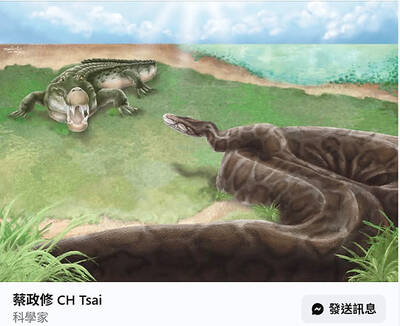
Taiwanese paleontologists have discovered fossil evidence that pythons up to 4m long inhabited Taiwan during the Pleistocene epoch, reporting their findings in the international scientific journal Historical Biology. National Taiwan University (NTU) Institute of Ecology and Evolutionary Biology associate professor Tsai Cheng-hsiu (蔡政修) led the team that discovered the largest snake fossil ever found in Taiwan. The single trunk vertebra was discovered in Tainan at the Chiting Formation, dated to between 400,000 and 800,000 years ago in the Middle Pleistocene, the paper said. The area also produced Taiwan’s first avian fossil, as well as crocodile, mammoth, saber-toothed cat and rhinoceros fossils, it said. Discoveries

Taiwanese paleontologists have discovered fossil evidence that pythons up to 4m long inhabited Taiwan during the Pleistocene epoch, reporting their findings in the international scientific journal Historical Biology. National Taiwan University (NTU) Institute of Ecology and Evolutionary Biology associate professor Tsai Cheng-hsiu (蔡政修) led the team that discovered the largest snake fossil ever found in Taiwan. A single trunk vertebra was discovered in Tainan at the Chiting Formation, dated to between 800,000 to 400,000 years ago in the Middle Pleistocene, the paper said. The area also produced Taiwan’s first avian fossil, as well as crocodile, mammoth, sabre-toothed cat and rhinoceros fossils, it said. Discoveries
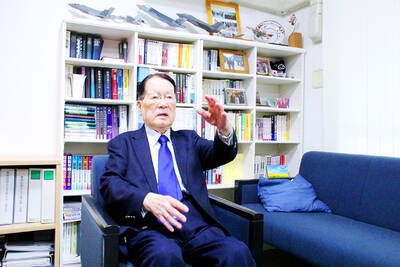
Whether Japan would help defend Taiwan in case of a cross-strait conflict would depend on the US and the extent to which Japan would be allowed to act under the US-Japan Security Treaty, former Japanese minister of defense Satoshi Morimoto said. As China has not given up on the idea of invading Taiwan by force, to what extent Japan could support US military action would hinge on Washington’s intention and its negotiation with Tokyo, Morimoto said in an interview with the Liberty Times (sister paper of the Taipei Times) yesterday. There has to be sufficient mutual recognition of how Japan could provide


 RSS
RSS