


The Kaohsiung District Prosecutors’ Office yesterday cracked down on an examination fraud ring that allegedly charged people to assign proxies to sit exams for positions at state-owned corporations, reportedly generating more than NT$50 million (US$1.68 million) in illicit gains.
The group has over the past two years helped 12 people enter state-run corporations — such as CPC Corp, Taiwan (CPC) and Taiwan Power Co — as well as police academies by sending proxies to take the exams on their behalf, the office said in a news release.
The office conducted the investigation with the Agency Against Corruption under the Ministry of Justice.
Huang Yao-chin (黃耀進), 43, the alleged leader of the ring and a CPC employee, charged fees ranging from NT$900,000 to NT$1.3 million per client, the office said, adding that proxies included students from National Tsing Hua University and National Chiao Tung University, medical interns and junior-high school science teachers.
To deceive exam administrators, Huang and the other suspects digitally combined the photographs of clients with those of proxies, and had the clients use the edited photographs to apply for new National Health Insurance cards, which were used as an identification documents at the exams, it said.
The ring charged clients an upfront payment of about NT$100,000 to NT$450,000 before the exams, of which NT$20,000 to NT$100,000 went to a proxy, the office said, adding that clients paid the remainder once the proxy passed the exam.
To increase its gains, the ring moved from only helping people take written exams to providing “full services,” which included taking care of subsequent interviews or fitness tests for clients, as some of them failed to demonstrate professionalism in the fields, the office said.
The office and the agency said they launched the investigation after receiving a report from a person following CPC’s written exam in January.
The source said that a friend of theirs who had never studied for the test passed it after bragging that “my father took care of the exam for me,” officials said.
The suspects were caught in the act on the day of CPC’s second-round exam, the office said.
A client who had failed the CPC exam for several years said that he commissioned a proxy out of pressure after his girlfriend threatened to break up with him if he failed once more, it said.
Some parents even raised money from friends and family to secure a position for their child at a state-run corporation, the office added.
One client was fired from China Steel Corp in less than one year after starting work, as his manager had found that “he knew literally nothing” about the job, the office said.
The ring helped 10 people pass CPC’s written exam last year, it said, adding that seven clients did not get into any state-run corporations.
However, due to damaged data on Huang’s computer, the identities of 39 other clients could not be determined, while another NT$30 million in gains could not be deemed illicit, as its source was known, it said.
Huang and the five main proxies were indicted on charges of fraud and forgery of documents, while 46 clients, family of clients and other proxies received a suspended indictment, the office said.


UPGRADE: The Kang Ding-class frigate is replacing its Chaparall missiles with Tien Chien II and Hua Yang VLS, which would provide it with long-range, 360° air defense Taiwan plans to produce 1,200 to 1,376 Hai Chien II missiles (海劍二, Sea Sword II) — also known as TC-2N — to serve as the standard air defense system of the navy’s surface combatant fleet, a source said yesterday. Last week, the Hai Chien II, the naval version of the Tien Kung II missile (天劍二, Sky Sword II), completed a live-fire test in waters off the National Chungshan Institute of Science and Technology’s Jiupeng facility (九鵬) in Pingtung County’s Manjhou Township (滿州). The MIM72 Chaparral and other dated air defense missiles that currently arm Taiwanese ships have inadequate range to combat Chinese

REASONS FOR TRAVEL: An assistant professor said that proposed amendments to penalize drivers if they used drugs overseas would not deter people from traveling People who operate a motor vehicle under the influence of marijuana would have their driver’s license revoked, even if they used the substance while overseas, the Ministry of Transportation and Communications said yesterday, citing proposed amendments to the Road Traffic Management and Penalty Act (道路交通管理處罰條例). The amendments would also authorize the government to revoke the licenses of people determined to have used Category 1 or Category 2 narcotics, even if they were not operating a vehicle while under the influence of drugs, as well as ban them from taking the license test for three years, the ministry said. People aged 18 or
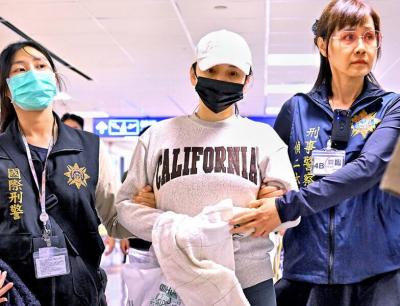
Johanne Liou (劉喬安), a Taiwanese woman who shot to unwanted fame during the Sunflower movement protests in 2014, returned to Taiwan last night after being deported from the US. She is to stand trial in Taiwan for charges involving embezzlement, fraud and drug crimes. The Criminal Investigation Bureau (CIB) said it took her into custody at Taiwan Taoyuan International Airport and would first question her before transferring her to the New Taipei District Prosecutors’ Office. She was arrested upon disembarking a flight from San Francisco that landed shortly before 7pm. Liou absconded to the US in 2019 after jumping bail
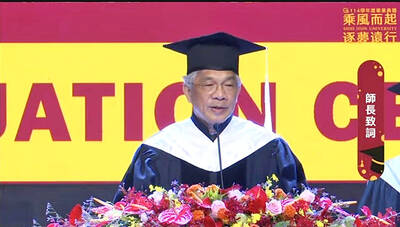
Shih Hsin University President Chen Ching-he (陳清河) yesterday issued a public apology for comments made in his commencement speech last week, stating that he has asked the school to suspend his duties and halt his wages for two months as a show of contrition. At the commencement ceremony on May 30, Chen said, “If you don’t manage your time well, or your own emotions, or your health, then I am telling every one of you — put a quick end to ‘you,’ because the world has no need for ‘you.’” The comments have sparked significant controversy online, and Chen through an open


 RSS
RSS