


The Kaohsiung City Council yesterday flew the council flag at half-mast to pay tribute to Chinese Nationalist Party (KMT) Kaohsiung City Council Speaker Hsu Kun-yuan (許崑源), who was found dead after falling from his 17th-floor apartment late on Saturday night.
Hsu died several hours after the city voted to recall Kaohsiung Mayor Han Kuo-yu (韓國瑜), whom Hsu had strongly supported.
Kaohsiung City Council Deputy Speaker Lu Shu-mei (陸淑美) said that the council is assisting Hsu’s family with funeral arrangements, and that it would hold a by-election for the speaker position.
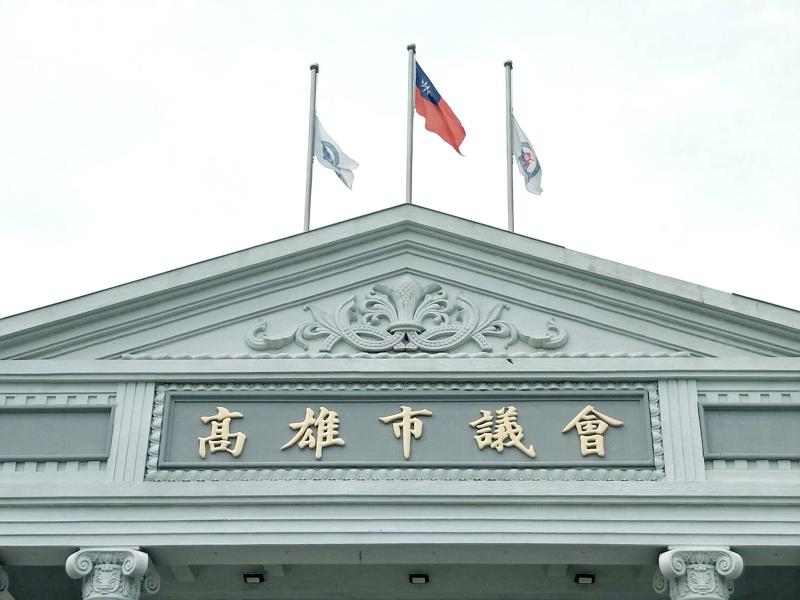
Photo courtesy of Kaohsiung City Council
Kaohsiung prosecutors at 2:40am yesterday finished examining Hsu’s body, saying that he had sustained several broken bones and a fractured skull after what appears to have been a fall from his 17th-floor apartment.
They are still attempting to determine the exact cause of death, they added.
Initial investigations have ruled out any suspects in the death, and no suicide note was found, Kaohsiung District Prosecutors’ Office Director Tseng Ching-ya (曾靖雅) said.
Hsu’s wife and daughter were at home at the time of his death, but they had no insight into the cause, and police did not plan to question them further, Tseng said.
Hsu, who was 63, was in his second term as city council speaker.
A friend of Hsu’s told investigators that the speaker had experienced difficulty with his vision, hearing and movement since a stroke last year, and that he had been in rehabilitation.
Shortly after news reports of Hsu’s death, Democratic Progressive Party Taipei City Councilor Liang Wen-chieh (梁文傑) posted about it on Facebook, with the comment: “This is quite scary. Did [Hsu] get himself in trouble gambling or something?”
The post was quickly removed, and Liang apologized after receiving criticism for it.
“That was just careless conjecture on my part due to lack of information. Although I deleted the post quickly, I recognize my mistake. I solemnly apologize to the family for the disrespect,” he wrote.
Several commenters continued to criticize Liang, with one person writing: “Your first reaction is reflective of your true character, everything else is an act.”
Another wrote: “Show some decorum, the man is already dead.”
Meanwhile, KMT Chairman Johnny Chiang (江啟臣) yesterday went to the funeral hall to offer condolences to Hsu’s family and pay tribute to his contributions to the city council.
Hsu had always shown more care for Kaohsiung than for himself, despite his health problems, and had always reminded Kaohsiung residents to look to the future rather than dwell on the past, Chiang said.
Chiang also asked people to refrain from spreading rumors about Hsu’s death, and called for calm in the wake of Han’s recall.
Separately, the city government quoted Han in a statement saying that he was “extremely shocked” and “deeply saddened” by news of Hsu’s death.
Han called on his supporters to remain calm and act rationally despite his recall, asking them to move on.
Former KMT chairman Wu Den-yih (吳敦義), who was Kaohsiung mayor from 1990 to 1998, yesterday also went to the funeral hall to offer condolences to Hsu’s family.
Wu said that Hsu, a “mild-tempered and selfless” person, was a good friend of his in Kaohsiung.
Additional reporting by CNA

Considering that most countries issue more than five denominations of banknotes, the central bank has decided to redesign all five denominations, the bank said as it prepares for the first major overhaul of the banknotes in more than 24 years. Central bank Governor Yang Chin-lung (楊金龍) is expected to report to the Legislative Yuan today on the bank’s operations and the redesign’s progress. The bank in a report sent to the legislature ahead of today’s meeting said it had commissioned a survey on the public’s preferences. Survey results showed that NT$100 and NT$1,000 banknotes are the most commonly used, while NT$200 and NT$2,000

The Centers for Disease Control (CDC) yesterday reported the first case of a new COVID-19 subvariant — BA.3.2 — in a 10-year-old Singaporean girl who had a fever upon arrival in Taiwan and tested positive for the disease. The girl left Taiwan on March 20 and the case did not have a direct impact on the local community, it said. The WHO added the BA.3.2 strain to its list of Variants Under Monitoring in December last year, but this was the first imported case of the COVID-19 variant in Taiwan, CDC Deputy Director-General Lin Ming-cheng (林明誠) said. The girl arrived in Taiwan on

South Korea is planning to revise its controversial electronic arrival card, a step Taiwanese officials said prompted them to hold off on planned retaliatory measures, a South Korean media report said yesterday. A Yonhap News Agency report said that the South Korean Ministry of Foreign Affairs is planning to remove the “previous departure place” and “next destination” fields from its e-arrival card system. The plan, reached after interagency consultations, is under review and aims to simplify entry procedures and align the electronic form with the paper version, a South Korean ministry official said. The fields — which appeared only on the electronic form

The Ministry of Foreign Affairs (MOFA) is suspending retaliation measures against South Korea that were set to take effect tomorrow, after Seoul said it is updating its e-arrival system, MOFA said today. The measures were to be a new round of retaliation after Taiwan on March 1 changed South Korea's designation on government-issued alien resident certificates held by South Korean nationals to "South Korea” from the "Republic of Korea," the country’s official name. The move came after months of protests to Seoul over its listing of Taiwan as "China (Taiwan)" in dropdown menus on its new online immigration entry system. MOFA last week


 RSS
RSS