


A man suspected of causing a scare by marking shoes belonging to women in a community in Taichung’s Shalu District (沙鹿) likely has a form of obsessive-compulsive disorder (OCD), a psychiatrist said.
Police said that the man, surnamed Lin (林), faces charges of trespassing and damaging personal property.
Lin, 23, works at a fish market in Taichung, and is married with two children, police said on May 19.
In March, in a community near Providence University, where many female university students rent apartments, women began to notice black dots on their shoes, police said, adding that they were scared that their shoes were being marked by would-be assailants.
Investigators found that Lin had lived in the community and after moving out allegedly retained the magnetic access card.
Records showed that he went there on March 22, when he apparently used a black marker to draw dots on the sides of shoes, investigators said.
Lin allegedly only marked shoes belonging to women, they said, adding that the dots corresponded to the shoe size, with a size 23 shoe having two plus three dots on it, for example.
Commenting on the case, Wen Wei-chun (溫偉鈞), a psychiatrist in Taichung, said that Lin could have obsessive-compulsive disorder.
If a student always places a cup of water at a specific spot on their desk when studying, or a person needs to check that the gas valve and windows are closed several times before leaving the house, they are showing signs of the disorder, Wen said.
Obsessive-compulsive disorder might only affect the sufferer, but other people would see it as odd behavior, he said.
When such behavior seriously interferes in a person’s life or the lives of others — for example if they continuously wash their hands, despite having already harmed their hands by over-washing, or have to check the gas valve so often that they are always late or are afraid of leaving their home — they need professional treatment, Wen said.
If people know of someone with such problems they should try to get that person to visit a psychiatrist or neurology specialist, Wen added.

FUKUOKA SITUATION: Japanese media reported that the pathogen is expected to be identified by the summer, while the CDC downplayed the idea that it was hMPV A “mysterious cold-like illness” reported in Japan’s Fukuoka Prefecture does not seem to be a new disease, but Japanese authorities have been asked about the situation, the Centers for Disease Control (CDC) said yesterday. The Fukuoka Prefectural Medical Association on Wednesday told a news conference that a “mystery cold” that has become a hot topic on social media is “highly likely to be caused by some kind of viral infection,” Japan’s KBC News reported. “Many people are experiencing symptoms starting with a sore throat, followed by a runny nose, phlegm and a severe cough,” KBC News reported, citing association officials. Health authorities are

Nvidia Corp CEO Jensen Huang (黃仁勳) arrived in Taiwan yesterday ahead of upcoming AI and technology events, saying he plans to meet with clients and Taiwan Semiconductor Manufacturing Co Chairman C.C. Wei (魏哲家) during his visit. After landing at Taipei Songshan Airport, Huang posed for photos with fans and handed out Yakult drinks to reporters and supporters waiting at the scene, saying he has “a lot to do” during the trip. Asked about reports that Nvidia’s planned headquarters site in Taipei’s Beitou Shilin Technology Park could break ground on May 27, Huang said that if the company holds an event, he would

The Ministry of Finance this afternoon announced the winning numbers for the March-April uniform invoice lottery. The winning number for the NT$10 million (US$318,060) special prize is 19531471, and the winning number for the NT$2 million grand prize is 85941329. Three numbers were drawn for the NT$200,000 first prize: 07225810, 20231230 and 83518781. Those with receipts matching the last seven digits of any of the first-prize numbers will win the NT$40,000 second prize, while those matching the last six digits will win the NT$10,000 third prize. Those whose receipts match the last five digits of the first-prize numbers can claim the NT$4,000 fourth prize,
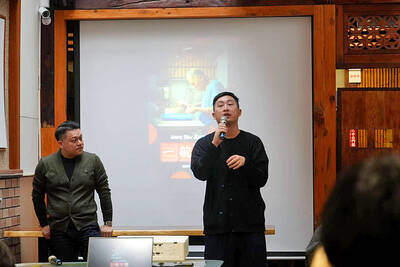
Taiwan Travelogue (臺灣漫遊錄), which earlier this week became the first Taiwanese novel to win the International Booker Prize, is to be adapted into a television series through a Taiwan-Japan coproduction, producer Chang Chen-yu (張辰漁) said yesterday. Chang, a producer at World Softest Production Film Co, wrote on Facebook that the company had been searching for projects with international appeal that retain a strong Taiwanese identity after colleagues and Japanese partners strongly recommended the novel. After reading the book, Chang said he immediately decided to pursue the screen rights. “A great story has the power to transcend time and borders, and connect countless people,”


 RSS
RSS