


The One Bear Museum in Hsinchu County’s Guansi Township (關西), a teddy bear museum once touted by the county government as a “luminous pearl” along Provincial Highway No. 13, is facing possible closure.
The museum’s building, which was provided by the county government, has a serious water leakage problem and lacks a parking lot for buses to bring in tour groups, Hsinchu County Councilor Lo Shih-shi (羅仕琦) said on Saturday.
The county government should step in to rescue the museum, or the negative reviews about the museum on the Internet might affect visitors’ impression of the township and the county, he said.

Photo: Huang Mei-chu, Taipei Times
The building used to be an illegal construction that served as a recreational center for farmers, Lo said.
The county government later legalized the building and the museum was opened about two years ago. It is said to be the largest teddy bear museum in Asia, he added.
However, as the building is old, it has problems, including water leakage, frequent elevator malfunctions, falling tiles from the ceiling and exposed steel reinforcing bars in the walls, causing safety concerns among visitors, he said.
Museum general manager Chou Hua-wen (周華文) said he was fond of the building’s large space and invested more than NT$40 million (US$1.33 million at the current exchange rate) to establish the museum.
He had expected that it would attract about 15,000 to 18,000 visitors per month, but it only attracted 4,000 to 7,000 visitors per month, Chou said.
The reasons for low visitor numbers include water leakage, facility malfunction and nearby parking lots always being occupied, he said.
The management has been reluctant to promote the museum for fear that it might lead to more negative reviews, he said, adding that travel agencies were also concerned about receiving complaints if they promoted the museum to their clients.
The county government last year started tackling the building’s 32 water leaks, with seven or eight spots still in need of repairs, Chou said.
The museum had not anticipated the COVID-19 outbreak, which has caused visitor numbers to fall by more than 90 percent, he said.
The museum’s revenue fell from NT$3 million per month to a total of NT$4 million in the past four months, Chou said, adding that although the nation’s COVID-19 situation is now under control, the museum’s water leakage and parking problems remain, and he would be forced to close the museum if they cannot be solved.

The manufacture of the remaining 28 M1A2T Abrams tanks Taiwan purchased from the US has recently been completed, and they are expected to be delivered within the next one to two months, a source said yesterday. The Ministry of National Defense is arranging cargo ships to transport the tanks to Taiwan as soon as possible, said the source, who is familiar with the matter. The estimated arrival time ranges from late this month to early next month, the source said. The 28 Abrams tanks make up the third and final batch of a total of 108 tanks, valued at about NT$40.5 billion

Two Taiwanese prosecutors were questioned by Chinese security personnel at their hotel during a trip to China’s Henan Province this month, the Mainland Affairs Council (MAC) said yesterday. The officers had personal information on the prosecutors, including “when they were assigned to their posts, their work locations and job titles,” MAC Deputy Minister and spokesman Liang Wen-chieh (梁文傑) said. On top of asking about their agencies and positions, the officers also questioned the prosecutors about the Cross-Strait Joint Crime-Fighting and Judicial Mutual Assistance Agreement, a pact that serves as the framework for Taiwan-China cooperation on combating crime and providing judicial assistance, Liang
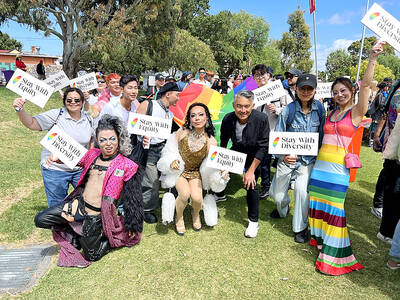
A group from the Taiwanese Designers in Australia association yesterday represented Taiwan at the Midsumma Pride March in Melbourne. The march, held in the St. Kilda suburb, is the city’s largest LGBTQIA+ parade and the flagship event of the annual Midsumma Festival. It attracted more than 45,000 spectators who supported the 400 groups and 10,000 marchers that participated this year, the association said. Taiwanese Designers said they organized a team to march for Taiwan this year, joining politicians, government agencies, professionals and community organizations in showing support for LGBTQIA+ people and diverse communities. As the first country in Asia to legalize same-sex
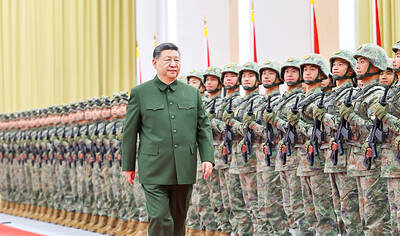
MOTIVES QUESTIONED The PLA considers Xi’s policies toward Taiwan to be driven by personal considerations rather than military assessment, the Epoch Times reports Chinese President Xi Jinping’s (習近平) latest purge of the Chinese People’s Liberation Army (PLA) leadership might have been prompted by the military’s opposition to plans of invading Taiwan, the Epoch Times said. The Chinese military opposes waging war against Taiwan by a large consensus, putting it at odds with Xi’s vision, the Falun Gong-affiliated daily said in a report on Thursday, citing anonymous sources with insight into the PLA’s inner workings. The opposition is not the opinion of a few generals, but a widely shared view among the PLA cadre, the Epoch Times cited them as saying. “Chinese forces know full well that


 RSS
RSS