

Democratic Progressive Party (DPP) lawmakers on Friday last week proposed extending the maximum period criminal offenders with mental health issues can be held in psychiatric detention from five to 14 years in the wake of a controversial case.
DPP Legislator Chou Chun-mi (周春米) said that the proposed amendments to Article 87 of the Criminal Code would allow courts to add three three-year extensions to the current five years of “custodial protection” that can be ordered for criminal offenders found not guilty on the grounds of diminished mental capacity.
The proposed amendments came after the Chiayi District Court on April 30 found a man surnamed Cheng (鄭) not guilty in the fatal stabbing of 24-year-old railway police officer Lee Cheng-han (李承翰) on a train from Tainan to Taipei in July last year.
The court said that Cheng’s long history of schizophrenia negated his legal culpability, and ruled that he could be released on NT$500,000 bail and transferred to a secure facility to undergo psychiatric treatment for five years.
Prosecutors have appealed the decision.
Regarding the proposed changes, Chou said that the current five-year limit does not adequately guarantee against recidivism, adding that the option of extending the treatment period would increase the likelihood that a person could be successfully rehabilitated.
The extensions would not be unilaterally decided by courts, but would be based on annual psychiatric evaluations carried out by medical professionals, she said.
Aside from the changes to the Criminal Code, the lawmakers also aim to amend Article 301 of the Code of Criminal Procedure (刑事訴訟法) to allow courts, when necessary, to commit defendants to mental health facilities before a verdict has been issued, Chou said.
DPP Legislator Wu Yu-chin (吳玉琴), who also voiced support for the measures, said that the changes had to be part of a larger effort to strengthen the nation’s social safety net.
For example, the ratio of social workers to people in need of psychiatric counseling is 1 to 405, she said.
The Ministry of Health and Welfare has set a goal of cutting that to 1 to 80.
DPP Legislator Hsu Chih-chieh (許智傑) suggested adding a requirement that at least two hospitals determine a suspect’s mental fitness in cases involving major crimes.
Hsu’s comments were likely a reaction to the Chiayi District Court’s reliance on a single expert witness’ psychiatric evaluation of Cheng to decide whether he could not be found guilty because of diminished mental capacity.

The donation of offshore patrol vessel Kinmen to the Philippines includes provisions that protect Taiwanese fishers and facilitate security cooperation across the First Island Chain, officials said yesterday. The comment was made during the Cabinet’s comprehensive administrative report at the legislature after Chinese Nationalist Party (KMT) Legislator Hsu Yu-chen (許宇甄) expressed concerns about the decision to give a ship to a country whose coast guard had in 2013 fired on a Taiwanese trawler and killed its captain without provocation. The Cabinet should lay out the safeguards that have been established to prevent the Philippine government from using the Kinmen to harass, expel

GROWING TIES: The CGA is planning a goodwill mission to the Philippines, in what would be the first time since 1975 a Taiwanese paramilitary vessel has visited the country The Coast Guard Administration (CGA) plans to significantly expand its participation in international security cooperative frameworks and its operational capabilities, a budget proposal for next year showed. The budget indicates a transformation of the CGA from a maritime law enforcement arm into a national defense and intelligence gathering entity capable of tackling larger regional security matters. The proposal showed that personnel from the coast guard’s Intelligence Division and Special Action Support Center are to participate in high-level national security talks with the US. As the CGA has dealt with China’s rising “gray zone” threats around Taiwan, it has become a valuable asset to
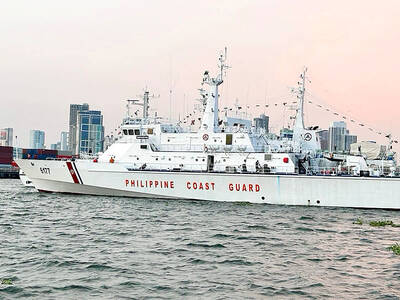
A patrol vessel donated by the Coast Guard Administration (CGA) to the Philippines was commissioned into the Philippine Coast Guard (PCG) on Friday, a Philippine non-governmental organization said. The CGA on Sept. 16 confirmed media reports that Taiwan had donated a retired 500-tonne patrol vessel to the Philippines. The Manila-based We Protect Our Seas (WPS) foundation, which served as an intermediary in the transfer, said that the vessel was formerly the CGA’s 500-tonne petrol vessel Kinmen (CG123). The WPS, in a statement issued on Friday, said the vessel, renamed as the BRP Sarangani, had been commissioned into the PCG the
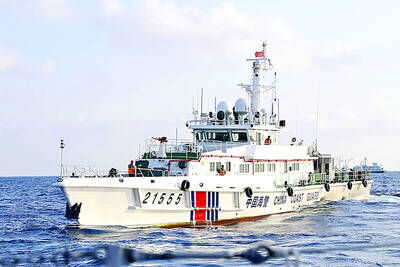
‘GRAY ZONE’ TACTICS: Beijing sent two China Coast Guard vessels to escort a ‘supposedly private research ship,’ a Philippine Coast Guard spokesman said The Coast Guard Administration (CGA) yesterday confirmed that it had recently deployed three patrol vessels to waters in Taiwan’s overlapping exclusive economic zone with the Philippines to monitor three Chinese vessels. CGA Deputy Director-General Hsieh Ching-chin (謝慶欽) said the agency regularly monitors Chinese vessels around Taiwan, and that the deployment south of Oluanpi (鵝鑾鼻), Taiwan proper’s southernmost point, was carried out in accordance with standard procedures. He added that the waters fall within the overlapping exclusive economic zones of Taiwan and the Philippines, which extend 200 nautical miles (370km) from their coastlines. Hsieh made the comments when asked about a


 RSS