


A 44-year-old woman surnamed Lin (林) was yesterday sentenced to 18 years in prison for beating her mother to death last year, although the defense told the Shilin District Court of Lin’s mental illness and alleged abuse by family members.
The judges convicted Lin of assaulting her mother and inducing injuries causing death, and said that despite having a mental illness, she had the ability to control her actions at the time of the crime, so the sentence could not be commuted to a lesser punishment.
As it was the first ruling, Lin can file an appeal.
An investigation showed that Lin lived with her 73-year-old mother in Taipei’s Tianmu (天母) area. The two had quarreled for many years, as Lin said she believed her mother took her things and had placed a death curse on her.
On March 1 last year, Lin knocked down her mother, punched and kicked her, struck her with a blunt object, and strangled her, leaving her lying unconscious in a pool of blood, investigators said.
Lin called the authorities at about 10pm, they said, but her mother was later pronounced dead.
She initially told police that her mother was beaten up in the neighborhood and brought home with serious injuries by two unknown men, but the evidence showed that her mother was at home that day, they added.
A psychiatric evaluation showed that Lin has schizophrenia, and has for years experienced paranoia, hallucinations and delusions, as well as heard voices, with investigators quoting her as saying that a voice inside her head at times controlled her actions.
Prosecutors said that Lin was aware and in control of her actions at the time, as she took out the garbage and misled investigators with false information.
Her lawyer told the court of how Lin’s parents sent her as a high-school student to the US, where she went on to earn a master’s degree, obtained a green card and got married, although she later divorced her husband and returned to Taiwan.
Evidence and psychiatric reports showing the emotional and physical abuse that Lin allegedly experienced from her parents and her husband were presented by her defense as causes of her mental illness.
Her lawyer said that Lin was later involved in a traffic accident that worsened her already weakened physical and mental state, and that she began to display unusual behavior and speech, purportedly showing her break from reality.
Although the court found Lin guilty and sentenced her to prison, it also ordered that she receive regular mental health treatment, saying that her mental condition should be understood so that she can be rehabilitated and kept from relapsing into crime.

UPGRADE: The Kang Ding-class frigate is replacing its Chaparall missiles with Tien Chien II and Hua Yang VLS, which would provide it with long-range, 360° air defense Taiwan plans to produce 1,200 to 1,376 Hai Chien II missiles (海劍二, Sea Sword II) — also known as TC-2N — to serve as the standard air defense system of the navy’s surface combatant fleet, a source said yesterday. Last week, the Hai Chien II, the naval version of the Tien Kung II missile (天劍二, Sky Sword II), completed a live-fire test in waters off the National Chungshan Institute of Science and Technology’s Jiupeng facility (九鵬) in Pingtung County’s Manjhou Township (滿州). The MIM72 Chaparral and other dated air defense missiles that currently arm Taiwanese ships have inadequate range to combat Chinese

REASONS FOR TRAVEL: An assistant professor said that proposed amendments to penalize drivers if they used drugs overseas would not deter people from traveling People who operate a motor vehicle under the influence of marijuana would have their driver’s license revoked, even if they used the substance while overseas, the Ministry of Transportation and Communications said yesterday, citing proposed amendments to the Road Traffic Management and Penalty Act (道路交通管理處罰條例). The amendments would also authorize the government to revoke the licenses of people determined to have used Category 1 or Category 2 narcotics, even if they were not operating a vehicle while under the influence of drugs, as well as ban them from taking the license test for three years, the ministry said. People aged 18 or

HEAVY WEATHER: Typhoon Jangmi is due to crash straight into the Ryukyus as airlines look to shift flights to larger aircraft or cancel flights to Okinawa entirely Taiwan’s international air carriers announced flight adjustments over the weekend as Typhoon Jangmi is forecast to hit the Ryukyu Islands today and tomorrow. The Central Weather Administration (CWA) upgraded Jangmi from a tropical storm to a typhoon at 8am yesterday, with the eye located 580km south of Naha city. It was moving north at 19kph. Today, China Airlines’ CI-120, CI-121, CI-122 and CI-123 flights between Taoyuan and Naha, Okinawa, have been canceled as well as CI-132 and CI-133 between Kaohsiung and Naha. EVA Air’s BR-112, BR-113, BR-186 and BR-185 flights between Taoyuan and Naha are also canceled. Low-cost carrier Tigerair Taiwan canceled IT-230,
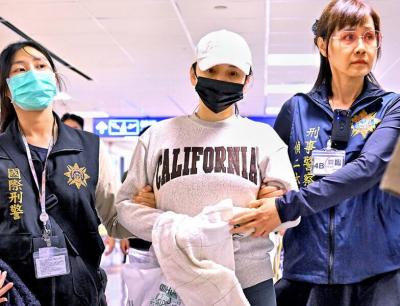
Johanne Liou (劉喬安), a Taiwanese woman who shot to unwanted fame during the Sunflower movement protests in 2014, returned to Taiwan last night after being deported from the US. She is to stand trial in Taiwan for charges involving embezzlement, fraud and drug crimes. The Criminal Investigation Bureau (CIB) said it took her into custody at Taiwan Taoyuan International Airport and would first question her before transferring her to the New Taipei District Prosecutors’ Office. She was arrested upon disembarking a flight from San Francisco that landed shortly before 7pm. Liou absconded to the US in 2019 after jumping bail


 RSS
RSS