


The Food and Drug Administration (FDA) should recall low-sodium salt products made by Taiyen Biotech Co (台鹽), which used Chinese-made potassium chloride with high radioactivity levels and falsely labeled the products, an environmentalist and a lawmaker said yesterday.
Food producers usually replace some of the sodium chloride in salt products with potassium chloride to make low-sodium salt to help consumers avoid high blood pressure or cardiovascular diseases linked to a high intake of sodium chloride.
At a news conference at the legislature in Taipei, Green Consumers’ Foundation secretary-general Jay Fang (方儉) and New Power Party Legislator Chen Jiau-Hua (陳椒華) raised concerns about alleged false labeling and excessive radioactivity levels in Taiyen’s low-sodium salt products.
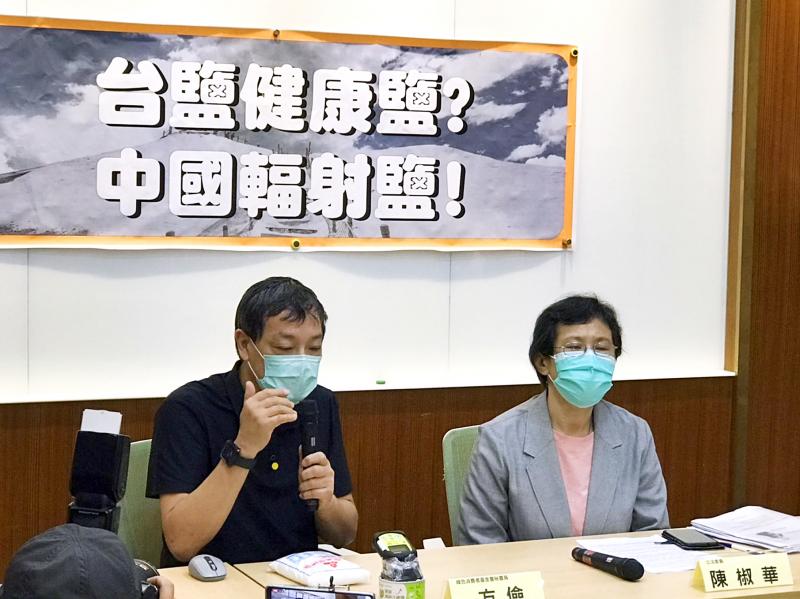
Photo: Peng Wan-hsin, Taipei Times
After Fang called attention to the products in 2017, the Control Yuan that year corrected the FDA for failing to regulate radioisotopes in food products and for trying to pass responsibility to the Atomic Energy Council.
The government has set the maximum allowable level of potassium-40 in building materials at 10,000 becquerels per kilogram (Bq/kg), but does not regulate its levels in food products, Fang said yesterday.
The level of radioactivity of the potassium chloride used in Taiyen’s products was found to reach 18,000Bq/kg, high enough to be regulated by the council, he said, asking why the ingredient was not regulated and highlighted on product labels when used as a food additive.
Although potassium-40 is a natural isotope found in the human body, people who do not lack potassium should not unnecessarily expose themselves to additional radioactive material or consume excessive levels of potassium chloride, which could cause kidney problems, he said.
The products’ labels also state that they are manufactured in Taiwan, but their main ingredient, potassium chloride, is imported from China, Fang said.
Taiyen’s salt products dominate the domestic market, but authorities have failed to strictly evaluate their safety, Chen said, calling on the FDA to recall the products immediately.
Taiyen later yesterday said in a statement that it developed the products to help people consume more potassium, as some studies have shown that Taiwanese generally lack the element.
After the Executive Yuan and the Legislative Yuan held meetings on the issue, experts agreed that potassium is necessary for humans and a warning label is not needed, the company said.
Its low-sodium salt products use sodium chloride as the base ingredient, which is produced at its plant in Miaoli County, with potassium chloride and other ingredients added later, Taiyen said, without clarifying their proportions or radiation levels.
Potassium chloride is imported from Europe, the US or China, it said, adding that its salt products are absolutely safe, with legal labeling and ingredients.
Under the Control Yuan’s advice, the company last year renamed its low-sodium salt products by removing the word “healthy” from their titles, it added.

Considering that most countries issue more than five denominations of banknotes, the central bank has decided to redesign all five denominations, the bank said as it prepares for the first major overhaul of the banknotes in more than 24 years. Central bank Governor Yang Chin-lung (楊金龍) is expected to report to the Legislative Yuan today on the bank’s operations and the redesign’s progress. The bank in a report sent to the legislature ahead of today’s meeting said it had commissioned a survey on the public’s preferences. Survey results showed that NT$100 and NT$1,000 banknotes are the most commonly used, while NT$200 and NT$2,000

The Centers for Disease Control (CDC) yesterday reported the first case of a new COVID-19 subvariant — BA.3.2 — in a 10-year-old Singaporean girl who had a fever upon arrival in Taiwan and tested positive for the disease. The girl left Taiwan on March 20 and the case did not have a direct impact on the local community, it said. The WHO added the BA.3.2 strain to its list of Variants Under Monitoring in December last year, but this was the first imported case of the COVID-19 variant in Taiwan, CDC Deputy Director-General Lin Ming-cheng (林明誠) said. The girl arrived in Taiwan on

South Korea is planning to revise its controversial electronic arrival card, a step Taiwanese officials said prompted them to hold off on planned retaliatory measures, a South Korean media report said yesterday. A Yonhap News Agency report said that the South Korean Ministry of Foreign Affairs is planning to remove the “previous departure place” and “next destination” fields from its e-arrival card system. The plan, reached after interagency consultations, is under review and aims to simplify entry procedures and align the electronic form with the paper version, a South Korean ministry official said. The fields — which appeared only on the electronic form

The Ministry of Foreign Affairs (MOFA) is suspending retaliation measures against South Korea that were set to take effect tomorrow, after Seoul said it is updating its e-arrival system, MOFA said today. The measures were to be a new round of retaliation after Taiwan on March 1 changed South Korea's designation on government-issued alien resident certificates held by South Korean nationals to "South Korea” from the "Republic of Korea," the country’s official name. The move came after months of protests to Seoul over its listing of Taiwan as "China (Taiwan)" in dropdown menus on its new online immigration entry system. MOFA last week


 RSS
RSS