


Solar power developers are required to pay recycling fees for installing solar panels, and those caught illegally dumping panels would face a fine of up to NT$3 million (US$100,164), the Environmental Protection Administration (EPA) said yesterday.
The EPA has, in cooperation with the Bureau of Energy, set up a recycling system for solar panel waste, EPA Department of Waste Management Director-General Lai Ying-ying (賴瑩瑩) told a news conference in Taipei.
The system was established to prevent heavy metal pollution caused by decommissioned photovoltaic panels and to foster a circular economy within the solar power industry, she said.
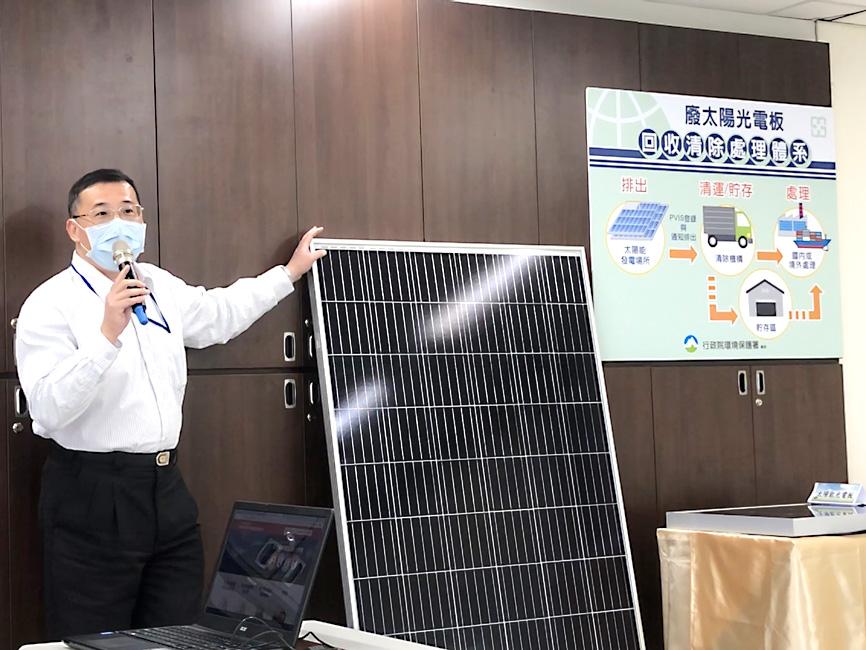
Photo: Lo Chi, Taipei Times
With the government’s aim to generate 20 gigawatts of electricity from solar power by 2025 as part of its energy transformation policy, the EPA estimates that more than 100,000 tonnes of solar panels would be decommissioned each year, starting from 2035, in addition to waste materials caused by natural disasters.
Solar power developers planning to install solar panels first have to obtain a registration number for each panel from the energy bureau and pay a recycling fee of NT$1,000 for every kilowatt, Lai said.
To handle used panels, developers have to file an application with the EPA’s online solar panel recycling system, and the Taiwan Photovoltaic Industry Association would help recycle them, Lai said.
For personal installations, people can call the EPA hotline at (03) 582-0009 on proper waste disposal and recycling, she said.
Photovoltaic panels consist of 74.16 percent glass, 10.3 percent aluminum, 3.35 percent silicon, 0.57 percent of copper, and other precious metal and plastic components, she said.
Waste disposal firms process discarded panels by separating the glass from their battery sets, recycling the two materials for different purposes, she said.
Power developers caught illegally dumping obsolete panels or asking unlicensed firms to deal with them would be fined up to NT$3 million under the Waste Disposal Act (廢棄物清理法), she said.
The EPA last month helped recycle 50 solar panels decommissioned from an energy installation site in Penghu County, where solar panels are more easily eroded due to salty and humid conditions.
The recycling fee collected by the energy bureau would go into a special fund, the EPA said, adding that nearly NT$200 million in panel recycling fees are expected to be collected this year.

Actor Darren Wang (王大陸) was sentenced to six months in prison, commutable to a fine, by the New Taipei District Court today for contravening the Personal Data Protection Act (個人資料保護法) in a case linked to an alleged draft-dodging scheme. Wang allegedly paid NT$3.6 million (US$114,380) to an illegal group to help him evade mandatory military service through falsified medical documents, prosecutors said. He transferred the funds to Chen Chih-ming (陳志明), the alleged mastermind of a draft-evasion ring, although he lost contact with him as he was already in detention on fraud charges, they said. Chen is accused of helping a

SECURITY: Starlink owner Elon Musk has taken pro-Beijing positions, and allowing pro-China companies to control Taiwan’s critical infrastructure is risky, a legislator said Starlink was reluctant to offer services in Taiwan because of the nation’s extremely high penetration rates in 4G and 5G services, the Ministry of Digital Affairs said yesterday. The ministry made the comments at a meeting of the legislature’s Transportation Committee, which reviewed amendments to Article 36 of the Telecommunications Management Act (電信管理法). Article 36 bans foreigners from holding more than 49 percent of shares in public telecommunications networks, while shares foreigners directly and indirectly hold are also capped at 60 percent of the total, unless specified otherwise by law. The amendments, sponsored by Chinese Nationalist Party (KMT) Legislator Ko
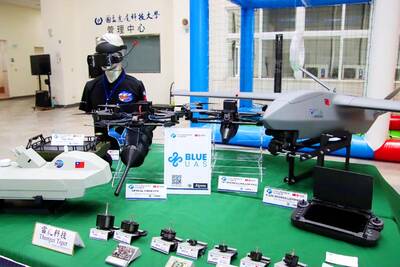
NON-RED SUPPLY: Boosting the nation’s drone industry is becoming increasingly urgent as China’s UAV dominance could become an issue in a crisis, an analyst said Taiwan’s drone exports to Europe grew 41.7-fold from 2024 to last year, with demand from Ukraine’s fight against Russian aggression the most likely driver of growth, a study showed. The Institute for Democracy, Society and Emerging Technology (DSET) in a statement on Wednesday said it found that many of Taiwan’s uncrewed aerial vehicle (UAV) sales were from Poland and the Czech Republic. These countries likely transferred the drones to Ukraine to aid it in its fight against the Russian invasion that started in 2022, it said. Despite the gains, Taiwan is not the dominant drone exporter to these markets, ranking second and fourth

The eastern extension of the Taipei MRT Red Line could begin operations as early as late June, the Taipei Department of Rapid Transit Systems said yesterday. Taipei Rapid Transit Corp said it is considering offering one month of free rides on the new section to mark its opening. Construction progress on the 1.4km extension, which is to run from the current terminal Xiangshan Station to a new eastern terminal, Guangci/Fengtian Temple Station, was 90.6 percent complete by the end of last month, the department said in a report to the Taipei City Council's Transportation Committee. While construction began in October 2016 with an


 RSS
RSS