


Web searches for “hand washing” was correlated with lower confirmed COVID-19 cases in 21 nations, a National Health Research Institutes (NHRI) analysis of Google’s search data showed, the authors of a study said on Friday.
Searches for the keyword pair in Taiwan and the nation’s successful disease-prevention efforts support the findings, the researchers said.
Lin Yu-hsuan (林煜軒), an assistant investigator in the NHRI’s Institute of Popular Health Sciences, headed the research, which was published in the journal Brain, Behavior and Immunity.
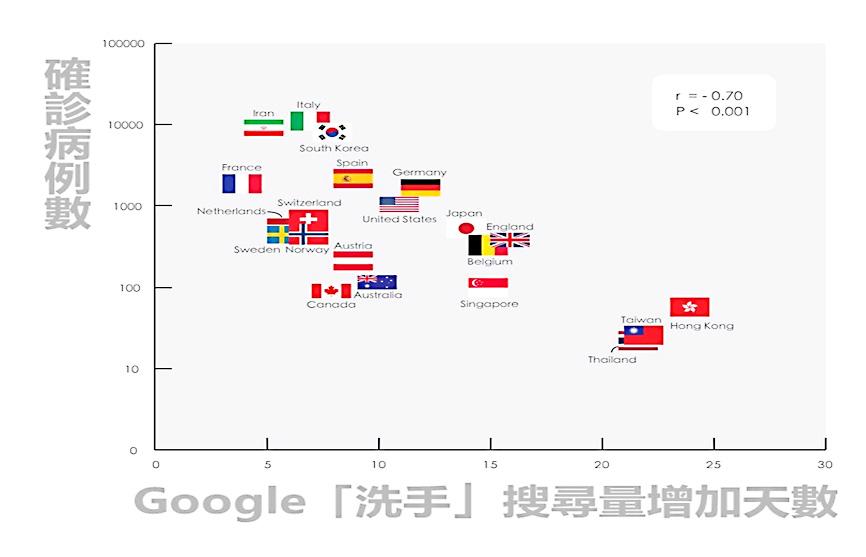
Photo copied by Cheng Ming-hsiang, Taipei Times
Three weeks after days on which the data showed a spike in searches for “hand washing,” there were fewer confirmed cases, Lin said.
Taiwan, Hong Kong and Thailand had higher frequencies of such searches, with all three subsequently showing lower numbers of confirmed cases, he said, adding that Iran, Italy and South Korea showed the opposite result after fewer searches.
The high number of searches in Taiwan shows that the NHRI’s efforts to relay pandemic information were working and Taiwanese were following up on it, Lin said.
Taiwan’s success should be credited to the government and the public, he said.
In related news, Taichung Tzu Chi Hospital Department of Pediatrics doctor Yu Meng-kung (余孟恭) on Friday said that people should wash their hands with soap and water rather than isopropyl alcohol.
Medical personnel complain of dermatitis because alcohol dissolves sebum secretions on the hands, Yu said.
While the best way to prevent dermatitis would be to avoid sanitizers, they are an occupational hazard that medical workers must face, he said.
However, outside of healthcare situations, people should wash their hands with soap and water, and dry them completely before going back to work, he said, adding that appropriate use of lotions to keep the skin moist would further protect the hands.
If people have redness, puffiness or itching of the hands, they should visit a doctor immediately, he said.
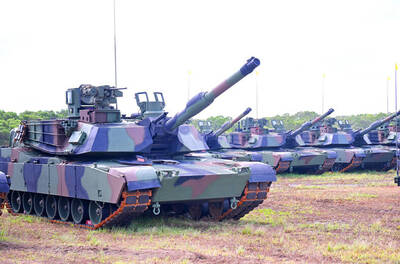
The manufacture of the remaining 28 M1A2T Abrams tanks Taiwan purchased from the US has recently been completed, and they are expected to be delivered within the next one to two months, a source said yesterday. The Ministry of National Defense is arranging cargo ships to transport the tanks to Taiwan as soon as possible, said the source, who is familiar with the matter. The estimated arrival time ranges from late this month to early next month, the source said. The 28 Abrams tanks make up the third and final batch of a total of 108 tanks, valued at about NT$40.5 billion

Two Taiwanese prosecutors were questioned by Chinese security personnel at their hotel during a trip to China’s Henan Province this month, the Mainland Affairs Council (MAC) said yesterday. The officers had personal information on the prosecutors, including “when they were assigned to their posts, their work locations and job titles,” MAC Deputy Minister and spokesman Liang Wen-chieh (梁文傑) said. On top of asking about their agencies and positions, the officers also questioned the prosecutors about the Cross-Strait Joint Crime-Fighting and Judicial Mutual Assistance Agreement, a pact that serves as the framework for Taiwan-China cooperation on combating crime and providing judicial assistance, Liang
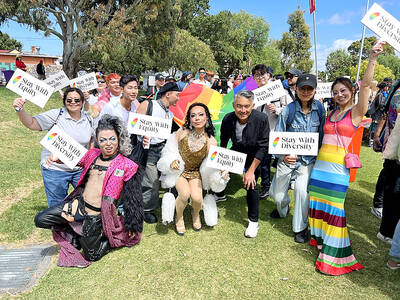
A group from the Taiwanese Designers in Australia association yesterday represented Taiwan at the Midsumma Pride March in Melbourne. The march, held in the St. Kilda suburb, is the city’s largest LGBTQIA+ parade and the flagship event of the annual Midsumma Festival. It attracted more than 45,000 spectators who supported the 400 groups and 10,000 marchers that participated this year, the association said. Taiwanese Designers said they organized a team to march for Taiwan this year, joining politicians, government agencies, professionals and community organizations in showing support for LGBTQIA+ people and diverse communities. As the first country in Asia to legalize same-sex
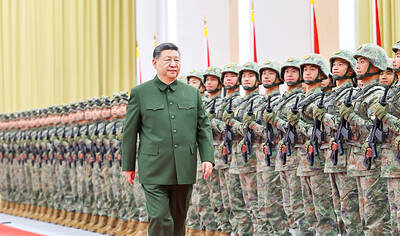
MOTIVES QUESTIONED The PLA considers Xi’s policies toward Taiwan to be driven by personal considerations rather than military assessment, the Epoch Times reports Chinese President Xi Jinping’s (習近平) latest purge of the Chinese People’s Liberation Army (PLA) leadership might have been prompted by the military’s opposition to plans of invading Taiwan, the Epoch Times said. The Chinese military opposes waging war against Taiwan by a large consensus, putting it at odds with Xi’s vision, the Falun Gong-affiliated daily said in a report on Thursday, citing anonymous sources with insight into the PLA’s inner workings. The opposition is not the opinion of a few generals, but a widely shared view among the PLA cadre, the Epoch Times cited them as saying. “Chinese forces know full well that


 RSS
RSS