


The Ministry of National Defense yesterday said that it would form a special committee to investigate a cluster of COVID-19 cases among navy personnel who returned from a goodwill mission in the Pacific.
The Central Epidemic Command Center (CECC) on Saturday reported three new COVID-19 cases, who were all naval cadets on board three vessels making up a “Friendship Flotilla.”
The CECC yesterday reported 22 new COVID-19 cases, 21 of which involved people who traveled on the flotilla and disembarked at Zuoying Naval Base in Kaohsiung on Wednesday.
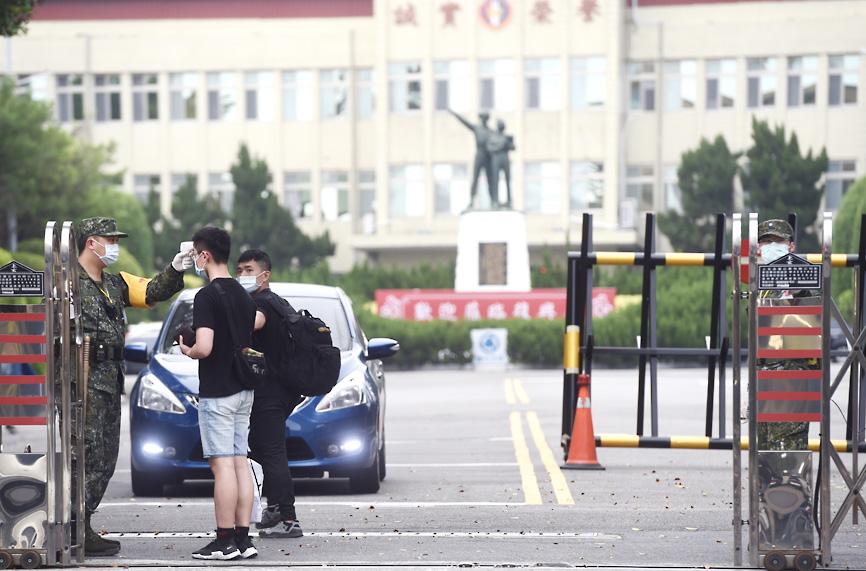
Photo: Chieh Jung-fong, Taipei Times
The flotilla visited Palau from March 12 to 15 and returned to the Port of Kaohsiung on April 9.
As cadets from the military’s political warfare academy — the National Defense University’s Fu Hsing Kang College in Taipei — were traveling with the fleet, the school would be thoroughly disinfected and classes would be suspended for two weeks, a military official, who declined to be named, said yesterday.
Kaohsiung’s Department of Health and Environmental Protection Bureau said that they have disinfected areas close to the naval base, especially bus stops and train stations.
Meanwhile, President Tsai Ing-wen (蔡英文) issued a three-point statement in response to the incident, Presidential Office spokesman Xavier Chang (張惇涵) said.
First, disease prevention is a battle, and the military — which shoulders the responsibility of protecting the nation and its people — should have exercised the highest caution, Tsai said in the statement.
Besides being held accountable and apologizing to society, the military must learn from the experience and reflect deeply on disease-prevention management, she said.
Second, the military should cooperate fully with the CECC, while the ministry’s committee should leave no stone unturned in the investigation, which concerns the nation’s control of the pandemic, as well as society’s trust in the military, she added.
Third, all military personnel involved must adhere strictly to the CECC’s directives, such as quarantine and health management, she said, calling on the military and the healthcare system to spare no effort in taking care of those infected.
Separately, Chinese Nationalist Party (KMT) Chairman Johnny Chiang (江啟臣) said the infections are a national security problem.
Given the lessons of similar outbreaks in the US and French navies and on the Diamond Princess cruise ship, the Ministry of National Defense’s attitude was “too relaxed,” he said.
The military should have known from these incidents that an outbreak on a ship was possible and the potential impact, he said.
The military’s image would be severely damaged if poor management leads to a community outbreak, he said, adding that the navy should clarify whether it intentionally concealed the cases.
Additional reporting by Aaron Tu, Lin Liang-sheng and Fang Chih-hsien

Considering that most countries issue more than five denominations of banknotes, the central bank has decided to redesign all five denominations, the bank said as it prepares for the first major overhaul of the banknotes in more than 24 years. Central bank Governor Yang Chin-lung (楊金龍) is expected to report to the Legislative Yuan today on the bank’s operations and the redesign’s progress. The bank in a report sent to the legislature ahead of today’s meeting said it had commissioned a survey on the public’s preferences. Survey results showed that NT$100 and NT$1,000 banknotes are the most commonly used, while NT$200 and NT$2,000

The Centers for Disease Control (CDC) yesterday reported the first case of a new COVID-19 subvariant — BA.3.2 — in a 10-year-old Singaporean girl who had a fever upon arrival in Taiwan and tested positive for the disease. The girl left Taiwan on March 20 and the case did not have a direct impact on the local community, it said. The WHO added the BA.3.2 strain to its list of Variants Under Monitoring in December last year, but this was the first imported case of the COVID-19 variant in Taiwan, CDC Deputy Director-General Lin Ming-cheng (林明誠) said. The girl arrived in Taiwan on

South Korea is planning to revise its controversial electronic arrival card, a step Taiwanese officials said prompted them to hold off on planned retaliatory measures, a South Korean media report said yesterday. A Yonhap News Agency report said that the South Korean Ministry of Foreign Affairs is planning to remove the “previous departure place” and “next destination” fields from its e-arrival card system. The plan, reached after interagency consultations, is under review and aims to simplify entry procedures and align the electronic form with the paper version, a South Korean ministry official said. The fields — which appeared only on the electronic form

The Ministry of Foreign Affairs (MOFA) is suspending retaliation measures against South Korea that were set to take effect tomorrow, after Seoul said it is updating its e-arrival system, MOFA said today. The measures were to be a new round of retaliation after Taiwan on March 1 changed South Korea's designation on government-issued alien resident certificates held by South Korean nationals to "South Korea” from the "Republic of Korea," the country’s official name. The move came after months of protests to Seoul over its listing of Taiwan as "China (Taiwan)" in dropdown menus on its new online immigration entry system. MOFA last week


 RSS
RSS