


Several overseas Taiwanese groups on Wednesday called for changing the English-language title on the nation’s passport to “Taiwan,” while World United Formosans for Independence (WUFI) in Taiwan urged the government to promote the name change at a time when the nation is drawing unprecedented attention worldwide for its efforts to contain the COVID-19 pandemic.
In a joint statement titled “Let Taiwan Passport Be Taiwan,” 46 Taiwanese organizations in North and South America, Europe, Asia and Oceania said they are all familiar with stories of confusion at foreign immigration desks when Taiwanese present a passport that says “Republic of China” on the cover.
Although the word “Taiwan” also appears on the passport cover, foreign immigration authorities often mistake it for a Chinese passport, the groups said.
A constitutional amendment to change Taiwan’s official name — the Republic of China (ROC) — might not be possible in the near term, while but there is broad public support for the use of the English designation “Taiwan,” the organizations said, citing a poll that showed 74.3 percent of Taiwanese support that name.
Ken Wu (吳兆峯), director of the Los Angeles branch of the Formosan Association for Public Affairs, said that he had met many people who did not know “the difference between the ROC and the PRC [People’s Republic of China]” in his work in the financial field.
In some cases, Taiwanese clients are misidentified as Chinese, which can have significant legal repercussions, said Wu, whose organization is among those that signed the statement.
He said that while a name change on passports was unlikely, the government should make an effort, particularly in light of the ruling Democratic Progressive Party’s (DPP) long-term goal of promoting the use of the name “Taiwan” internationally.
The “Let Taiwan Passport Be Taiwan” statement followed an online petition launched by an overseas Taiwanese group to change the name of Taiwan’s flagship carrier, China Airlines (CAL), to “Taiwan Airlines.”
Premier Su Tseng-chang (蘇貞昌) on Tuesday expressed support for changing CAL’s name, but said it might not be easy as it could affect the nation’s freedoms of the air privileges.
CAL could use “more symbols of Taiwan” to prevent misconceptions about its origin, Su said.
President Tsai Ing-wen (蔡英文) yesterday endorsed Su’s stance, saying the government would increase the recognizability of things representing Taiwan and that members of the public have shown their creativity in suggesting potential alternatives.
Meanwhile, WUFI urged the Tsai administration to make more progress in promoting the nation’s name change at this critical juncture.
Taiwan has received unprecedented attention from other countries because of its effective response to contain COVID-19, which is a good opportunity for Taiwan to assert its sovereignty and rights to join international organizations, it said in a news release yesterday.
It would not push Tsai to complete the name change process immediately, but Tsai should show her committment to the nearly 8.17 million people who voted for her in the Jan. 11 presidential election, it said.

SECURITY: Starlink owner Elon Musk has taken pro-Beijing positions, and allowing pro-China companies to control Taiwan’s critical infrastructure is risky, a legislator said Starlink was reluctant to offer services in Taiwan because of the nation’s extremely high penetration rates in 4G and 5G services, the Ministry of Digital Affairs said yesterday. The ministry made the comments at a meeting of the legislature’s Transportation Committee, which reviewed amendments to Article 36 of the Telecommunications Management Act (電信管理法). Article 36 bans foreigners from holding more than 49 percent of shares in public telecommunications networks, while shares foreigners directly and indirectly hold are also capped at 60 percent of the total, unless specified otherwise by law. The amendments, sponsored by Chinese Nationalist Party (KMT) Legislator Ko

The military has spotted two Chinese warships operating in waters near Penghu County in the Taiwan Strait and sent its own naval and air forces to monitor the vessels, the Ministry of National Defense (MND) said. Beijing sends warships and warplanes into the waters and skies around Taiwan on an almost daily basis, drawing condemnation from Taipei. While the ministry offers daily updates on the locations of Chinese military aircraft, it only rarely gives details of where Chinese warships are operating, generally only when it detects aircraft carriers, as happened last week. A Chinese destroyer and a frigate entered waters to the southwest

The eastern extension of the Taipei MRT Red Line could begin operations as early as late June, the Taipei Department of Rapid Transit Systems said yesterday. Taipei Rapid Transit Corp said it is considering offering one month of free rides on the new section to mark its opening. Construction progress on the 1.4km extension, which is to run from the current terminal Xiangshan Station to a new eastern terminal, Guangci/Fengtian Temple Station, was 90.6 percent complete by the end of last month, the department said in a report to the Taipei City Council's Transportation Committee. While construction began in October 2016 with an
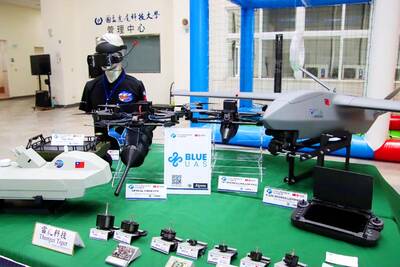
NON-RED SUPPLY: Boosting the nation’s drone industry is becoming increasingly urgent as China’s UAV dominance could become an issue in a crisis, an analyst said Taiwan’s drone exports to Europe grew 41.7-fold from 2024 to last year, with demand from Ukraine’s fight against Russian aggression the most likely driver of growth, a study showed. The Institute for Democracy, Society and Emerging Technology (DSET) in a statement on Wednesday said it found that many of Taiwan’s uncrewed aerial vehicle (UAV) sales were from Poland and the Czech Republic. These countries likely transferred the drones to Ukraine to aid it in its fight against the Russian invasion that started in 2022, it said. Despite the gains, Taiwan is not the dominant drone exporter to these markets, ranking second and fourth


 RSS
RSS