


Premier Su Tseng-chang (蘇貞昌) yesterday approved a bill, which, if passed, would transform the nation’s 17 irrigation associations into government agencies and give them authority to punish polluters of irrigation water.
The bill was drafted in compliance with an amendment to the Act of Irrigation Association Organization (農田水利會組織通則) that stipulated a new law be introduced to convert the associations into agencies, and govern their assets and staff, Council of Agriculture (COA) Department of Irrigation and Engineering Director-General Hsieh Sheng-hsin (謝勝信) told a news conference at the Executive Yuan in Taipei.
The associations oversee about 60 percent of the nation’s water resources, but do not have authority over polluters, Hsieh said.
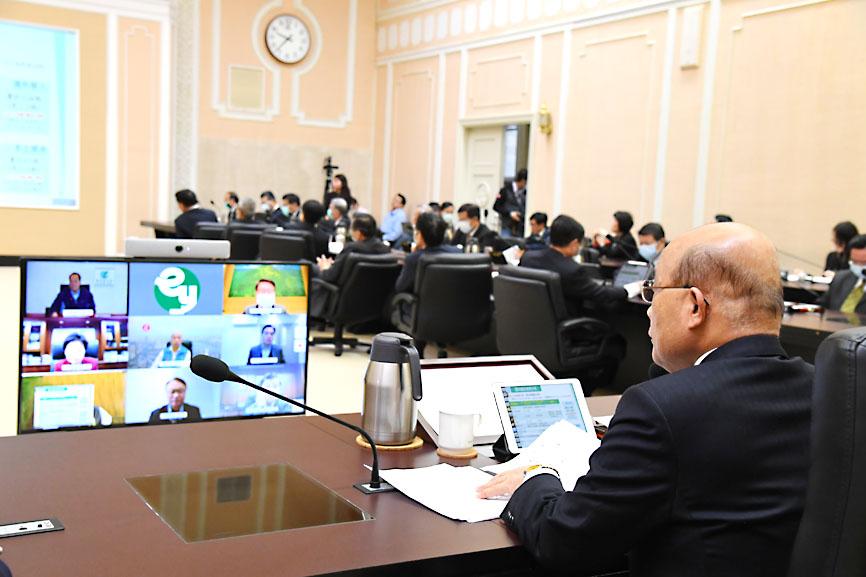
Photo courtesy of the Executive Yuan
Other than shutting factories down, there are no penalties for offenders whose effluent contaminates irrigation water, he said.
Under the bill, only registered businesses that discharge effluent into irrigation water would be punished, with fines from NT$30,000 to NT$600,000.
About 2,300 employees at the 17 associations would be transferred to 17 corresponding agencies, which are to be created by the COA, Hsieh said.
The employees would enjoy benefits equivalent to those for civil servants under separate regulations to be introduced by the council, the draft says.
Should the transition from private entities to public entail the expropriation of land — for example in cases where an association’s premises encroach on private property — the government would pay for the properties, Hsieh said.
Land belonging to an association that has been idle due to outdated irrigation canals would be auctioned, with the income transferred to funds governed by each association to cover their operations, he said.
Asked how the council plans to persuade Chinese Nationalist Party (KMT) lawmakers to back the bill, COA Deputy Minister Chen Tien-shou (陳添壽) said that it would communicate with the KMT caucus to hopefully meet the Oct. 1 deadline to complete the move.
The KMT has been vocal in its opposition to the transition, saying that it is a “pork barrel” policy by the DPP.


An essay competition jointly organized by a local writing society and a publisher affiliated with the Chinese Communist Party (CCP) might have contravened the Act Governing Relations Between the People of the Taiwan Area and the Mainland Area (臺灣地區與大陸地區人民關係條例), the Mainland Affairs Council (MAC) said on Thursday. “In this case, the partner organization is clearly an agency under the CCP’s Fujian Provincial Committee,” MAC Deputy Minister and spokesperson Liang Wen-chieh (梁文傑) said at a news briefing in Taipei. “It also involves bringing Taiwanese students to China with all-expenses-paid arrangements to attend award ceremonies and camps,” Liang said. Those two “characteristics” are typically sufficient
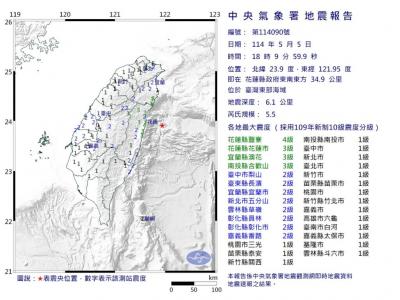
A magnitude 5.9 earthquake that struck about 33km off the coast of Hualien City was the "main shock" in a series of quakes in the area, with aftershocks expected over the next three days, the Central Weather Administration (CWA) said yesterday. Prior to the magnitude 5.9 quake shaking most of Taiwan at 6:53pm yesterday, six other earthquakes stronger than a magnitude of 4, starting with a magnitude 5.5 quake at 6:09pm, occurred in the area. CWA Seismological Center Director Wu Chien-fu (吳健富) confirmed that the quakes were all part of the same series and that the magnitude 5.5 temblor was

The brilliant blue waters, thick foliage and bucolic atmosphere on this seemingly idyllic archipelago deep in the Pacific Ocean belie the key role it now plays in a titanic geopolitical struggle. Palau is again on the front line as China, and the US and its allies prepare their forces in an intensifying contest for control over the Asia-Pacific region. The democratic nation of just 17,000 people hosts US-controlled airstrips and soon-to-be-completed radar installations that the US military describes as “critical” to monitoring vast swathes of water and airspace. It is also a key piece of the second island chain, a string of
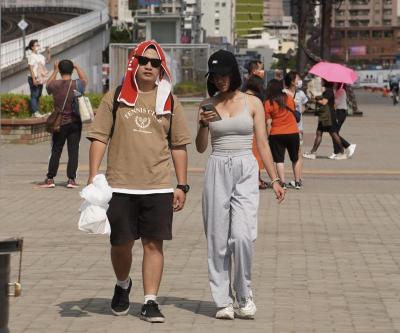
The Central Weather Administration has issued a heat alert for southeastern Taiwan, warning of temperatures as high as 36°C today, while alerting some coastal areas of strong winds later in the day. Kaohsiung’s Neimen District (內門) and Pingtung County’s Neipu Township (內埔) are under an orange heat alert, which warns of temperatures as high as 36°C for three consecutive days, the CWA said, citing southwest winds. The heat would also extend to Tainan’s Nansi (楠西) and Yujing (玉井) districts, as well as Pingtung’s Gaoshu (高樹), Yanpu (鹽埔) and Majia (瑪家) townships, it said, forecasting highs of up to 36°C in those areas


 RSS
RSS