


The Central Epidemic Command Center (CECC) yesterday announced 10 new COVID-19 cases — eight imported and two locally transmitted — bringing the nation’s tally of confirmed cases to 339.
The imported cases involved six men and two women, all Taiwanese, who had traveled to Austria, Canada, the Czech Republic, Denmark, Indonesia, countries in Latin America, the UK or the US before arriving back in Taiwan between March 6 and Tuesday, center data showed.
Among them, patient No. 338 was part of a tour group that traveled to Austria and the Czech Republic, and has resulted in an infection cluster of five cases, including the group’s guide, a man in his 40s who passed away on Sunday, the center said.
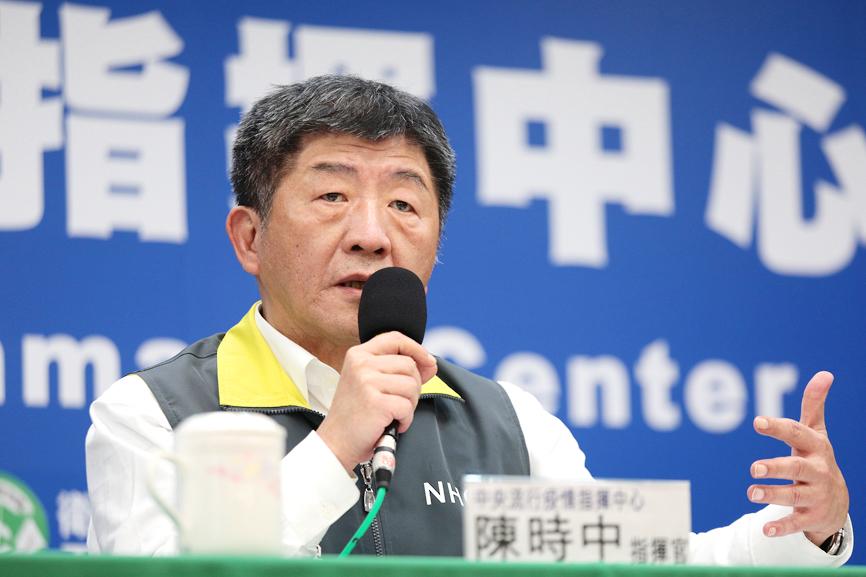
Photo provided by the Central Epidemic Command Center via CNA
The two locally transmitted cases, a man and a woman, are in their 50s, it said.
Neither had traveled abroad recently, but the man had contact with a previously confirmed case, it said, adding that the source of the woman’s infection remains unclear.
The woman worked as a security guard at an apartment complex and the center is tracing her contact history there, said Minister of Health and Welfare Chen Shih-chung (陳時中), who heads the center.
Asked if people would be blocked from having contact with the complex, Chen said that the center has asked the building managers to inform residents that they should avoid contact with outside people.
The process of disinfecting the complex was begun yesterday morning, he added.
Asked for the complex’s location, Centers for Disease Control Deputy Director-General Chuang Jen-hsiang (莊人祥) said that it is in northern Taiwan.
As of yesterday, the nation had five coronavirus-related deaths, while 50 people had been discharged from quarantine facilities, center data showed.
The center began yesterday — “in principle” — to ban people from visiting patients in hospitals, except for in emergencies, Chen said, adding that hospitals across the nation have been informed.
In addition, as of today, all inbound passengers who have developed suspicious symptoms in the 14 days prior to arriving are to be transported to a government-designated quarantine facility by the taxi service for quarantined travelers, said Deputy Minister of the Interior Chen Tsung-yen (陳宗彥), deputy head of the center.
As often as possible, people would be taken to the facility nearest the airport they arrived at: Taiwan Taoyuan International Airport, Taipei International Airport (Songshan airport) or Kaohsiung International Airport, he said.
Inbound travelers would not be charged to stay at a government-designated facility, the center said, adding that those testing positive would be hospitalized, while those testing negative could quarantine themselves at home or quarantine hotels.
By Wednesday, the number of people arriving in Taiwan had fallen to nearly 1,500 — 81 of whom had suspicious symptoms, he added.
India on Wednesday last week implemented a lockdown, but 12 Taiwanese were able to take a Japan Airlines fight to Tokyo, the Ministry of Foreign Affairs said.
Some were able to return to Taiwan yesterday, while the others would arrive later, the ministry said, expressing its thanks to agencies in India and Japan for their assistance.


South Korea is planning to revise its controversial electronic arrival card, a step Taiwanese officials said prompted them to hold off on planned retaliatory measures, a South Korean media report said yesterday. A Yonhap News Agency report said that the South Korean Ministry of Foreign Affairs is planning to remove the “previous departure place” and “next destination” fields from its e-arrival card system. The plan, reached after interagency consultations, is under review and aims to simplify entry procedures and align the electronic form with the paper version, a South Korean ministry official said. The fields — which appeared only on the electronic form
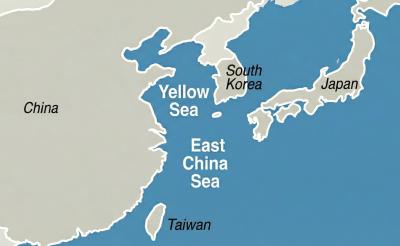
China has reserved offshore airspace in the Yellow Sea and East China Sea from March 27 to May 6, issuing alerts usually used to warn of military exercises, although no such exercises have been announced, the Wall Street Journal (WSJ) reported yesterday. Reserving such a large area for 40 days without explanation is an “unusual step,” as military exercises normally only last a few days, the paper said. These alerts, known as Notice to Air Missions (Notams), “are intended to inform pilots and aviation authorities of temporary airspace hazards or restrictions,” the article said. The airspace reserved in the alert is

A bipartisan group of US senators has introduced a bill to enhance cooperation with Taiwan on drone development and to reduce reliance on supply chains linked to China. The proposed Blue Skies for Taiwan Act of 2026 was introduced by Republican US senators Ted Cruz and John Curtis, and Democratic US senators Jeff Merkley and Andy Kim. The legislation seeks to ease constraints on Taiwan-US cooperation in uncrewed aerial systems (UAS), including dependence on China-sourced components, limited access to capital and regulatory barriers under US export controls, a news release issued by Cruz on Wednesday said. The bill would establish a "Blue UAS
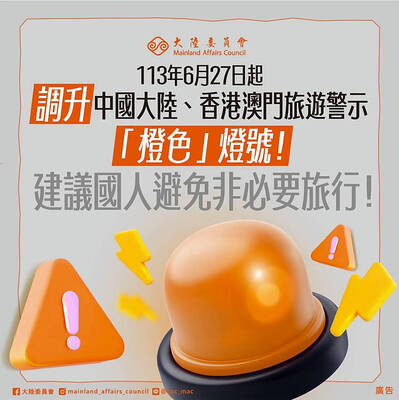
More than 6,000 Taiwanese students have participated in exchange programs in China over the past two years, despite the Mainland Affairs Council’s (MAC) “orange light” travel advisory, government records showed. The MAC’s publicly available registry showed that Taiwanese college and university students who went on exchange programs across the Strait numbered 3,592 and 2,966 people respectively. The National Immigration Agency data revealed that 2,296 and 2,551 Chinese students visited Taiwan for study in the same two years. A review of the Web sites of publicly-run universities and colleges showed that Taiwanese higher education institutions continued to recruit students for Chinese educational programs without


 RSS
RSS