


Senior judges yesterday met to discuss the constitutionality of a law that makes adultery a criminal offense, before being ordered by Judicial Yuan President Hsu Tzong-li (許宗力) to set a date for a constitutional interpretation within the next month.
The judges met to discuss Article 239 of the Criminal Code on offenses against marriage and family, after 18 judges had called for a constitutional interpretation of the issue.
Taipei District Court Judge Lin Meng-huang (林孟皇) said that while he had previously tried adultery cases and never questioned the law, his feelings changed when trying a case last year involving baseball star Wang Chuan-jia (王傳家).
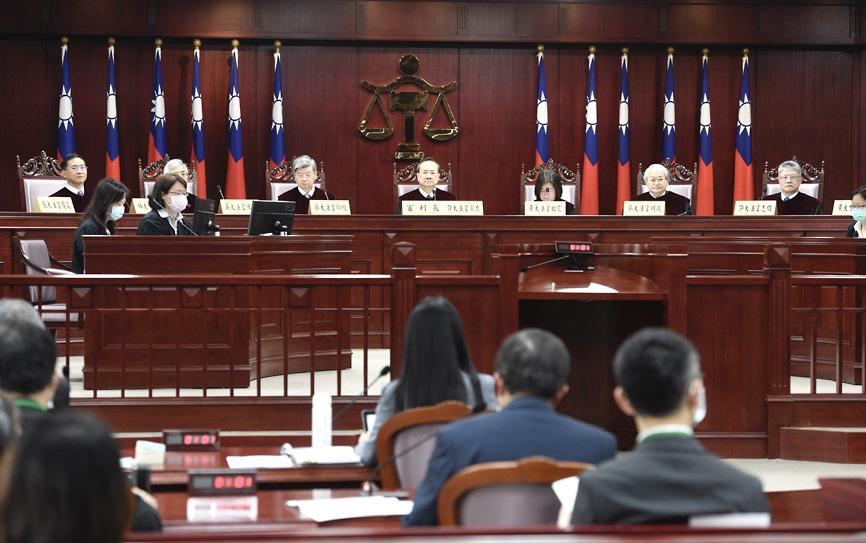
Photo: George Tsorng, Taipei Times
During that case evidence was presented showing Wang naked in bed with a female fan surnamed Tu (杜), which later became public, and Lin felt this was a violation of Wang’s personal privacy, he said.
In the case in March last year, Lin ruled that the video evidence presented to the court was insufficient for there to be a prosecution as it did not show penetration. Wang and Tu were found not guilty.
Laws should evolve along with the progress of time, and although most Taiwanese support the law on adultery, such a law erodes personal freedoms guaranteed by the Constitution, Lin said.
“Decriminalizing adultery does not mean encouraging people to have affairs, but you cannot deal with the pain and suffering caused by adultery by using the criminal justice system,” he said. “You must find another way of dealing with those emotions.”
To use the Criminal Code to punish what equates to “immoral behavior” limits a person’s sexual autonomy and personal privacy, and runs contrary to the Constitution, he added.
The justice system should not get involved in people’s intimate relations, Lin said, adding that the happiness of a marriage depends on the conduct of those involved.
Deputy Minister of Justice Tsai Pi-chung (蔡碧仲), who opposes the decriminalization of adultery, said that since marriage is entered into freely, the courts have a duty to protect the institutions of marriage and the family.
With 70 to 80 percent of the public opposed to the decriminalization of adultery, the Council of Grand Justices’ decision on the matter should respect public opinion, he said.
High Court Judge Pong Shing-ming (彭幸鳴) said that times have changed and more people recognize an individual’s sexual autonomy.
There are already sufficient laws to protect the interests of married couples and adultery should be decriminalized, Pong said.
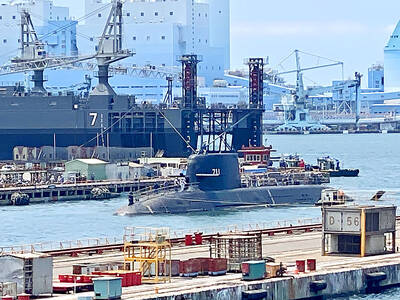
AGING: While Japan has 22 submarines, Taiwan only operates four, two of which were commissioned by the US in 1945 and 1946, and transferred to Taiwan in 1973 Taiwan would need at least 12 submarines to reach modern fleet capabilities, CSBC Corp, Taiwan chairman Chen Cheng-hung (陳政宏) said in an interview broadcast on Friday, citing a US assessment. CSBC is testing the nation’s first indigenous defense submarine, the Hai Kun (海鯤, Narwhal), which is scheduled to be delivered to the navy next month or in July. The Hai Kun has completed torpedo-firing tests and is scheduled to undergo overnight sea trials, Chen said on an SET TV military affairs program. Taiwan would require at least 12 submarines to establish a modern submarine force after assessing the nation’s operational environment and defense

Yangmingshan National Park authorities yesterday urged visitors to respect public spaces and obey the law after a couple was caught on a camera livestream having sex at the park’s Qingtiangang (擎天崗) earlier in the day. The Shilin Police Precinct in Taipei said it has identified a suspect and his vehicle registration number, and would summon him for questioning. The case would be handled in accordance with public indecency charges, it added. The couple entered the park at about 11pm on Thursday and began fooling around by 1am yesterday, the police said, adding that the two were unaware of the park’s all-day live
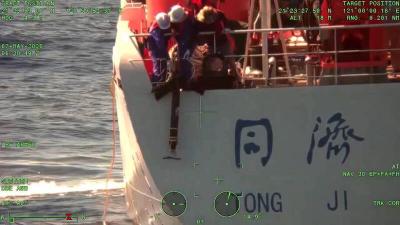
The coast guard today said that it had disrupted "illegal" operations by a Chinese research ship in waters close to the nation and driven it away, part of what Taipei sees a provocative pattern of China's stepped up maritime activities. The coast guard said that it on Thursday last week detected the Chinese ship Tongji (同濟號), which was commissioned only last year, 29 nautical miles (54km) southeast of the southern tip of Taiwan, although just outside restricted waters. The ship was observed lowering ropes into the water, suspected to be the deployment of scientific instruments for "illegal" survey operations, and the coast

A former soldier and an active-duty army officer were yesterday indicted for allegedly selling classified military training materials to a Chinese intelligence operative for a total of NT$79,440. The Taipei District Prosecutors’ Office indicted Chen Tai-yin (陳泰尹) and Lee Chun-ta (李俊達) for contravening the National Security Act (國家安全法) and the Anti-Corruption Act (貪污治罪條例). Chen left the military in September 2013 after serving alongside then-staff sergeant Lee, now an army lieutenant, at the 21st Artillery Command of the army’s Sixth Corps from 2011 to 2013, according to the indictment. Chen met a Chinese intelligence operative identified as “Wang” (王) through a friend in November


 RSS
RSS