


China Airlines (CAL) must explain how two of its cargo plane pilots contracted COVID-19 when the airline has enforced disease-prevention measures designed to contain the pandemic, the Ministry of Transportation and Communications said yesterday.
The two pilots should have followed standard procedures to avoid contracting the coronavirus, Deputy Minister of Transportation and Communications Wang Kwo-tsai (王國材) said in an interview on the sidelines of a meeting of the legislature’s Transportation Committee.
“They needed to enter and exit the airport through a designated passageway and were not allowed to go out after arriving at their hotel,” Wang said. “They were supposed to follow the same procedures when they returned to the country. We have asked the airline to investigate what they actually did when they were overseas and it should promptly fix any loophole it might have.”
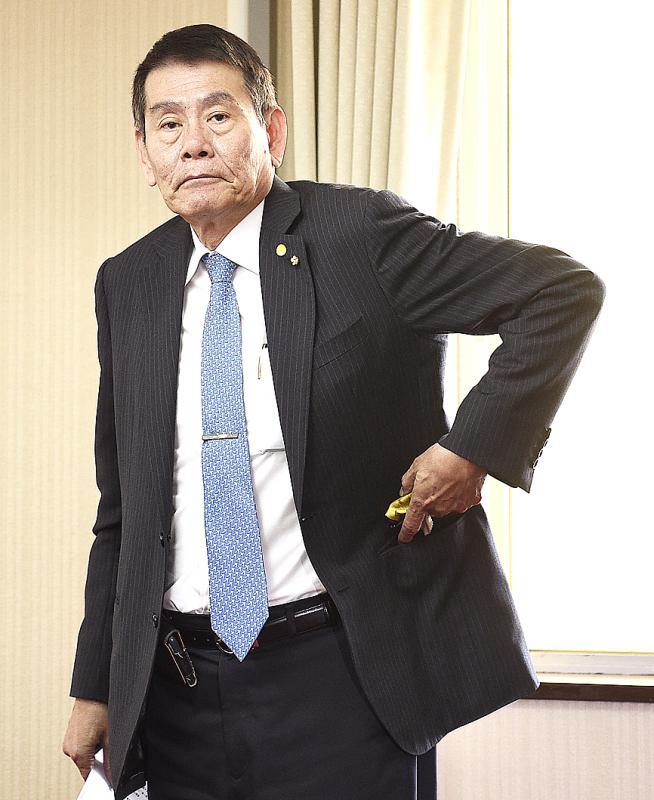
Photo: Chen Chih-chu, Taipei Times
The airline did not deliberately hide the information from the public, CAL chairman Hsieh Shih-chien (謝世謙), who also attended the meeting, told reporters, adding that such accusations were made by “shoddy news outlets.”
“Companies that have employees with confirmed COVID-19 infections are supposed to follow directives from the Central Epidemic Command Center [CECC],” Hsieh said. “There was absolutely nothing we could have done about it.”
The airline has already implemented many measures — also under the center’s supervision — to keep cabin crew from contracting the coronavirus, he added.
All flight attendants need to follow the center’s requirements, whether they are returning from a country with a level 3 “warning” travel advisory or are standing by at overseas travel destinations, Hsieh said, adding that flight attendants’ movements are restricted.
Pilots and flight attendants are afraid of contracting the virus, but it would be a great loss to the nation’s economy if cargo flights stopped, he said.
Rather than focusing on loopholes and whether the pilots have contracted the virus, the public should sympathize with them and give them encouragement, he said.
“What we can do is improve our operations, which is our way of protecting our employees,” Hsieh said.
Asked if CAL is prepared to dispatch another charter flight to evacuate Taiwanese from Wuhan, China, Wang said that the airline is always standing by, but that the CECC must make the call.
In an open letter, EVA Airways asked its flight attendants to self-quarantine at home from today until Sunday after it learned that some attendants became infected.
In other developments, the ministry is considering offering a NT$500 coupon to people who had to cancel an overseas package tour because of the pandemic, Wang said, adding that the coupons, which the government would need to allocate about NT$1 billion to fund, could be used for domestic travel.
Rules governing the distribution of the coupons are to be determined after the ministry consults with the Ministry of Economic Affairs, he said, adding that it has not decided whether the program should be part of a bailout package or stimulus package for businesses affected by the pandemic.
The transport ministry plans for the coupons to be used to cover expenses during domestic tours, such as accommodation costs, Wang said.

Considering that most countries issue more than five denominations of banknotes, the central bank has decided to redesign all five denominations, the bank said as it prepares for the first major overhaul of the banknotes in more than 24 years. Central bank Governor Yang Chin-lung (楊金龍) is expected to report to the Legislative Yuan today on the bank’s operations and the redesign’s progress. The bank in a report sent to the legislature ahead of today’s meeting said it had commissioned a survey on the public’s preferences. Survey results showed that NT$100 and NT$1,000 banknotes are the most commonly used, while NT$200 and NT$2,000

The Centers for Disease Control (CDC) yesterday reported the first case of a new COVID-19 subvariant — BA.3.2 — in a 10-year-old Singaporean girl who had a fever upon arrival in Taiwan and tested positive for the disease. The girl left Taiwan on March 20 and the case did not have a direct impact on the local community, it said. The WHO added the BA.3.2 strain to its list of Variants Under Monitoring in December last year, but this was the first imported case of the COVID-19 variant in Taiwan, CDC Deputy Director-General Lin Ming-cheng (林明誠) said. The girl arrived in Taiwan on

South Korea is planning to revise its controversial electronic arrival card, a step Taiwanese officials said prompted them to hold off on planned retaliatory measures, a South Korean media report said yesterday. A Yonhap News Agency report said that the South Korean Ministry of Foreign Affairs is planning to remove the “previous departure place” and “next destination” fields from its e-arrival card system. The plan, reached after interagency consultations, is under review and aims to simplify entry procedures and align the electronic form with the paper version, a South Korean ministry official said. The fields — which appeared only on the electronic form

The Ministry of Foreign Affairs (MOFA) is suspending retaliation measures against South Korea that were set to take effect tomorrow, after Seoul said it is updating its e-arrival system, MOFA said today. The measures were to be a new round of retaliation after Taiwan on March 1 changed South Korea's designation on government-issued alien resident certificates held by South Korean nationals to "South Korea” from the "Republic of Korea," the country’s official name. The move came after months of protests to Seoul over its listing of Taiwan as "China (Taiwan)" in dropdown menus on its new online immigration entry system. MOFA last week


 RSS
RSS