


The Criminal Investigation Bureau (CIB) on Tuesday last week detained a man who allegedly cheated Taiwanese out of their passports as part of a China-based human smuggling operation.
Police held the Taoyuan man surnamed Lin (林), 21, for questioning and recovered 20 Republic of China (ROC) passports, said Su Li-tsung (蘇立琮), captain of the 2nd Squadron at the CIB International Criminal Affairs Division.
Lin had prior criminal convictions and was working with a international human-trafficking ring, based in China’s Fujian Province, Su said.

Photo copied by Chiu Chun-fu, Taipei Times
An investigation is ongoing to locate any other Taiwanese affiliated with the ring, he added.
“Taiwanese passports can fetch good prices on the international black market, selling for up to NT$30,000 each, as there are reciprocal arrangements for visa-free entry to the US and European nations, for a total of 112 countries around the world,” Su said.
The “passports are highly coveted by Chinese human smugglers and criminal groups, who can use them to smuggle Chinese from China and Southeast Asia into these countries,” he said.
During questioning, Lin said that he communicated with the Fujian group through WeChat and was given instructions on where to collect the passports, which he would send to an address in Fujian through an air courier.
Lin said he allegedly sent nine air courier parcels in the past few months, each containing two to four passports, for total of 20, and that he received NT$1,500 for each parcel, Su said.
However, Lin said that he did not know the people who gave him the instructions, he added.
CIB investigators launched the investigation after an international courier company alerted them in December last year, as the law prohibits sending passports abroad by mail or courier.
The parcels containing the passports were traced to a temporary storage unit in a warehouse at Taiwan Taoyuan International Airport.
With other Taiwanese suspects, Lin reportedly obtained the passports by defrauding the passport holders, Su said.
The suspects allegedly posted job ads online and asked applicants to hand over their passports, posed as police or judiciary officials to ask people for their passports under the guise of investigating a criminal case, or promoted favorable loans and asked for passports as collateral, he added.
Lin would face fraud charges for contravening legal provisions governing passport use, prosecutors said.
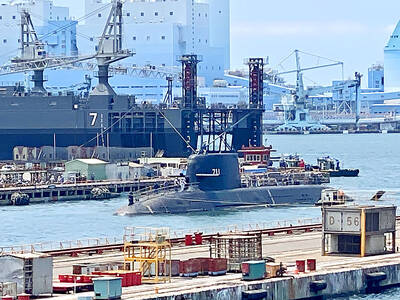
AGING: While Japan has 22 submarines, Taiwan only operates four, two of which were commissioned by the US in 1945 and 1946, and transferred to Taiwan in 1973 Taiwan would need at least 12 submarines to reach modern fleet capabilities, CSBC Corp, Taiwan chairman Chen Cheng-hung (陳政宏) said in an interview broadcast on Friday, citing a US assessment. CSBC is testing the nation’s first indigenous defense submarine, the Hai Kun (海鯤, Narwhal), which is scheduled to be delivered to the navy next month or in July. The Hai Kun has completed torpedo-firing tests and is scheduled to undergo overnight sea trials, Chen said on an SET TV military affairs program. Taiwan would require at least 12 submarines to establish a modern submarine force after assessing the nation’s operational environment and defense

Yangmingshan National Park authorities yesterday urged visitors to respect public spaces and obey the law after a couple was caught on a camera livestream having sex at the park’s Qingtiangang (擎天崗) earlier in the day. The Shilin Police Precinct in Taipei said it has identified a suspect and his vehicle registration number, and would summon him for questioning. The case would be handled in accordance with public indecency charges, it added. The couple entered the park at about 11pm on Thursday and began fooling around by 1am yesterday, the police said, adding that the two were unaware of the park’s all-day live
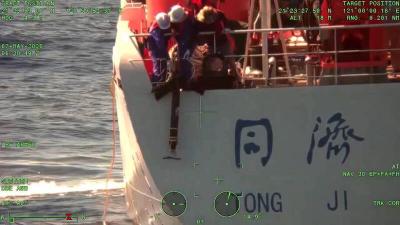
The coast guard today said that it had disrupted "illegal" operations by a Chinese research ship in waters close to the nation and driven it away, part of what Taipei sees a provocative pattern of China's stepped up maritime activities. The coast guard said that it on Thursday last week detected the Chinese ship Tongji (同濟號), which was commissioned only last year, 29 nautical miles (54km) southeast of the southern tip of Taiwan, although just outside restricted waters. The ship was observed lowering ropes into the water, suspected to be the deployment of scientific instruments for "illegal" survey operations, and the coast

A former soldier and an active-duty army officer were yesterday indicted for allegedly selling classified military training materials to a Chinese intelligence operative for a total of NT$79,440. The Taipei District Prosecutors’ Office indicted Chen Tai-yin (陳泰尹) and Lee Chun-ta (李俊達) for contravening the National Security Act (國家安全法) and the Anti-Corruption Act (貪污治罪條例). Chen left the military in September 2013 after serving alongside then-staff sergeant Lee, now an army lieutenant, at the 21st Artillery Command of the army’s Sixth Corps from 2011 to 2013, according to the indictment. Chen met a Chinese intelligence operative identified as “Wang” (王) through a friend in November


 RSS
RSS