


Two charter flights from Wuhan, China, arrived in Taiwan at nearly midnight and early yesterday morning carrying 361 Taiwanese, who were placed in three quarantine centers after being screened for fever and respiratory symptoms, the Central Epidemic Command Center (CECC) said.
Minister of Health and Welfare Chen Shih-chung (陳時中), who heads the center, said that the two flights, operated by China Airlines and China Eastern Airlines, landed in Taiwan at about 11:40pm on Tuesday and at about 4am yesterday morning respectively after delayed departures.
“There were many negotiations between Taiwan and China, but we found that there are still many differences in perception and approach on how the operation should proceed,” Chen said, but added that “both sides were willing to accomplish the mission and overcame some difficulties to make it happen.”
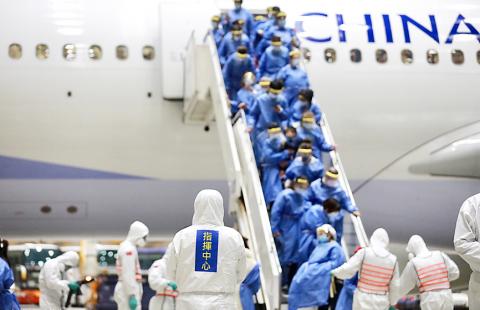
Photo: CNA
The China Airlines flight carried 169 passengers, 10 medical personnel and 12 crew members from Taiwan, while the China Eastern Airlines aircraft carried 192 passengers and three medical personnel from Taiwan, he said.
A total of 22 buses and 10 ambulances were deployed at Taiwan Taoyuan International Airport to ferry the 361 passengers to the quarantine centers for 14-day quarantine or to hospitals if they exhibited symptoms, he added.
The differences between the two sides included Chinese authorities claiming that the passengers did not need to don protective equipment because they had all tested negative for COVID-19 and screened for a fever before boarding, but the Taiwanese government insisted that they should still wear a mask, goggles and protective clothing, Chen said.
“We want to avoid the chances of regretting that we did not do enough, so we would rather take thorough preventive measures when we can,” Chen said.
Some confirmed cases in Taiwan have shown that a person can go from testing negative to positive, so it is better to be careful, he said.
A few people who were on the passenger list did not report to the airport in Wuhan and a few who refused to be screened for symptoms were not allowed to board the aircraft, including a man who had a mild fever, Chen said, adding that the CECC is concerned whether he would receive proper medical treatment in China.
While the CECC did not know why some passengers refused to be screened or did not show up at the airport, Chen said that some might have had mild symptoms and were afraid that they would be forcibly hospitalized in China, increasing their risk of contracting COVID-19.
Following Taipei’s request that vulnerable people receive priority and that proper disease-prevention measures be taken for the flights, Ministry of Health and Welfare Department of Medical Affairs Director-General Shih Chung-liang (石崇良) said that about 20 percent of the passengers were minors, while the oldest was 91 years old.
The passengers who might need medical attention were taken to the quarantine center closest to a hospital, Shih said.
Many quarantine officials, medical personnel and other officials stayed up all night to accomplish the mission, said Chen, who oversaw the operations at the airport and visited all three quarantine centers before holding a news conference at the CECC in Taipei in the morning.
“I am not the only one who is exhausted. Everyone is equally tired, but they are willing to do more for Taiwanese,” he said.
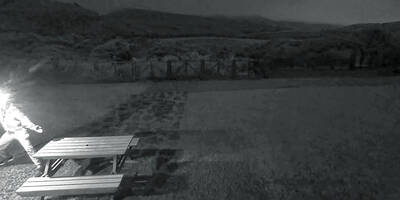
Yangmingshan National Park authorities yesterday urged visitors to respect public spaces and obey the law after a couple was caught on a camera livestream having sex at the park’s Qingtiangang (擎天崗) earlier in the day. The Shilin Police Precinct in Taipei said it has identified a suspect and his vehicle registration number, and would summon him for questioning. The case would be handled in accordance with public indecency charges, it added. The couple entered the park at about 11pm on Thursday and began fooling around by 1am yesterday, the police said, adding that the two were unaware of the park’s all-day live

Fast food chain McDonald's is to raise prices by up to NT$5 on some products at its restaurants across Taiwan, starting on Wednesday next week, the company announced today. The prices of all extra value meals and sharing boxes are to increase by NT$5, while breakfast combos and creamy corn soup would go up by NT$3, the company said in a statement. The price of the main items of those meals, if ordered individually, would remain the same. Meanwhile, the price of a medium-sized lemon iced tea and hot cappuccino would rise by NT$3, extra dipping sauces for chicken nuggets would go up

Yangmingshan National Park’s Qingtiangang (擎天崗) nature area has gone viral after a park livestream camera observed a couple in the throes of intimate congress, which was broadcast live on YouTube, drawing large late-night crowds and sparking a backlash over noise, bright lights and disruption to wildlife habitat. The area’s livestream footage appeared to show a couple engaging in sexual activity on a picnic table in the park on Friday last week, with the uncensored footage streamed publicly online. The footage quickly spread across social media, prompting a tide of visitors to travel to the site to “check in” and recreate the

Minister of Digital Affairs Lin Yi-ching (林宜敬) yesterday cited regulatory issues and national security concerns as an expert said that Taiwan is among the few Asian regions without Starlink. Lin made the remarks on Facebook after funP Innovation Group chief executive officer Nathan Chiu (邱繼弘) on Friday said Taiwan and four other countries in Asia — China, North Korea, Afghanistan and Syria — have no access to Starlink. Starlink has become available in 166 countries worldwide, including Ukraine, Malaysia, the Philippines and Vietnam, in the six years since it became commercial, he said. While China and North Korea block Starlink, Syria is not


 RSS
RSS