


The development of artificial intelligence (AI) technology should be transparent and establish accountability, so as to better society instead of dividing it, Minister Without Portfolio Audrey Tang (唐鳳) said yesterday.
Tang, who is responsible for the government’s digital policy, told a news conference on the nation’s AI development at the Ministry of Science and Technology in Taipei that many people were pessimistic about AI three years ago, but that Taiwan has shown a positive trajectory for promoting “open innovation.”
For example, the ministry’s 2018 Grand Challenge, aimed to develop voice assistants in Mandarin, even shared all of the data with those unable to sign up for the event, she said.

Photo: Chien Hui-ju, Taipei Times
AI could also be referred to as “assistive intelligence,” meaning that its tools are supposed to solve problems in industry, society or the environment, Tang said.
Privacy protection and accountability are two essential issues for AI development, while transparency is key to fostering accountability with AI so that it makes a society better, not more divided, she said.
Asked to compare AI strategies in Taiwan and China, Taiwan AI Labs founder Ethan Tu (杜奕瑾) told the news conference that “it is crucial to make the world trust your tools.”
As users become more vigilant about Facebook, privacy and information security issues, Taiwan has its edge in diversity and transparency, he said.
When he left his Microsoft job in the US to return to Taiwan three years ago, many people told him that the domestic market was too small to support the development of AI technology and application, Tu said.
Nonetheless, even Microsoft ended up establishing a research center in Taiwan, showing the appeal of Taiwanese software talent, he said.
Minister of Science and Technology Chen Liang-gee (陳良基) said that without the support of Tang and Tu, he would not have been confident enough as a minister to promote AI.
After Tu founded Taiwan AI Labs in April 2017, the ministry established AI innovative research centers at National Taiwan University, National Cheng Kung University, National Tsing Hua University and National Chiao Tung University, he said.
Cheng Kung researchers have developed AI-assisted systems for shortening the diagnosis time needed for COVID-19 tests from two-and-a-half hours to 30 minutes, just one example of smart medicine applications, he said.
While AI is being used in several areas, Taiwan is lagging behind in the development of self-driving technology, Chen said.

Yangmingshan National Park authorities yesterday urged visitors to respect public spaces and obey the law after a couple was caught on a camera livestream having sex at the park’s Qingtiangang (擎天崗) earlier in the day. The Shilin Police Precinct in Taipei said it has identified a suspect and his vehicle registration number, and would summon him for questioning. The case would be handled in accordance with public indecency charges, it added. The couple entered the park at about 11pm on Thursday and began fooling around by 1am yesterday, the police said, adding that the two were unaware of the park’s all-day live
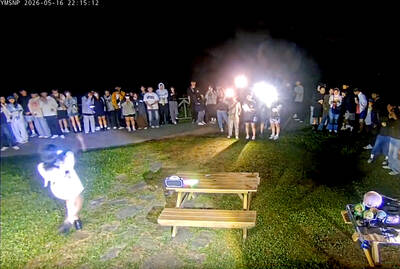
Yangmingshan National Park’s Qingtiangang (擎天崗) nature area has gone viral after a park livestream camera observed a couple in the throes of intimate congress, which was broadcast live on YouTube, drawing large late-night crowds and sparking a backlash over noise, bright lights and disruption to wildlife habitat. The area’s livestream footage appeared to show a couple engaging in sexual activity on a picnic table in the park on Friday last week, with the uncensored footage streamed publicly online. The footage quickly spread across social media, prompting a tide of visitors to travel to the site to “check in” and recreate the
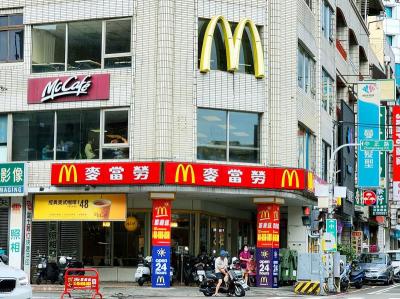
Fast food chain McDonald's is to raise prices by up to NT$5 on some products at its restaurants across Taiwan, starting on Wednesday next week, the company announced today. The prices of all extra value meals and sharing boxes are to increase by NT$5, while breakfast combos and creamy corn soup would go up by NT$3, the company said in a statement. The price of the main items of those meals, if ordered individually, would remain the same. Meanwhile, the price of a medium-sized lemon iced tea and hot cappuccino would rise by NT$3, extra dipping sauces for chicken nuggets would go up

Minister of Digital Affairs Lin Yi-ching (林宜敬) yesterday cited regulatory issues and national security concerns as an expert said that Taiwan is among the few Asian regions without Starlink. Lin made the remarks on Facebook after funP Innovation Group chief executive officer Nathan Chiu (邱繼弘) on Friday said Taiwan and four other countries in Asia — China, North Korea, Afghanistan and Syria — have no access to Starlink. Starlink has become available in 166 countries worldwide, including Ukraine, Malaysia, the Philippines and Vietnam, in the six years since it became commercial, he said. While China and North Korea block Starlink, Syria is not


 RSS
RSS