


The Chinese Nationalist Party (KMT) must remain strong when dealing with China, because the party is bound to the continued existence of the Republic of China (ROC), former KMT vice chairman Hau Lung-bin (郝龍斌) said yesterday.
Hau is running for party chairperson.
Hau made similar comments on Friday in an interview with TV political talk show host Jaw Shaw-kang (趙少康) on Situation Room.
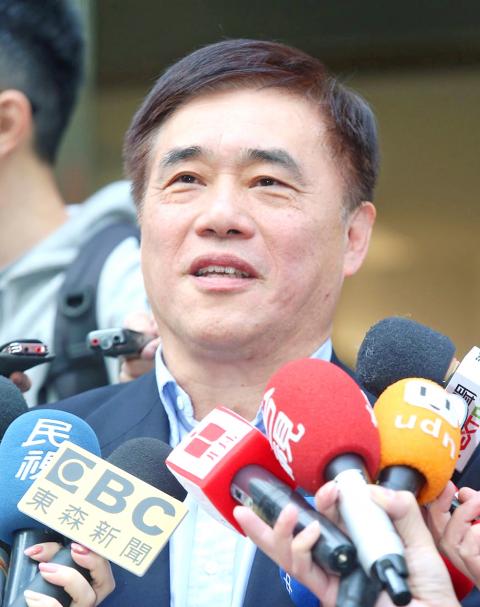
Photo: Fang Pin-chao, Taipei Times
“Should Beijing refuse to acknowledge the ROC, then we no longer need to interact with them,” Hau said. “If our goodwill is not reciprocated in kind and we do not receive dignified treatment as an equal partner, why should we continue?”
“If that happens, then there is no need to maintain postal services, commercial services or transportation services with China. We can consider other alternatives,” he said.
However, Hau said that the KMT does not want that situation to occur.
“We should not have to force each other to back down,” Hau said, adding that he hoped Beijing would offer Taiwan some respect and goodwill.
“Some [party] members have, indeed, backed down too much,” he said, referencing the perception that the KMT was often weak when facing the Chinese Communist Party (CCP).
Hau said that some pan-blue supporters — not necessarily politicians — might have acted in a less than dignified manner while in pursuit of economic benefits from China.
“We cannot continue to do so,” he said.
The party chairperson, leaders and members of a certain rank should decline all offers by the Chinese government to “treat them” to meals during future visits, Hau said.
All cross-strait interaction must be conducted based on maintaining our dignity, he added.
The basic consensus on both sides of the Taiwan Strait is the “1992 consensus,” he said.
The so-called “1992 consensus,” a term former Mainland Affairs Council chairman Su Chi (蘇起) in 2006 admitted making up in 2000, refers to a tacit understanding between the KMT and the Chinese government that both sides of the Strait acknowledge there is “one China,” with each side having its own interpretation of what “China” means.
However, the basis of that agreement has been undermined by the Democratic Progressive Party’s denial of the consensus’ validity, calling it the “one country, two systems” concept, while Beijing flatly refuses to acknowledge the ROC, he said.
The KMT should debate whether its cross-strait policies require revision as consensus between the two sides of the Strait, as well as between the KMT and the CCP, appears to be over, he said.

Considering that most countries issue more than five denominations of banknotes, the central bank has decided to redesign all five denominations, the bank said as it prepares for the first major overhaul of the banknotes in more than 24 years. Central bank Governor Yang Chin-lung (楊金龍) is expected to report to the Legislative Yuan today on the bank’s operations and the redesign’s progress. The bank in a report sent to the legislature ahead of today’s meeting said it had commissioned a survey on the public’s preferences. Survey results showed that NT$100 and NT$1,000 banknotes are the most commonly used, while NT$200 and NT$2,000

The Centers for Disease Control (CDC) yesterday reported the first case of a new COVID-19 subvariant — BA.3.2 — in a 10-year-old Singaporean girl who had a fever upon arrival in Taiwan and tested positive for the disease. The girl left Taiwan on March 20 and the case did not have a direct impact on the local community, it said. The WHO added the BA.3.2 strain to its list of Variants Under Monitoring in December last year, but this was the first imported case of the COVID-19 variant in Taiwan, CDC Deputy Director-General Lin Ming-cheng (林明誠) said. The girl arrived in Taiwan on

South Korea is planning to revise its controversial electronic arrival card, a step Taiwanese officials said prompted them to hold off on planned retaliatory measures, a South Korean media report said yesterday. A Yonhap News Agency report said that the South Korean Ministry of Foreign Affairs is planning to remove the “previous departure place” and “next destination” fields from its e-arrival card system. The plan, reached after interagency consultations, is under review and aims to simplify entry procedures and align the electronic form with the paper version, a South Korean ministry official said. The fields — which appeared only on the electronic form

The Ministry of Foreign Affairs (MOFA) is suspending retaliation measures against South Korea that were set to take effect tomorrow, after Seoul said it is updating its e-arrival system, MOFA said today. The measures were to be a new round of retaliation after Taiwan on March 1 changed South Korea's designation on government-issued alien resident certificates held by South Korean nationals to "South Korea” from the "Republic of Korea," the country’s official name. The move came after months of protests to Seoul over its listing of Taiwan as "China (Taiwan)" in dropdown menus on its new online immigration entry system. MOFA last week


 RSS
RSS