


Taichung Mayor Lu Shiow-yen (盧秀燕) on Tuesday criticized the Environmental Protection Agency (EPA) for approving the construction of two new natural gas-fired generators at Taichung Power Plant.
The agency approved an environmental impact assessment for the new generators at a five-hour meeting on Monday, sparking criticism not only from Lu, but also the Changhua, Nantou and Miaoli county commissioners.
At a Taichung City Government meeting, Lu slammed the agency for allowing the plant to build new generators while continuing to operate the 10 coal-fired generators it already has, and likened the decision to a “nightmare scenario.”
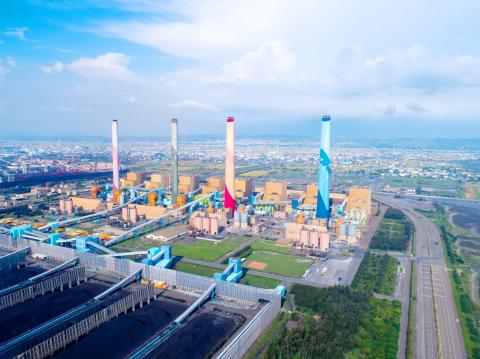
Photo courtesy of the Taichung City Government
“We will not accept this,” Lu said.
Representatives from Taichung, Changhua and Nantou who attended the meeting all called for the plant to remove four coal-fired generators if the new natural gas-fired generators are to be built, Lu said.
The central government continues to do as it pleases, without any concern for public opinion, Lu said.
The fossil fuel-dependent plant, one of the largest of its kind in the world, is operated by state-run Taiwan Power Co (Taipower), and was fined on multiple occasions last year by the Taichung City Government for coal use contraventions.
The plant is the largest stationary pollution source in Taichung, Lu said.
The agency’s decision showed “complete disregard for the health and lives of the people of Changhua,” Changhua County Commissioner Wang Hui-mei (王惠美) said in a statement.
Miaoli County Commissioner Hsu Yao-chang (徐耀昌) said that although natural gas is a cleaner energy source, the new generators would still worsen air pollution in central Taiwan, a point echoed by Nantou County Commissioner Lin Ming-chen (林明溱).
Taipower said in a statement on Monday that after the two new generators are activated, four of the 10 coal-fired generators would gradually become backups, and would only be operated under specific circumstances.
The two and six combination would allow the plant to reduce its emissions of air pollutants by 64 to 72 percent, Taipower said.
The backup generators would only be used between April and September — when air pollution is less serious — when air quality is rated “good” or “moderate” on the EPA’s air quality index and when the operating reserve margin is below 8 percent, Taipower said.
Only two of the four generators would be activated at the same time under such circumstances, it said.
Taipower said that it was not retiring the generators because they could still be of use during emergency situations, and that it would be “unsuitable” to retire them before they reach the required age.
The company would also have to abide by stricter conditions listed by the Ministry of Economic Affairs when running the plant’s other coal-fired units.
It is allowed to operate more than six coal-fired generators together for only 240 hours per year, and it can only run 10 generators — coal-fired and natural gas-fired — simultaneously.

Considering that most countries issue more than five denominations of banknotes, the central bank has decided to redesign all five denominations, the bank said as it prepares for the first major overhaul of the banknotes in more than 24 years. Central bank Governor Yang Chin-lung (楊金龍) is expected to report to the Legislative Yuan today on the bank’s operations and the redesign’s progress. The bank in a report sent to the legislature ahead of today’s meeting said it had commissioned a survey on the public’s preferences. Survey results showed that NT$100 and NT$1,000 banknotes are the most commonly used, while NT$200 and NT$2,000

The Centers for Disease Control (CDC) yesterday reported the first case of a new COVID-19 subvariant — BA.3.2 — in a 10-year-old Singaporean girl who had a fever upon arrival in Taiwan and tested positive for the disease. The girl left Taiwan on March 20 and the case did not have a direct impact on the local community, it said. The WHO added the BA.3.2 strain to its list of Variants Under Monitoring in December last year, but this was the first imported case of the COVID-19 variant in Taiwan, CDC Deputy Director-General Lin Ming-cheng (林明誠) said. The girl arrived in Taiwan on

South Korea is planning to revise its controversial electronic arrival card, a step Taiwanese officials said prompted them to hold off on planned retaliatory measures, a South Korean media report said yesterday. A Yonhap News Agency report said that the South Korean Ministry of Foreign Affairs is planning to remove the “previous departure place” and “next destination” fields from its e-arrival card system. The plan, reached after interagency consultations, is under review and aims to simplify entry procedures and align the electronic form with the paper version, a South Korean ministry official said. The fields — which appeared only on the electronic form

The Ministry of Foreign Affairs (MOFA) is suspending retaliation measures against South Korea that were set to take effect tomorrow, after Seoul said it is updating its e-arrival system, MOFA said today. The measures were to be a new round of retaliation after Taiwan on March 1 changed South Korea's designation on government-issued alien resident certificates held by South Korean nationals to "South Korea” from the "Republic of Korea," the country’s official name. The move came after months of protests to Seoul over its listing of Taiwan as "China (Taiwan)" in dropdown menus on its new online immigration entry system. MOFA last week


 RSS
RSS