


Taiwan Solidarity Union (TSU) officials and legislative candidates yesterday urged voters to cast their ballots for President Tsai Ing-wen (蔡英文) and reject Kaohsiung Mayor Han Kuo-yu (韓國瑜), the Chinese Nationalist Party’s (KMT) presidential candidate, as supporting Han is tantamount to supporting support China.
The Chinese government has meddled in the election by providing money for several small political parties, they said.
“Tsai and the Democratic Progressive Party [DPP] have moved to the middle ground, in upholding the Republic of China [ROC]-Taiwan framework, and only the TSU advocates scrapping the ROC and establishing the Taiwan nation,” said Billy Pan (潘建志), first of the TSU’s list of legislators-at-large nominee.
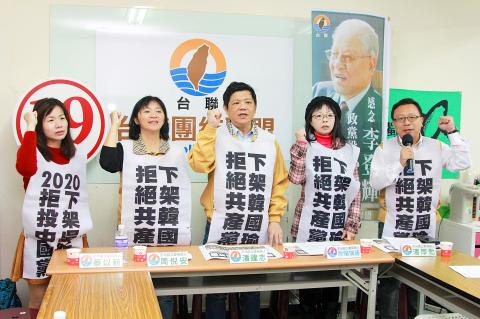
Photo: Hsieh Chun-lin, Taipei Times
Taiwanese must reject all the pro-China parties in tomorrow’s elections, including the KMT, the New Party and the People First Party (PFP), and get rid of Han, he said.
The judiciary must investigate the finances of New Party Chairman Yok Mu-ming (郁慕明) and New Party at-large nominee Chiu Yi (邱毅), Pan said.
“We have received reports from people that Yok and Chiu have money flowing into their accounts from China. This should be investigated under the recently passed Anti-infiltration Act (反滲透法). I am sure they will be found guilty, with clear evidence of violating the act, which will land them both in prison,” Pan said.
Former TSU legislator Chou Ni-an (周倪安) said Taiwanese have a distinct cultural and national identity apart from China and are opposed to becoming part of China
“Yok and Chiu’s New Party are advocating for ‘one country, two systems’ model for fast tracking unification with China. This is pushing us into the fire pit, making Taiwanese like Tibetans, Uighurs and Hong Kongers, who are under the oppressive rule of a Chinese dictatorship,” she said.
The TSU needs the support of Taiwanese voters in this election so that such a staunch pro-Taiwan party will not lose to the pro-China New Party, she added.
If the TSU does not improve its showing over the 2018 election, it might have to fold, Chou said.

Considering that most countries issue more than five denominations of banknotes, the central bank has decided to redesign all five denominations, the bank said as it prepares for the first major overhaul of the banknotes in more than 24 years. Central bank Governor Yang Chin-lung (楊金龍) is expected to report to the Legislative Yuan today on the bank’s operations and the redesign’s progress. The bank in a report sent to the legislature ahead of today’s meeting said it had commissioned a survey on the public’s preferences. Survey results showed that NT$100 and NT$1,000 banknotes are the most commonly used, while NT$200 and NT$2,000

The Centers for Disease Control (CDC) yesterday reported the first case of a new COVID-19 subvariant — BA.3.2 — in a 10-year-old Singaporean girl who had a fever upon arrival in Taiwan and tested positive for the disease. The girl left Taiwan on March 20 and the case did not have a direct impact on the local community, it said. The WHO added the BA.3.2 strain to its list of Variants Under Monitoring in December last year, but this was the first imported case of the COVID-19 variant in Taiwan, CDC Deputy Director-General Lin Ming-cheng (林明誠) said. The girl arrived in Taiwan on

South Korea is planning to revise its controversial electronic arrival card, a step Taiwanese officials said prompted them to hold off on planned retaliatory measures, a South Korean media report said yesterday. A Yonhap News Agency report said that the South Korean Ministry of Foreign Affairs is planning to remove the “previous departure place” and “next destination” fields from its e-arrival card system. The plan, reached after interagency consultations, is under review and aims to simplify entry procedures and align the electronic form with the paper version, a South Korean ministry official said. The fields — which appeared only on the electronic form

The Ministry of Foreign Affairs (MOFA) is suspending retaliation measures against South Korea that were set to take effect tomorrow, after Seoul said it is updating its e-arrival system, MOFA said today. The measures were to be a new round of retaliation after Taiwan on March 1 changed South Korea's designation on government-issued alien resident certificates held by South Korean nationals to "South Korea” from the "Republic of Korea," the country’s official name. The move came after months of protests to Seoul over its listing of Taiwan as "China (Taiwan)" in dropdown menus on its new online immigration entry system. MOFA last week


 RSS
RSS