


A doctor warned that smokers could increase their risk of having a stroke by 12 percent and they run a 1.81 times greater risk of developing multiple sclerosis.
Health Promotion Administration (HPA) data show that as many as 35.6 percent of recovering male heart attack patients and 20 to 30 percent of males recovering from a stroke do not quit smoking, Mackay Memorial Hospital deputy superintendent Yeh Hung-yi (葉宏一) said.
The statistics show that public knowledge of the risks to cardiovascular health from smoking remains inadequate, he said.
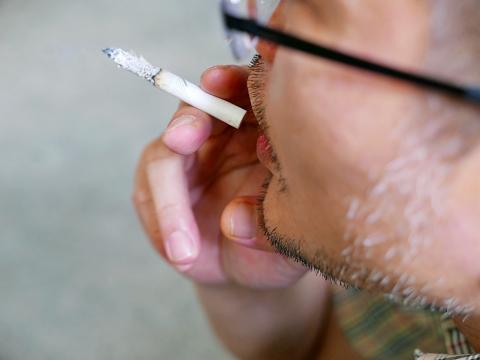
Photo: Tsai Shu-yuan, Taipei Times
Conversely, 77.8 percent of people with lung cancer are males and only 7.7 percent of them continue to smoke after they recover from lung cancer, Yeh said.
Heart disease, cerebrovascular disease and conditions related to high blood pressure have all been among the top 10 causes of death in Taiwan since the government began keeping statistics, he said, adding that the three causes combined accounted for nearly 40,000 deaths in the nation last year.
Nicotine and other chemicals found in cigarettes could hasten the hardening of arterial walls, he said, adding that the condition increases the risk of stroke, as the arteries become less elastic and less resilient to blockages.
Secondhand smoke also increases the risks to heart health, meaning that those who smoke at home are putting their family at risk of developing heart disease, he said.
Within 20 minutes after a person has stopped smoking their heart rate and blood pressure begin returning to normal levels, HPA Director-General Wang Ying-wei (王英偉) said.
From two weeks to three months after a person has quit smoking, their circulatory system begins to improve, he said, adding that after a year of not smoking, a person’s risk of heart disease is cut in half, and after 15 years heart function would be the same as that of a healthy person.
The HPA and the Taiwan Stroke Society have helped more than 2,000 people quit smoking, the HPA said.

Considering that most countries issue more than five denominations of banknotes, the central bank has decided to redesign all five denominations, the bank said as it prepares for the first major overhaul of the banknotes in more than 24 years. Central bank Governor Yang Chin-lung (楊金龍) is expected to report to the Legislative Yuan today on the bank’s operations and the redesign’s progress. The bank in a report sent to the legislature ahead of today’s meeting said it had commissioned a survey on the public’s preferences. Survey results showed that NT$100 and NT$1,000 banknotes are the most commonly used, while NT$200 and NT$2,000

The Centers for Disease Control (CDC) yesterday reported the first case of a new COVID-19 subvariant — BA.3.2 — in a 10-year-old Singaporean girl who had a fever upon arrival in Taiwan and tested positive for the disease. The girl left Taiwan on March 20 and the case did not have a direct impact on the local community, it said. The WHO added the BA.3.2 strain to its list of Variants Under Monitoring in December last year, but this was the first imported case of the COVID-19 variant in Taiwan, CDC Deputy Director-General Lin Ming-cheng (林明誠) said. The girl arrived in Taiwan on

South Korea is planning to revise its controversial electronic arrival card, a step Taiwanese officials said prompted them to hold off on planned retaliatory measures, a South Korean media report said yesterday. A Yonhap News Agency report said that the South Korean Ministry of Foreign Affairs is planning to remove the “previous departure place” and “next destination” fields from its e-arrival card system. The plan, reached after interagency consultations, is under review and aims to simplify entry procedures and align the electronic form with the paper version, a South Korean ministry official said. The fields — which appeared only on the electronic form

The Ministry of Foreign Affairs (MOFA) is suspending retaliation measures against South Korea that were set to take effect tomorrow, after Seoul said it is updating its e-arrival system, MOFA said today. The measures were to be a new round of retaliation after Taiwan on March 1 changed South Korea's designation on government-issued alien resident certificates held by South Korean nationals to "South Korea” from the "Republic of Korea," the country’s official name. The move came after months of protests to Seoul over its listing of Taiwan as "China (Taiwan)" in dropdown menus on its new online immigration entry system. MOFA last week


 RSS
RSS