


Shuttle services between Taipei and Hualien are to begin when improved sections on the Suhua Highway (Highway No. 9) open on Jan. 6, the Directorate-General of Highways (DGH) said yesterday.
The services would be operated by United Highway Bus (Ubus), Taipei Bus and Capital Bus, the highway authority said.
Of the 85 buses to be used on the route, 11 bear designs and colors that are associated with the Suhua Highway, it said.
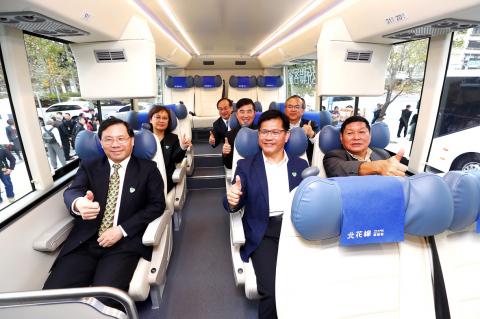
Photo courtesy of the Ministry of Transportation and Communications
News media were invited to view two of the buses, which are white with patterns designed to reflect the eight tunnels constructed as part of the improved sections.
The buses’ white seats, with blue headrests, have USB charging ports and the buses are equipped with free Wi-Fi service and bathrooms. Nine of the specially designed buses would be capable of accommodating wheelchair users, it said.
All three operators would provide the service from Taipei’s Nangang Bus Station (南港轉運站) to Hualien, with an estimated travel time of three-and-a-half to four hours, and from New Taipei City’s Banciao District (板橋) to Hualien, which is estimated to take four hours, it said.
Ticket prices range from NT$290 to NT$350 per person, depending on whether the bus has three seats or four seats to a row, it said.
UBus began selling tickets for the new line yesterday, while the other operators are to start selling advanced tickets at noon on Tuesday next week. All three are to offer discounts to attract customers at the initial stage of operations, it said.
The new express route adds another option to reach Hualien, in addition to the railway and South Link Highway, Taipei Motor Vehicle Office chief Chang Tung-min (張東閔) said, adding that it also makes it possible to travel around Taiwan by bus within 24 hours.
A previous bus line from Taipei to Hualien took six hours and passed through Keelung, the Northeast Cape and Highway No. 2, before continuing on the Suhua Highway.
Chang said that two years ago, it took him two days to travel around Taiwan by bus, as he had to first travel from Taipei to Kaohsiung, transfer to Taitung, then to Hualien, where he made his way to Lishan (梨山) and eventually to Yilan.
The Executive Yuan has approved a proposal for a Suhua Highway safety enhancement project, which would address sections not covered by the Suhua Highway Improvement Project, DGH Deputy Director-General Hsu Cheng-chang (許鉦漳) said.
The improvement project only focused on three landslide-prone sections, including between Suao (蘇澳) and Dongao (東澳) in Yilan County’s Suao Township; Nanao Township (南澳) in Yilan and Heping (和平) Township in Hualien County; and Hejhong (和中) and Dacingshuei (大清水) in Hualien’s Sioulin Township (秀林), Hsu said.
“We are aware of the potential impact from the increasingly frequent occurrence of extreme weather on the highways, as well as changes in the transportation systems, and we have come to the conclusion that the sections that are not included in the improvement project could still be affected during a typhoon and heavy rainfall, which could trigger landslides and consequently disrupt traffic on Highway No. 9. This would put lives in danger and inconvenience those seeking medical attention,” he said.
Hsu said that the estimated NT$36 billion (US$1.19 billion) Suhua project would cover 19.1km through the sections between Dongao and Nanao townships; Heping Township and Heren (和仁) in Hualien; and Dacingshuei and Chongde (崇德) in Hualien.
The agency plans to build a 9km tunnel in the Dacingshuei to Chongde section, located within Taroko National Park, which could increase the cost by NT$10 billion.
The project would need to undergo an environmental impact assessment by the Environmental Protection Administration, Hsu said.
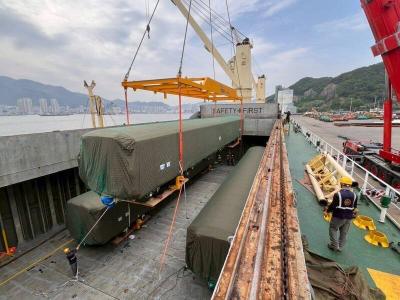
The first of 10 new high-capacity trains purchased from South Korea’s Hyundai Rotem arrived at the Port of Taipei yesterday to meet the demands of an expanding metro network, Taipei Rapid Transit Corp (TRTC) said yesterday. The train completed a three-day, 1,200km voyage from the Port of Masan in South Korea, the company said. Costing NT$590 million (US$18.79 million) each, the new six-carriage trains feature a redesigned interior based on "human-centric" transportation concepts, TRTC said. The design utilizes continuous longitudinal seating to widen the aisles and optimize passenger flow, while also upgrading passenger information displays and driving control systems for a more comfortable
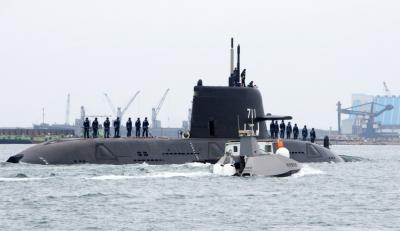
Taiwan's first indigenous defense submarine, the SS-711 Hai Kun (海鯤, or Narwhal), departed for its 13th sea trial at 7am today, marking its seventh submerged test, with delivery to the navy scheduled for July. The outing also marked its first sea deployment since President William Lai (賴清德) boarded the submarine for an inspection on March 19, drawing a crowd of military enthusiasts who gathered to show support. The submarine this morning departed port accompanied by CSBC Corp’s Endeavor Manta (奮進魔鬼魚號) uncrewed surface vessel and a navy M109 assault boat. Amid public interest in key milestones such as torpedo-launching operations and overnight submerged trials,
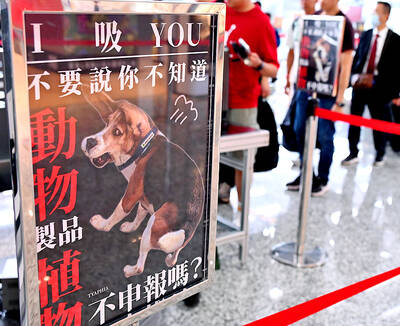
Quarantine awareness posters at Taiwan Taoyuan International Airport have gone viral for their use of wordplay. Issued by the airport branch of the Animal and Plant Health Inspection Agency, the posters feature sniffer dogs making a range of facial expressions, paired with advisory messages built around homophones. “We update the messages for holidays and campaign needs, periodically refreshing materials to attract people’s attention,” quarantine officials said. “The aim is to use the dogs’ appeal to draw focus to quarantine regulations.” A Japanese traveler visiting Taiwan has posted a photo on X of a poster showing a quarantine dog with a

Taiwan’s coffee community has launched a “one-person-one-e-mail” campaign, calling for people to send a protest-e-mail to the World Coffee Championships (WCC) urging it to redesignate Taiwanese competitors as from “Taiwan,” rather than “Chinese Taipei.” The call followed sudden action last week after the WCC changed all references to Taiwanese competitors from “Taiwan” to “Chinese Taipei,” including recent World Latte Art champion Bala (林紹興), who won the World Latte Art Championship in San Diego earlier this month. When Bala received the trophy, he was referred to as representing Taiwan, as well as in the announcement on the WCC’s Web site, until it


 RSS
RSS