


Kaohsiung Mayor Han Kuo-yu (韓國瑜) yesterday said that a march on Saturday calling for his recall was unjustified and that organizers used “tricks” to make the crowd seem bigger.
Han, the Chinese Nationalist Party’s (KMT) presidential candidate, yesterday morning posted a picture on Facebook of the Kaohsiung march organized by civic groups, which shows demonstrators carrying a giant banner with a small number of people under it.
“The biggest fig leaf in Taiwan’s history since its democratization,” he wrote of the picture.
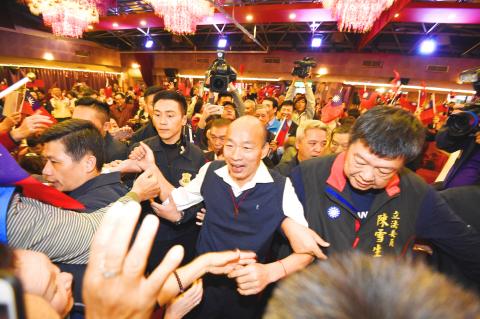
Photo: George Tsorng, Taipei Times
Asked to explain the post later yesterday, Han told reporters in New Taipei City that the banner was like a “fig leaf” used by event organizers to create the illusion of having more participants than they actually did.
Event organizers claimed that 500,000 people took part in the march, but perhaps 480,000 of them were hiding under the banner and thus could not be seen, Han said.
“No one expected them to pull this kind of trick,” he said, adding that the organizers were better at creating illusions than magician Louis Liu (劉謙).
He said he even saw “foreigners” at the march, even though only Kaohsiung residents could recall the mayor.
While members of the public have the right to recall elected officials, the campaign to recall him seemed to be the result of political manipulation, Han said.
The march was a “ridiculous performance” put on by certain groups to defame him and advance their own political interests, he said, adding: “We do not see how [the march] can be justified.”
In response, Wecare Kaohsiung, a coalition of civic groups that co-organized the march with Citizens Mowing Action and the Taiwan Statebuilding Party, posted a video on Facebook showing large crowds of people under the banner as they carried it over their heads.
The banner, which was 210m long and 12m wide, was designed to showcase participants’ conviction to work together for the recall campaign, as it required a group effort to carry, Wecare Kaohsiung said on Facebook.
Han’s remarks show that he is “scared,” it said.
In other developments, Han yesterday reiterated his plan to reinstate the Special Investigation Division (SID) if elected.
During a morning visit to Taipei’s Guandu Temple (關渡宮) with KMT legislative candidate Wang Chih-pin (汪志冰), Han encountered a supporter holding a placard calling for the SID to be re-established to fight corruption.
The placard speaks to the public’s shared wish for a government with integrity, Han said, adding: “There is a Bao Qingtian (包青天) inside every one of us.”
Bao, a Song Dynasty judge, is worshiped as a symbol of justice due to his reputation for being incorruptible.
At a later campaign event with KMT legislative candidate Hung Meng-kai (洪孟楷) in New Taipei City, Han urged President Tsai Ing-wen (蔡英文) to explain why she abolished the SID in 2017.
Tsai’s administration is incompetent and corrupt, he said, adding: “We must let the Democratic Progressive Party know that the Republic of China belongs to the people by voting in the elections.”

Considering that most countries issue more than five denominations of banknotes, the central bank has decided to redesign all five denominations, the bank said as it prepares for the first major overhaul of the banknotes in more than 24 years. Central bank Governor Yang Chin-lung (楊金龍) is expected to report to the Legislative Yuan today on the bank’s operations and the redesign’s progress. The bank in a report sent to the legislature ahead of today’s meeting said it had commissioned a survey on the public’s preferences. Survey results showed that NT$100 and NT$1,000 banknotes are the most commonly used, while NT$200 and NT$2,000

The Centers for Disease Control (CDC) yesterday reported the first case of a new COVID-19 subvariant — BA.3.2 — in a 10-year-old Singaporean girl who had a fever upon arrival in Taiwan and tested positive for the disease. The girl left Taiwan on March 20 and the case did not have a direct impact on the local community, it said. The WHO added the BA.3.2 strain to its list of Variants Under Monitoring in December last year, but this was the first imported case of the COVID-19 variant in Taiwan, CDC Deputy Director-General Lin Ming-cheng (林明誠) said. The girl arrived in Taiwan on

South Korea is planning to revise its controversial electronic arrival card, a step Taiwanese officials said prompted them to hold off on planned retaliatory measures, a South Korean media report said yesterday. A Yonhap News Agency report said that the South Korean Ministry of Foreign Affairs is planning to remove the “previous departure place” and “next destination” fields from its e-arrival card system. The plan, reached after interagency consultations, is under review and aims to simplify entry procedures and align the electronic form with the paper version, a South Korean ministry official said. The fields — which appeared only on the electronic form

The Ministry of Foreign Affairs (MOFA) is suspending retaliation measures against South Korea that were set to take effect tomorrow, after Seoul said it is updating its e-arrival system, MOFA said today. The measures were to be a new round of retaliation after Taiwan on March 1 changed South Korea's designation on government-issued alien resident certificates held by South Korean nationals to "South Korea” from the "Republic of Korea," the country’s official name. The move came after months of protests to Seoul over its listing of Taiwan as "China (Taiwan)" in dropdown menus on its new online immigration entry system. MOFA last week


 RSS
RSS