

The Taiwan Transportation Safety Board yesterday said it would publish information decoded from the Compact Flash (CF) memory cards retrieved from a Puyuma Express train that derailed in Yilan County on Oct. 21 last year, killing 18 passengers and injuring 212 other people.
The draft of a final investigative report is to be completed in September next year, which would include analysis of data collected from the accident, potential causes and the board’s recommendations for the Taiwan Railways Administration (TRA) to improve safety, it said.
An Executive Yuan probe into the cause of the accident and its conclusions have failed to satisfy families of the victims and the public.
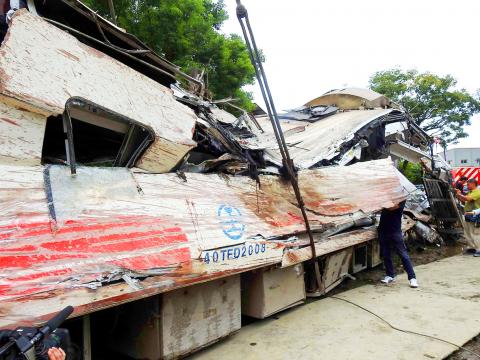
Photo: CNA
The board, which was established on Aug. 1, passed a resolution on Sept. 6 to provide supplementary information about the accident.
The board has reexamined the evidence and materials transferred from the Railway Bureau and the Yilan District Court, and decoded information recorded on the automatic train protection system, the train control and management system, and CF cards from damaged train cabins, it said.
The board added that it has established a timeline of the events leading to the accident based on footage from the dashboard camera and CCTVs, and recorded conversations at the train driver’s room.
It had also visited the TRA’s depot in Taoyuan to inspect the damaged train.
What the board is ascertaining is the speed at which the train was traveling before the accident occured, the condition of the railway tracks, the efficiency of the air compressors and its effect on the train’s operation, whether the train control and management system interface was driver-friendly and the TRA’s driver training program.
The board has completed decoding data from the CF cards and investigators have identified a problem in the cards’ design, board chairman Young Hong-tsu (楊宏智) said.
“We have about five minutes of data missing on the CF cards. We were not able to retrieve it not because we lost it during data download or do not have the ability to extract it, but because the CF card was not designed to record such information,” he said.
Young added that identifying the memory card design problem does not mean that it was the cause of the derailment or that the train’s design was flawed.
The missing information would not affect the conclusion of the investigation, he said, adding that the board would compare the data retrieved with other audio-visual data to make sure that it does not miss any important information.
The board also found that the train’s heat exchanger was covered in grass, which was unusual, he said.
The board would ascertain if the Japanese train manufacturer has indicated any potential problem with heat exchangers in its train maintenance manual, he said.
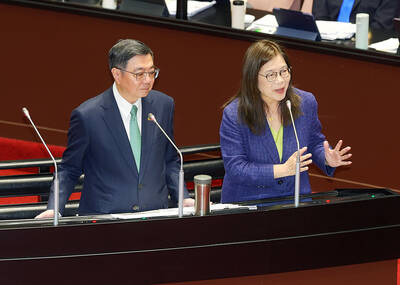
The donation of offshore patrol vessel Kinmen to the Philippines includes provisions that protect Taiwanese fishers and facilitate security cooperation across the First Island Chain, officials said yesterday. The comment was made during the Cabinet’s comprehensive administrative report at the legislature after Chinese Nationalist Party (KMT) Legislator Hsu Yu-chen (許宇甄) expressed concerns about the decision to give a ship to a country whose coast guard had in 2013 fired on a Taiwanese trawler and killed its captain without provocation. The Cabinet should lay out the safeguards that have been established to prevent the Philippine government from using the Kinmen to harass, expel
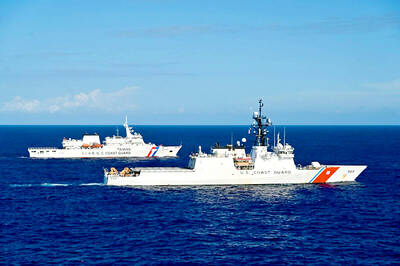
GROWING TIES: The CGA is planning a goodwill mission to the Philippines, in what would be the first time since 1975 a Taiwanese paramilitary vessel has visited the country The Coast Guard Administration (CGA) plans to significantly expand its participation in international security cooperative frameworks and its operational capabilities, a budget proposal for next year showed. The budget indicates a transformation of the CGA from a maritime law enforcement arm into a national defense and intelligence gathering entity capable of tackling larger regional security matters. The proposal showed that personnel from the coast guard’s Intelligence Division and Special Action Support Center are to participate in high-level national security talks with the US. As the CGA has dealt with China’s rising “gray zone” threats around Taiwan, it has become a valuable asset to
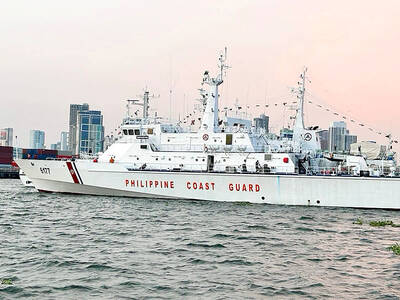
A patrol vessel donated by the Coast Guard Administration (CGA) to the Philippines was commissioned into the Philippine Coast Guard (PCG) on Friday, a Philippine non-governmental organization said. The CGA on Sept. 16 confirmed media reports that Taiwan had donated a retired 500-tonne patrol vessel to the Philippines. The Manila-based We Protect Our Seas (WPS) foundation, which served as an intermediary in the transfer, said that the vessel was formerly the CGA’s 500-tonne petrol vessel Kinmen (CG123). The WPS, in a statement issued on Friday, said the vessel, renamed as the BRP Sarangani, had been commissioned into the PCG the
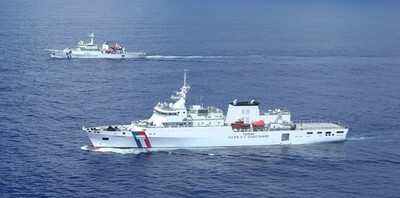
The Coast Guard Administration (CGA) today said that two of its patrol vessels have docked at Palau's Malakal Harbor as part of an expedition exercise and diplomatic visit, during which a senior official is expected to meet with the Palauan president. The two vessels, the 4,000-tonne-class Chiayi (嘉義) and the 1,000-tonne-class Penghu (澎湖), set sail for Palau from Taiwan last week and arrived at Malakal Harbor yesterday, the CGA's Fleet Branch said in a statement. The journey marked the second time the CGA has dispatched a "Friendship Fleet" to another country, after it sent its first-ever goodwill fleet, comprising the Hualien (花蓮)


 RSS
RSS