


National Tsing Hua University chair professor of philosophy Yang Rur-bin (楊儒賓) has donated to the university’s museum his personal collection of more than 2,000 historical pieces collected by the Chinese Nationalist Party (KMT) during its retreat from China to Taiwan in 1949.
Yang and his wife, Fang Sheng-ping (方聖平), who is also a chair professor at the university, on Saturday last week donated the relics, whose themes include war, politics, religion and economy. The couple has taught at the university for more than 30 years
The relics are to be on display at Taipei’s Zhongshan Hall (中山堂) until Dec. 29.
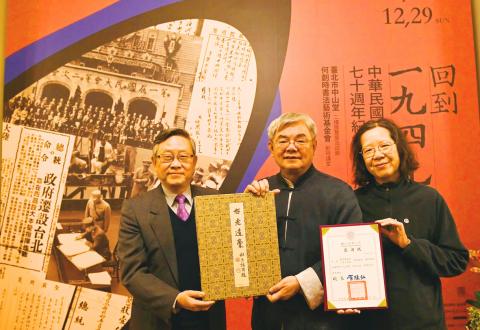
Photo courtesy of National Tsing Hua University
The university said that the museum, which is under construction, would open to the public in 2022.
The collection includes correspondence by major politicians and religious leaders on issues such as victory in the Second Sino-Japanese War, the evacuation of citizens from the Ta-chen Islands (大陳群島), the retreat of the KMT government to Taiwan and the subsequent cross-strait situation.
Residents of the Ta-chen Islands, off the east coast of China, retreated to Taiwan with KMT troops in 1955.
A letter written by Chiang Kai-shek (蔣介石) in late May 1949 to general Tang Enbo (湯恩伯) is also part of the collection.
In the letter, Chiang ordered that only the minimum amount of gold required to maintain the city finances was to stay in Shanghai, with the rest to be shipped to Taiwan.
Communist troops took over Shanghai only four days after Chiang wrote the letter, making it proof of the urgent need to transport the gold to Taiwan. The gold later became an important source of funds to drive Taiwan’s economic development.
In another letter, Master Wu-shang (無上法師) said he hoped to install the sarira — bead-shaped objects purportedly found among the cremated ashes of Buddhist spiritual masters — of legendary monk Xuanzang (玄奘) in Hsinchu City’s Lingyin Temple (靈隱寺).
Xuanzang traveled overland from China to India in search of Buddhist sutras, a story that has been immortalized in the classic novel Journey to the West.
In the second half of the Second Sino-Japanese War, the Imperial Japanese Army reportedly found Xuanzang’s sarira during construction. It was split into three parts, which were stored in Beijing, Nanjing and Japan.
After the war, Japan agreed to return the part in its possession to the KMT government, sparking a contest between Buddhist leaders in Taiwan. The sarira was eventually sent to Hsuanguang Temple (玄光寺) near Nantou County’s Sun Moon Lake (日月潭) at Chiang’s insistence.
“My salary comes from the university and [as it is a state-funded institution] it is taxpayers’ money, so the donation is simply putting the money back where it came from,” Yang said, adding that he hopes the relics would become treasured parts of the museum’s collection.

Considering that most countries issue more than five denominations of banknotes, the central bank has decided to redesign all five denominations, the bank said as it prepares for the first major overhaul of the banknotes in more than 24 years. Central bank Governor Yang Chin-lung (楊金龍) is expected to report to the Legislative Yuan today on the bank’s operations and the redesign’s progress. The bank in a report sent to the legislature ahead of today’s meeting said it had commissioned a survey on the public’s preferences. Survey results showed that NT$100 and NT$1,000 banknotes are the most commonly used, while NT$200 and NT$2,000

The Centers for Disease Control (CDC) yesterday reported the first case of a new COVID-19 subvariant — BA.3.2 — in a 10-year-old Singaporean girl who had a fever upon arrival in Taiwan and tested positive for the disease. The girl left Taiwan on March 20 and the case did not have a direct impact on the local community, it said. The WHO added the BA.3.2 strain to its list of Variants Under Monitoring in December last year, but this was the first imported case of the COVID-19 variant in Taiwan, CDC Deputy Director-General Lin Ming-cheng (林明誠) said. The girl arrived in Taiwan on

South Korea is planning to revise its controversial electronic arrival card, a step Taiwanese officials said prompted them to hold off on planned retaliatory measures, a South Korean media report said yesterday. A Yonhap News Agency report said that the South Korean Ministry of Foreign Affairs is planning to remove the “previous departure place” and “next destination” fields from its e-arrival card system. The plan, reached after interagency consultations, is under review and aims to simplify entry procedures and align the electronic form with the paper version, a South Korean ministry official said. The fields — which appeared only on the electronic form

The Ministry of Foreign Affairs (MOFA) is suspending retaliation measures against South Korea that were set to take effect tomorrow, after Seoul said it is updating its e-arrival system, MOFA said today. The measures were to be a new round of retaliation after Taiwan on March 1 changed South Korea's designation on government-issued alien resident certificates held by South Korean nationals to "South Korea” from the "Republic of Korea," the country’s official name. The move came after months of protests to Seoul over its listing of Taiwan as "China (Taiwan)" in dropdown menus on its new online immigration entry system. MOFA last week


 RSS
RSS