


Oscar-winning Taiwanese filmmaker Ang Lee (李安) on Saturday called China’s boycott of this year’s Golden Horse Awards regrettable, but said it would continue to welcome all Chinese-language films.
“Our arms will always be open,” Lee said after the 56th Golden Horse Awards at the Sun Yat-sen Memorial Hall in Taipei.
In August, Beijing banned Chinese films and filmmakers from participating in the awards, chaired this year by Lee, in response to comments made during last year’s event by Taiwanese documentary director Fu Yue (傅榆), who said during her acceptance speech that she hoped Taiwan would be treated as an “independent entity,” drawing rebuke from Chinese filmmakers in attendance.
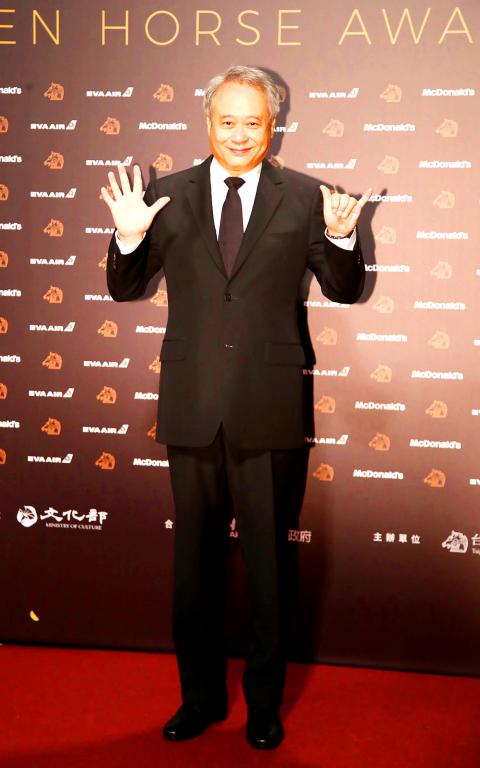
Photo: CNA
Lee said that China’s boycott was definitely a loss for the awards, but the quality of the films submitted was not reduced.
“Though we do not wish to see political situations, we must face them,” Lee said, adding that the awards would continue to strive to be a platform for all Chinese-language cinema, as well as one that nurtures filmmakers.
“I’m sure that everyone who has participated in the Golden Horse Awards feel a sense of coming home, a sense of mutual support in difficult times and a sense of learning,” Lee said.
In other news from the awards, Taiwanese director Chung Mong-hong’s (鍾孟宏) family drama A Sun (陽光普照) and Taiwanese director John Hsu’s (徐漢強) psychological horror film Detention (返校) were the biggest winners at this year’s awards.
A Sun, which entered the competition with 10 nominations, came away with best feature film, best director, best leading actor, best supporting male actor, best film editing and the audience choice award.
The nearly three-hour feature tells the story of a family managing life in the wake of a crime committed by the youngest son of a driving instructor and a hairdresser, and the struggles of the elder son, a high-school senior preparing for his medical school entrance exam.
The judges said the film is filled with emotion and pays special attention to the hidden corners of peoples’ souls. It also exposes the contrast and complements of good and evil.
Detention, which entered the competition with 12 nods, came out with best new director, best art direction, best original film score, best adapted screenplay and best visual effects.
The movie, set in the 1960s during the White Terror era, is an adaptation of a survival horror adventure video game created by Taiwanese developer Red Candle Games.
It became the highest-grossing domestic movie in Taiwan this year within three days of its release in September, and has since raked in more than NT$250 million (US$8.2 million) in box office receipts.
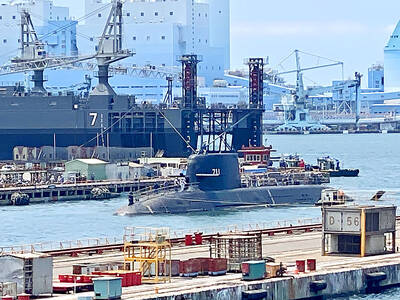
AGING: While Japan has 22 submarines, Taiwan only operates four, two of which were commissioned by the US in 1945 and 1946, and transferred to Taiwan in 1973 Taiwan would need at least 12 submarines to reach modern fleet capabilities, CSBC Corp, Taiwan chairman Chen Cheng-hung (陳政宏) said in an interview broadcast on Friday, citing a US assessment. CSBC is testing the nation’s first indigenous defense submarine, the Hai Kun (海鯤, Narwhal), which is scheduled to be delivered to the navy next month or in July. The Hai Kun has completed torpedo-firing tests and is scheduled to undergo overnight sea trials, Chen said on an SET TV military affairs program. Taiwan would require at least 12 submarines to establish a modern submarine force after assessing the nation’s operational environment and defense

A white king snake that frightened passengers and caused a stir on a Taipei MRT train on Friday evening has been claimed by its owner, who would be fined, Taipei Rapid Transit Corp (TRTC) said yesterday. A person on Threads posted that he thought he was lucky to find an empty row of seats on Friday after boarding a train on the Bannan (Blue) Line, only to spot a white snake with black stripes after sitting down. Startled, he jumped up, he wrote, describing the encounter as “terrifying.” “Taipei’s rat control plan: Release snakes on the metro,” one person wrote in reply, referring
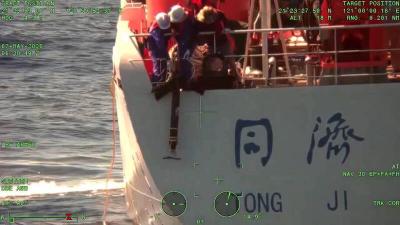
The coast guard today said that it had disrupted "illegal" operations by a Chinese research ship in waters close to the nation and driven it away, part of what Taipei sees a provocative pattern of China's stepped up maritime activities. The coast guard said that it on Thursday last week detected the Chinese ship Tongji (同濟號), which was commissioned only last year, 29 nautical miles (54km) southeast of the southern tip of Taiwan, although just outside restricted waters. The ship was observed lowering ropes into the water, suspected to be the deployment of scientific instruments for "illegal" survey operations, and the coast
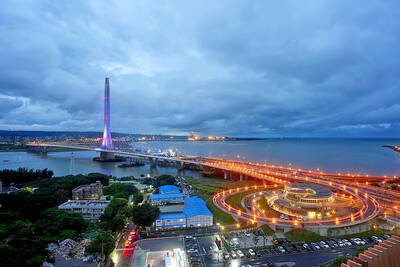
An inauguration ceremony was held yesterday for the Danjiang Bridge, the world’s longest single-mast asymmetric cable-stayed bridge, ahead of its official opening to traffic on Tuesday, marking a major milestone after nearly three decades of planning and construction. At the ceremony in New Taipei City attended by President William Lai (賴清德), Premier Cho Jung-tai (卓榮泰), Minister of Transportation and Communications Chen Shih-kai (陳世凱) and New Taipei City Mayor Hou Yu-ih (侯友宜), the bridge was hailed as both an engineering landmark and a long-awaited regional transport link connecting Tamsui (淡水) and Bali (八里)


 RSS
RSS