


Following the turmoil on Hong Kong university campuses earlier this week, the presidents of the nation’s leading universities reiterated that they would not allow unsolicited military and police forces to enter campus grounds.
The statement came in the wake of the fierce clashes between police, students and protesters on a number of university campuses in the territory on Monday and Tuesday, including at the Chinese University of Hong Kong and the University of Hong Kong.
National Tsing Hua University president Hocheng Hong (賀陳弘) on Thursday expressed his concerns for Hong Kong on the university’s Facebook page.
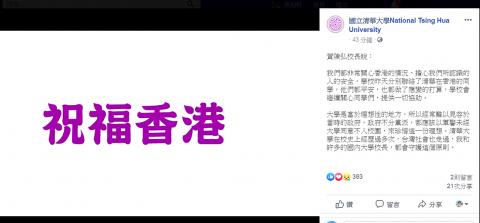
Screen grab from National Tsing Hua University’s Facebook page
Universities are a hotbed of idealism and might often be at odds with the government, but the government should — regardless its party affiliation — keep military and police forces off campuses as a show of respect for such idealism, he wrote.
National Taiwan University (NTU) president Kuan Chung-ming (管中閔) agreed, saying that no military or police personnel has the right to enter NTU grounds without first obtaining his approval.
National Taiwan Normal University (NTNU) knows what political oppression feels like as it was a victim in the April 6 Incident, which led to nearly two decades of indifference among NTNU students toward national and social issues, said its president, Wu Cheng-chih (吳正己).
Wu was referring to the April 6, 1949 incident when police and military entered the NTU and NTNU campuses and arrested more than 400 students suspected of engaging in underground communist activists. Seven were executed by firing squad.
The incident also marked the beginning of the White Terror era, with the then-Chinese Nationalist Party (KMT) regime declaring martial law on May 20 that year.
As a university is a cradle for future pillars of the nation, as well as a platform for intellectuals to voice their opinions, military and police interference in the exercise of freedom of speech can have a chilling effect on students and academics, which would hinder national development, Wu said.
Maintaining a safe university environment is a consensus in Taiwan, National Cheng Kung University Su Huey-jen (蘇慧貞) said, adding that security guards at the university are all told on their first day at work that military and police personnel cannot enter the campus without the school’s permission.
Only totalitarian regimes would send the military and police into schools, National Sun Yat-sen University president Cheng Ying-yao (鄭英耀) said.
As a school president, it is his obligation to fend off any political interference in an academic environment, he said.
China’s suppression of young people and surveillance of academics in Hong Kong have had a negative impact, he said, highlighting the value of Taiwan’s hard-earned democracy.
University autonomy is a consensus among Taiwanese schools, Shih Chien University president Michael Chen (陳振貴) said.
Taiwan and Hong Kong are different, as the latter was handed over to China 22 years ago in accordance with the treaty between the UK and China, while Taiwan is a democracy, he added.
National Yang-Ming University follows the same principle, president Steve Kuo (郭旭崧) said, adding that the situation in Hong Kong stems from long-term dissatisfaction, prompting people to take action to fight for a better future, despite the heavy cost.

Considering that most countries issue more than five denominations of banknotes, the central bank has decided to redesign all five denominations, the bank said as it prepares for the first major overhaul of the banknotes in more than 24 years. Central bank Governor Yang Chin-lung (楊金龍) is expected to report to the Legislative Yuan today on the bank’s operations and the redesign’s progress. The bank in a report sent to the legislature ahead of today’s meeting said it had commissioned a survey on the public’s preferences. Survey results showed that NT$100 and NT$1,000 banknotes are the most commonly used, while NT$200 and NT$2,000

The Centers for Disease Control (CDC) yesterday reported the first case of a new COVID-19 subvariant — BA.3.2 — in a 10-year-old Singaporean girl who had a fever upon arrival in Taiwan and tested positive for the disease. The girl left Taiwan on March 20 and the case did not have a direct impact on the local community, it said. The WHO added the BA.3.2 strain to its list of Variants Under Monitoring in December last year, but this was the first imported case of the COVID-19 variant in Taiwan, CDC Deputy Director-General Lin Ming-cheng (林明誠) said. The girl arrived in Taiwan on

South Korea is planning to revise its controversial electronic arrival card, a step Taiwanese officials said prompted them to hold off on planned retaliatory measures, a South Korean media report said yesterday. A Yonhap News Agency report said that the South Korean Ministry of Foreign Affairs is planning to remove the “previous departure place” and “next destination” fields from its e-arrival card system. The plan, reached after interagency consultations, is under review and aims to simplify entry procedures and align the electronic form with the paper version, a South Korean ministry official said. The fields — which appeared only on the electronic form

The Ministry of Foreign Affairs (MOFA) is suspending retaliation measures against South Korea that were set to take effect tomorrow, after Seoul said it is updating its e-arrival system, MOFA said today. The measures were to be a new round of retaliation after Taiwan on March 1 changed South Korea's designation on government-issued alien resident certificates held by South Korean nationals to "South Korea” from the "Republic of Korea," the country’s official name. The move came after months of protests to Seoul over its listing of Taiwan as "China (Taiwan)" in dropdown menus on its new online immigration entry system. MOFA last week


 RSS
RSS