


Yeh Ching-yi (葉經義), an 82-year-old master carpenter and carver, was honored with the National Craft Achievement Award on Saturday for his contributions to Taiwanese woodcarving.
Yeh was 15 when he began learning the craft from Su Shui-chin (蘇水欽), master of the Quanzhou carving style.
Just two months into his apprenticeship, he displayed his artistic gifts in his debut work — wooden figures for the Daitian Temple (代天宮) in Kaohsiung representing characters from the classical Chinese novel Romance of the Three Kingdoms.
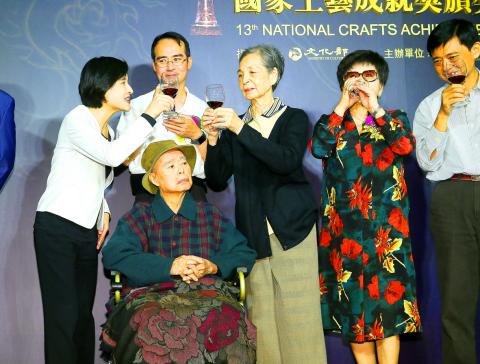
Photo: CNA
Yeh’s carvings, which are known for their realism, combine the fundamental elements of the style with his own distinctive flair.
His work, including statues of Buddha, temple decorations, Chinese screens, flowers, birds and shrines, can be found around the world.
Yeh’s eldest son, Yeh Kuang-chou (葉光洲), received the award from Minister of Culture Cheng Li-chiun (鄭麗君) on behalf of his father, who was in a wheelchair next to him, as he has speech and mobility problems.
Cheng thanked the craftsman for showing the world the beauty of Taiwanese woodcarvings.
“A few years ago, my father told me that his biggest regret in life was not having won this award yet, but today his wish has come true, which makes him extremely happy, although he is not able to say so,” Yeh Kuang-chou told the audience at a ceremony hosted by the National Taiwan Craft Research and Development Institute.
Thanks to Yeh Ching-yi’s work on several reconstruction projects on historical relics, many old temples and buildings have been given a second life, such as the Five Concubines Temple (五妃廟) and the Wang Clan Ancestral Temple (王姓大宗祠) in Tainan, the City God Temple (舊城城隍廟) in Kaohsiung’s Zuoying District (左營) and the Longshan Temple (龍山寺) in the Fengshan District (鳳山), the Lin Family Mansion and Garden in New Taipei City’s Banciao District (板橋) and the Red House Theater (紅樓劇場) in Taipei’s Ximending (西門町) area.
Yeh Ching-yi’s reputation extends beyond Taiwan. In 1991, he was invited by Shimizu Corp, a Japanese architectural and civil engineering firm, to help restore the throne, bed and litter of the Ryukyu Kingdom rulers who lived in Shurijo Castle in what is now Naha, Okinawa.
The remains of the castle were largely destroyed in the Battle of Okinawa in World War II, but a restoration project begun in the early 1990s to rebuild the structures and interiors.
The stone walls and building foundations of the castle are recognized as a UNESCO World Heritage site.
Yeh Ching-yi’s work at the castle, along with several Japanese temples, helped raise the global profile of Taiwanese woodcarving.
“Most people only know that the main pillar used in the reconstruction of the main hall of Shurijo castle in 1992 was made from Taiwanese cypress grown in Yilan County, but no Taiwanese know that the throne, bed and litter displayed in the castle were also made by a Taiwanese craftsman,” Yeh Kuang-chou said.
“Not even Japanese [know that], because they all think the works were done by craftsman from Japan,” he said.
Sadly, seven of the rebuilt castle structures, including the main hall, were destroyed in a fire on Oct. 31, he added.

Considering that most countries issue more than five denominations of banknotes, the central bank has decided to redesign all five denominations, the bank said as it prepares for the first major overhaul of the banknotes in more than 24 years. Central bank Governor Yang Chin-lung (楊金龍) is expected to report to the Legislative Yuan today on the bank’s operations and the redesign’s progress. The bank in a report sent to the legislature ahead of today’s meeting said it had commissioned a survey on the public’s preferences. Survey results showed that NT$100 and NT$1,000 banknotes are the most commonly used, while NT$200 and NT$2,000

The Centers for Disease Control (CDC) yesterday reported the first case of a new COVID-19 subvariant — BA.3.2 — in a 10-year-old Singaporean girl who had a fever upon arrival in Taiwan and tested positive for the disease. The girl left Taiwan on March 20 and the case did not have a direct impact on the local community, it said. The WHO added the BA.3.2 strain to its list of Variants Under Monitoring in December last year, but this was the first imported case of the COVID-19 variant in Taiwan, CDC Deputy Director-General Lin Ming-cheng (林明誠) said. The girl arrived in Taiwan on

South Korea is planning to revise its controversial electronic arrival card, a step Taiwanese officials said prompted them to hold off on planned retaliatory measures, a South Korean media report said yesterday. A Yonhap News Agency report said that the South Korean Ministry of Foreign Affairs is planning to remove the “previous departure place” and “next destination” fields from its e-arrival card system. The plan, reached after interagency consultations, is under review and aims to simplify entry procedures and align the electronic form with the paper version, a South Korean ministry official said. The fields — which appeared only on the electronic form

The Ministry of Foreign Affairs (MOFA) is suspending retaliation measures against South Korea that were set to take effect tomorrow, after Seoul said it is updating its e-arrival system, MOFA said today. The measures were to be a new round of retaliation after Taiwan on March 1 changed South Korea's designation on government-issued alien resident certificates held by South Korean nationals to "South Korea” from the "Republic of Korea," the country’s official name. The move came after months of protests to Seoul over its listing of Taiwan as "China (Taiwan)" in dropdown menus on its new online immigration entry system. MOFA last week


 RSS
RSS