


Kaohsiung Mayor Han Kuo-yu (韓國瑜) allegedly pressed a construction company into offering a NT$14 million (US$459,997 at the current exchange rate) loan for a pre-sold luxury apartment he purchased from it in 2015, Democratic Progressive Party (DPP) Legislator Lin Chun-hsien (林俊憲) said yesterday.
Taiwan Fertilizer Co initially refused when Han asked for the loan in November 2014, but agreed in April 2015 after Han’s wife, Lee Chia-fen (李佳芬), arranged three meetings between the company and a city councilor, Lin told a news conference in Taipei.
The purchase became the center of media attention after the Chinese-language Next Magazine on Wednesday reported that the Chinese Nationalist Party’s (KMT) presidential candidate had purchased a 90 ping (298m2) apartment in Taipei’s Nangang District (南港) for more than NT$70 million in 2011 and sold it in 2015 at a loss of about 3.5 percent.
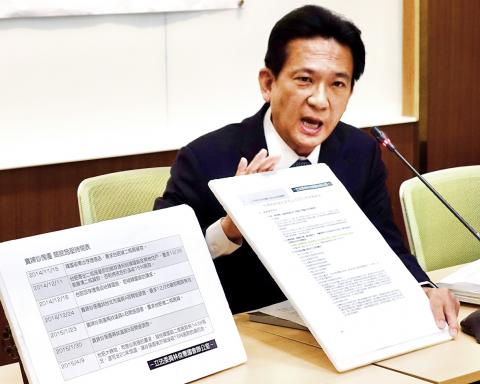
Photo: Chien Jung-fong, Taipei Times
Lin on Thursday said that Han allegedly used his political connections to demand a 20-year loan of more than NT$14 million from Taiwan Fertilizer to purchase the apartment, but did not offer many details or evidence.
At yesterday’s news conference, Lin presented copies of the Taipei City Government’s records of meetings held by a city councilor to resolve disputes between the company, Han and other buyers of its apartments.
The first meeting, on Dec. 24, 2014, prompted the company to waive a 15 percent fine on homebuyers who failed to pay overdue installments by Dec. 26, saving Han more than NT$10 million, Lin said.
Two more meetings in January 2015 led the company to agree to offer a 20-year loan of NT$1.3 billion to six buyers, including NT$14.38 million to Han, he said.
The loan breached the company’s policy, which bans it from offering loans longer than one year, he said.
Moreover, the loans were not approved by the firm’s board of directors and are nowhere to be found in its financial statements, he said, urging the Council of Agriculture, the company’s biggest shareholder, to launch an investigation.
“The reason so many are suffering in this world is because people like you are hiking up housing prices,” Lin said, an apparent reference to a remark of Han’s that “one must always keep in mind the many people who are suffering in this world.”
The council yesterday said it would ask Taiwan Fertilizer to submit a report about the loans and brief its board of directors within a week.
Han’s campaign office said that anyone who interprets an unprofitable apartment sale as a speculative investment designed to hike up housing prices must have either “a flawed intellect or the wrong attitude.”
Lin should do some research about President Tsai Ing-wen’s (蔡英文) 15 speculative real-estate investments in Taipei’s Neihu District (內湖), it said.
The office did not provide more details about the apartment, saying it had already explained the matter.
Should people find anything illegal with the sale, they are welcome to report it, it added.
Additional reporting by Wang Jung-hsiang and CNA

Considering that most countries issue more than five denominations of banknotes, the central bank has decided to redesign all five denominations, the bank said as it prepares for the first major overhaul of the banknotes in more than 24 years. Central bank Governor Yang Chin-lung (楊金龍) is expected to report to the Legislative Yuan today on the bank’s operations and the redesign’s progress. The bank in a report sent to the legislature ahead of today’s meeting said it had commissioned a survey on the public’s preferences. Survey results showed that NT$100 and NT$1,000 banknotes are the most commonly used, while NT$200 and NT$2,000

The Centers for Disease Control (CDC) yesterday reported the first case of a new COVID-19 subvariant — BA.3.2 — in a 10-year-old Singaporean girl who had a fever upon arrival in Taiwan and tested positive for the disease. The girl left Taiwan on March 20 and the case did not have a direct impact on the local community, it said. The WHO added the BA.3.2 strain to its list of Variants Under Monitoring in December last year, but this was the first imported case of the COVID-19 variant in Taiwan, CDC Deputy Director-General Lin Ming-cheng (林明誠) said. The girl arrived in Taiwan on

South Korea is planning to revise its controversial electronic arrival card, a step Taiwanese officials said prompted them to hold off on planned retaliatory measures, a South Korean media report said yesterday. A Yonhap News Agency report said that the South Korean Ministry of Foreign Affairs is planning to remove the “previous departure place” and “next destination” fields from its e-arrival card system. The plan, reached after interagency consultations, is under review and aims to simplify entry procedures and align the electronic form with the paper version, a South Korean ministry official said. The fields — which appeared only on the electronic form

The Ministry of Foreign Affairs (MOFA) is suspending retaliation measures against South Korea that were set to take effect tomorrow, after Seoul said it is updating its e-arrival system, MOFA said today. The measures were to be a new round of retaliation after Taiwan on March 1 changed South Korea's designation on government-issued alien resident certificates held by South Korean nationals to "South Korea” from the "Republic of Korea," the country’s official name. The move came after months of protests to Seoul over its listing of Taiwan as "China (Taiwan)" in dropdown menus on its new online immigration entry system. MOFA last week


 RSS
RSS