


The Taoyuan District Court yesterday withdrew the case against Taiwan Civilian Government (TCG) secretary-general Roger Lin (林志昇), who died on Wednesday after an accidental fall, but said that prosecution of other TCG officials for fraud would proceed.
Lin was a cofounder of TCG, a controversial organization that offered “citizenship cards” that Lin said were authorized by the “US military government” and entitled holders to travel to or reside in the US.
Family members said that Lin, 70, fell unconscious after a fall in his home in Taoyuan on Saturday last week. He was rushed to hospital for emergency treatment and put on life support.
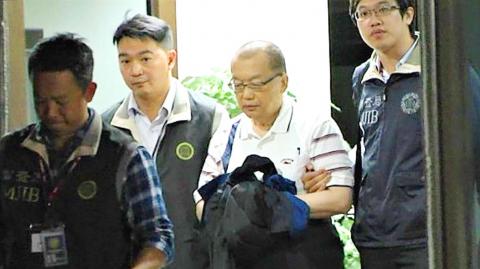
Photo: Chou Min-hung, Taipei Times
As he showed no signs of recovering, the family took him home on Tuesday and he died on Wednesday night.
After receiving notice of his death, a Taoyuan prosecutor and a coroner went to his home and examined the body to determine that no foul play was involved.
Prosecutors said they had to verify Lin’s cause of death, which a hospital report attributed to a brain hemorrhage. The coroner has not yet released a report on the cause of death.
Following the identity verification, the district court said it would not proceed with the case in accordance with Article 303 of the Code of Criminal Procedure (刑事訴訟法), which states that the court would not “entertain” a case if the accused is dead.
More than 300 people have filed complaints of fraud against Lin, his wife, Julian Lin (林梓安), and other TCG executives, saying that the citizenship cards TCG issued were worthless and not recognized by the US government.
Roger Lin, his wife and four top executives were indicted in May on charges of aggravated fraud, profiting on false pretenses, money laundering, operating a criminal organization and illegal fundraising among others.
Prosecution of the charges again Julian Lin and the four executives are to continue, the court said.
Prosecutors said that TCG “operated like a political Ponzi scheme” and estimated that Roger Lin and the other accused had made more than NT$1 billion (US$32.9 million) since the organization was founded in 2008.

Considering that most countries issue more than five denominations of banknotes, the central bank has decided to redesign all five denominations, the bank said as it prepares for the first major overhaul of the banknotes in more than 24 years. Central bank Governor Yang Chin-lung (楊金龍) is expected to report to the Legislative Yuan today on the bank’s operations and the redesign’s progress. The bank in a report sent to the legislature ahead of today’s meeting said it had commissioned a survey on the public’s preferences. Survey results showed that NT$100 and NT$1,000 banknotes are the most commonly used, while NT$200 and NT$2,000

The Centers for Disease Control (CDC) yesterday reported the first case of a new COVID-19 subvariant — BA.3.2 — in a 10-year-old Singaporean girl who had a fever upon arrival in Taiwan and tested positive for the disease. The girl left Taiwan on March 20 and the case did not have a direct impact on the local community, it said. The WHO added the BA.3.2 strain to its list of Variants Under Monitoring in December last year, but this was the first imported case of the COVID-19 variant in Taiwan, CDC Deputy Director-General Lin Ming-cheng (林明誠) said. The girl arrived in Taiwan on

South Korea is planning to revise its controversial electronic arrival card, a step Taiwanese officials said prompted them to hold off on planned retaliatory measures, a South Korean media report said yesterday. A Yonhap News Agency report said that the South Korean Ministry of Foreign Affairs is planning to remove the “previous departure place” and “next destination” fields from its e-arrival card system. The plan, reached after interagency consultations, is under review and aims to simplify entry procedures and align the electronic form with the paper version, a South Korean ministry official said. The fields — which appeared only on the electronic form

The Ministry of Foreign Affairs (MOFA) is suspending retaliation measures against South Korea that were set to take effect tomorrow, after Seoul said it is updating its e-arrival system, MOFA said today. The measures were to be a new round of retaliation after Taiwan on March 1 changed South Korea's designation on government-issued alien resident certificates held by South Korean nationals to "South Korea” from the "Republic of Korea," the country’s official name. The move came after months of protests to Seoul over its listing of Taiwan as "China (Taiwan)" in dropdown menus on its new online immigration entry system. MOFA last week


 RSS
RSS