


Taiwan and Vietnam on Wednesday signed a memorandum of understanding to boost collaboration on African swine fever detection, vaccine investigation and diagnostic technology, the Council of Agriculture said yesterday.
A delegation headed by Council Deputy Minister Huang Chin-cheng (黃金城) arrived in Vietnam on Tuesday to meet with Vietnamese officials.
The next day, Animal Health Research Institute Director-General Chiou Chwei-jang (邱垂章) signed the memorandum with Pham Thi Ngoc, acting chief of Vietnam’s National Institute of Veterinary Research in Hanoi.
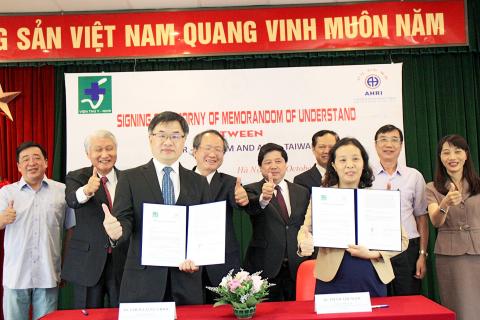
Photo courtesy of the Council of Agriculture
Although Taiwan has developed African swine fever diagnostic technology in compliance with World Organisation for Animal Health standards, it has not been tested on live pigs infected by the virus. The collaboration with Vietnam gives Taiwan the opportunity to test the measures on live pigs.
Since its first reported outbreak of African swine fever in February, Vietnam has identified a total of 6,083 cases, council data as of yesterday showed.
China in August last year was the first Asian country to report an outbreak. It was followed by Mongolia, Vietnam, Cambodia, North Korea, Laos, Myanmar, the Philippines, South Korea and East Timor.
Taiwan has tightened border inspections and started prevention work since China first reported the virus last year, the council said, adding that cross-border viral infections like African swine fever highlight the importance of regional collaboration to curb its spread.
The memorandum with Vietnam opens the door to more collaboration opportunities on examination, testing and vaccine development of African swine fever and other diseases, such as classical swine fever and foot-and-mouth disease, the council said, adding that it hoped to build a strengthened network of prevention with Vietnam.
Since Dec. 18 last year, people caught illegally transporting pork products from areas where African swine fever has been reported would face a fine of NT$200,000 (US$6,539) for the first offense and NT$1 million for repeated offenses.
Foreigners who fail to pay the fine at customs would be denied entry into Taiwan.

Considering that most countries issue more than five denominations of banknotes, the central bank has decided to redesign all five denominations, the bank said as it prepares for the first major overhaul of the banknotes in more than 24 years. Central bank Governor Yang Chin-lung (楊金龍) is expected to report to the Legislative Yuan today on the bank’s operations and the redesign’s progress. The bank in a report sent to the legislature ahead of today’s meeting said it had commissioned a survey on the public’s preferences. Survey results showed that NT$100 and NT$1,000 banknotes are the most commonly used, while NT$200 and NT$2,000

The Centers for Disease Control (CDC) yesterday reported the first case of a new COVID-19 subvariant — BA.3.2 — in a 10-year-old Singaporean girl who had a fever upon arrival in Taiwan and tested positive for the disease. The girl left Taiwan on March 20 and the case did not have a direct impact on the local community, it said. The WHO added the BA.3.2 strain to its list of Variants Under Monitoring in December last year, but this was the first imported case of the COVID-19 variant in Taiwan, CDC Deputy Director-General Lin Ming-cheng (林明誠) said. The girl arrived in Taiwan on

South Korea is planning to revise its controversial electronic arrival card, a step Taiwanese officials said prompted them to hold off on planned retaliatory measures, a South Korean media report said yesterday. A Yonhap News Agency report said that the South Korean Ministry of Foreign Affairs is planning to remove the “previous departure place” and “next destination” fields from its e-arrival card system. The plan, reached after interagency consultations, is under review and aims to simplify entry procedures and align the electronic form with the paper version, a South Korean ministry official said. The fields — which appeared only on the electronic form

The Ministry of Foreign Affairs (MOFA) is suspending retaliation measures against South Korea that were set to take effect tomorrow, after Seoul said it is updating its e-arrival system, MOFA said today. The measures were to be a new round of retaliation after Taiwan on March 1 changed South Korea's designation on government-issued alien resident certificates held by South Korean nationals to "South Korea” from the "Republic of Korea," the country’s official name. The move came after months of protests to Seoul over its listing of Taiwan as "China (Taiwan)" in dropdown menus on its new online immigration entry system. MOFA last week


 RSS
RSS