


The slew of incidents involving Chinese students vandalizing pro-Hong Kong democracy “Lennon walls” on campuses in Taiwan and threatening Hong Kong students are a manifestations of a collective anxiety, National Tsing Hua University professor Cheng Chih-peng (鄭志鵬) said yesterday.
Since Taiwan allowed Chinese students to study in Taiwan in 2011, they have never made such an aggressive political statement, not even during the Sunflower movement and Hong Kong’s “Umbrella movement,” Cheng said.
He cited three possible causes of anxiety among Chinese students in Taiwan.
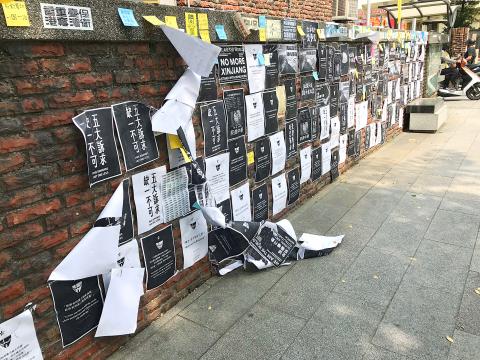
Photo: Liu Wan-chun, Taipei Times
First, Chinese President Xi Jinping (習近平) has been pushing the so-called “Chinese dream” since his rise to power, elevating Chinese ethnocentrism, he said.
With China’s rapidly growing economic power, ethnocentrism has prompted Chinese to seek recognition from the international community, he said.
However, some Chinese students studying abroad feel anxious, because many countries are not so friendly toward China, he said, adding that incidents of Chinese students seeking to impose their views on others have not only occurred in Taiwan, but also in Western countries.
Second, the anti-extradition bill movement in Hong Kong has showen many Taiwanese that Beijing reneged on the promise that it would maintain a “one country, two systems” policy there, which has increased Taiwanese’s distrust of the Chinese government, making unification with Taiwan even more unlikely, he said.
Third, Taiwanese students have become increasingly aware of the “Chinese factor” and more vigilant of China’s tactics to influence Taiwanese society, which is a source of contention between Taiwanese and Chinese students, especially during discussions of public affairs, Cheng said.
Regarding speculation that alleged vandalism of Lennon walls by Chinese students had been orchestrated, Cheng said that people should not view Chinese students as a group that cannot be reasoned with, but should try to understand what has made them anxious.
Cheng said he could not approve of the Ministry of Education leaving incidents of vandalism in the hands of universities.
The ministry should set a standard for dealing with such incidents to prevent inadequate policies being set by institutions, he said.
Cheng said he could not agree with Immigration Agency Director-General Chiu Feng-kuang’s (邱豐光) statement that if Chinese sabotage Lennon walls, they could be barred from re-entering the nation.
It is generally accepted that students should be given a second chance if they have made a mistake at university, so the authorities should not have a “double standard” on this matter, he said.
Puma Shen (沈伯洋), an associate professor in National Taipei University’s Graduate School of Criminology, said that similar incidents have occurred in other countries, so Taiwan needs to introduce a model to handle conflicts on campus to better manage risks.
The authorities should provide counseling to Chinese studying in the nation and help them form an understanding of the predominant public opinion to help them interact with classmates, Shen said.
Students from both sides should keep in mind that the point is to exchange ideas, which should be based on democratic values, he said.
If Taiwan cannot abide by democratic institutions, it would defeat the purpose of allowing in Chinese exchange students, he said.
Academic exchanges are a way for Taiwanese to win the approval of young Chinese, so the vandalism of the Lennon walls should not be treated in a manner that would only escalate hostility, he said.
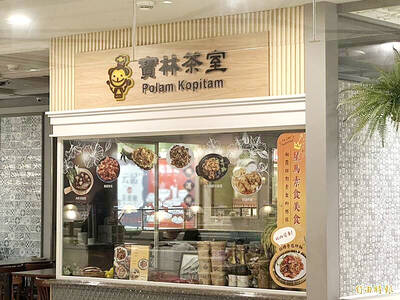
POLAM KOPITIAM CASE: Of the two people still in hospital, one has undergone a liver transplant and is improving, while the other is being evaluated for a liver transplant A fourth person has died from bongkrek acid poisoning linked to the Polam Kopitiam (寶林茶室) restaurant in Taipei’s Far Eastern Sogo Xinyi A13 Department Store, the Ministry of Health and Welfare said yesterday, as two other people remain seriously ill in hospital. The first death was reported on March 24. The man had been 39 years old and had eaten at the restaurant on March 22. As more cases of suspected food poisoning involving people who had eaten at the restaurant were reported by hospitals on March 26, the ministry and the Taipei Department of Health launched an investigation. The Food and

The long-awaited Taichung aquarium is expected to open next year after more than a decade of development. The building in Cingshui District (清水) is to feature a large ocean aquarium on the first floor, coral display area on the second floor, a jellyfish tank and Dajia River (大甲溪) basin display on the third, a river estuary display and restaurant on the fourth, and a cafe and garden on the fifth. As it is near Wuci Fishing Port (梧棲漁港), many are expecting the opening of the aquarium to bring more tourism to the harbor. Speaking at the city council on Monday, Taichung City Councilor
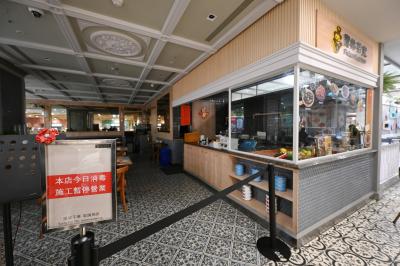
A fourth person has died in a food poisoning outbreak linked to the Xinyi (信義) branch of Malaysian restaurant chain Polam Kopitiam (寶林茶室) in Taipei, Deputy Minister of Health and Welfare Victor Wang (王必勝) said on Monday. It was the second fatality in three days, after another was announced on Saturday. The 40-year-old woman experienced multiple organ failure in the early hours on Monday, and the family decided not to undergo emergency resuscitation, Wang said. She initially showed signs of improvement after seeking medical treatment for nausea, vomiting and diarrhea, but her condition worsened due to an infection, he said. Two others who
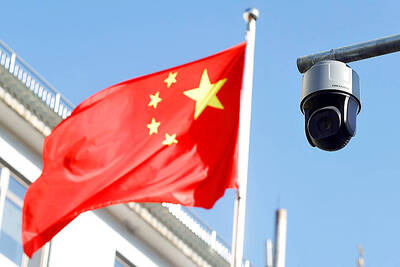
Taiwanese should be mindful when visiting China, as Beijing in July is likely to tighten the implementation of policies on national security following the introduction of two regulations, a researcher said on Saturday. China on Friday unveiled the regulations governing the law enforcement and judicial activities of national security agencies. They would help crack down on “illegal” and “criminal” activities that Beijing considers to be endangering national security, according to reports by China’s state media. The definition of what constitutes a national security threat in China is vague, Taiwan Thinktank researcher Wu Se-chih (吳瑟致) said. The two procedural regulations are to provide Chinese


 RSS
RSS