


The Democratic Progressive Party (DPP) appears to be leaning toward a Tsai-Lai — President Tsai Ing-wen (蔡英文) and former premier William Lai (賴清德) — ticket for next year’s presidential election, despite an ugly and heated primary in June.
Tsai has dodged media question regarding the election, saying only that she believed the DPP must be united and would provide the best pair of candidates at the appropriate time.
She added that state matters should take precedence and that she would provide proof of her administration’s accomplishments, as well as her policy platform.
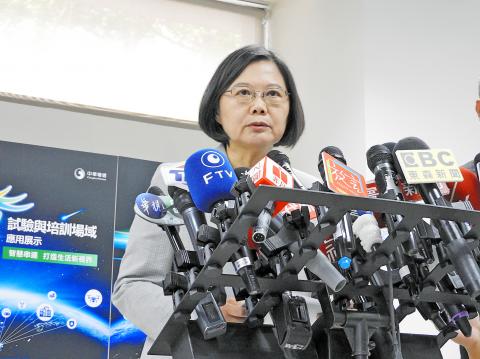
Photo: Lai Hsiao-tung, Taipei Times
Independence advocate Koo Kwang-ming (辜寬敏) yesterday said that he was “optimistic” about Tsai and Lai running together, but added that the two would need to “talk things out” regarding their views about Taiwan’s future.
Koo also told reporters that Lai had told him in June to stop his criticism of Tsai, adding that Lai is the type of person who would stop others from criticizing his opponent.
During the DPP primary, Koo and other independence advocates had been vocal in their opposition to Tsai running for re-election and had favored Lai as the party’s candidate.
When Tsai’s public support rating hovered at about 20 percent, it was Lai, then the mayor of Tainan, who stepped in, took over the position of premier and saved the day, Koo said.
However, his efforts were not reciprocated and Lai was denied the freedom to appoint officials, Koo said.
In other developments, the DPP said that this election campaign would be tougher than the one in 2016, but the party remained optimistic.
The DPP looks forward to winning a majority in the 113-seat Legislative Yuan as it did in 2016, it said.
The party has a strong position south of Yunlin County and could work on its influence north of Changhua County, a source in the DPP said on condition of anonymity.
It is tied with the Chinese Nationalist Party (KMT) in some constituencies, the source said.
However, it hopes to conclude nominations for legislators-at-large during a Central Executive Committee meeting on Oct. 16, the source added.
DPP Chairman Cho Jung-tai (卓榮泰) has said the party is looking to win 18 legislator-at-large seats.
The KMT is also confident about its chances in the legislature, but said it has to do more if it wants to capture 60 seats.
Taipei, New Taipei City, Taoyuan and Taichung are traditional KMT strongholds, and the party could win one to two additional seats from Tainan, KMT Chairman Wu Den-yih (吳敦義) said.
The party would do better in Kaohsiung after Han Kuo-yu (韓國瑜) won the mayoral election last year, the first time the party won the city seat since 1994, Wu said.
A KMT source speaking on condition of anonymity said the split between Han and Hon Hai Precision Industry Co founder Terry Gou (郭台銘) was “problematic” for KMT legislators, but Gou’s decision not to run for president has helped solidify party support.
Despite their confidence, observers said the DPP and the KMT are facing a potential threat from Taipei Mayor Ko Wen-je’s (柯文哲) Taiwan People’s Party.
Additional reporting by CNA

Considering that most countries issue more than five denominations of banknotes, the central bank has decided to redesign all five denominations, the bank said as it prepares for the first major overhaul of the banknotes in more than 24 years. Central bank Governor Yang Chin-lung (楊金龍) is expected to report to the Legislative Yuan today on the bank’s operations and the redesign’s progress. The bank in a report sent to the legislature ahead of today’s meeting said it had commissioned a survey on the public’s preferences. Survey results showed that NT$100 and NT$1,000 banknotes are the most commonly used, while NT$200 and NT$2,000

The Centers for Disease Control (CDC) yesterday reported the first case of a new COVID-19 subvariant — BA.3.2 — in a 10-year-old Singaporean girl who had a fever upon arrival in Taiwan and tested positive for the disease. The girl left Taiwan on March 20 and the case did not have a direct impact on the local community, it said. The WHO added the BA.3.2 strain to its list of Variants Under Monitoring in December last year, but this was the first imported case of the COVID-19 variant in Taiwan, CDC Deputy Director-General Lin Ming-cheng (林明誠) said. The girl arrived in Taiwan on

South Korea is planning to revise its controversial electronic arrival card, a step Taiwanese officials said prompted them to hold off on planned retaliatory measures, a South Korean media report said yesterday. A Yonhap News Agency report said that the South Korean Ministry of Foreign Affairs is planning to remove the “previous departure place” and “next destination” fields from its e-arrival card system. The plan, reached after interagency consultations, is under review and aims to simplify entry procedures and align the electronic form with the paper version, a South Korean ministry official said. The fields — which appeared only on the electronic form

The Ministry of Foreign Affairs (MOFA) is suspending retaliation measures against South Korea that were set to take effect tomorrow, after Seoul said it is updating its e-arrival system, MOFA said today. The measures were to be a new round of retaliation after Taiwan on March 1 changed South Korea's designation on government-issued alien resident certificates held by South Korean nationals to "South Korea” from the "Republic of Korea," the country’s official name. The move came after months of protests to Seoul over its listing of Taiwan as "China (Taiwan)" in dropdown menus on its new online immigration entry system. MOFA last week


 RSS
RSS