


Taiwan and Germany can pursue more collaborations to promote decarbonization to mitigate the effects of climate change, Potsdam Institute for Climate Impact Research (PIK) founding director Hans Joachim Schellnhuber told an Academia Sinica symposium in Taipei yesterday.
Known as the “father of the 2-degree limit,” Schellnhuber delivered a keynote speech titled “The Climate Challenge and the Great Transformation.”
Academia Sinica President James Liao (廖俊智) opened the event by welcoming Schellnhuber’s return to Taiwan.
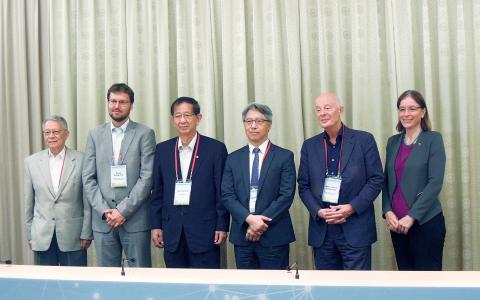
Photo: CNA
He last visited in 2015.
As Taiwan is a small island with limited energy resources, the nation faces more difficulties promoting energy transformation to achieve a carbon-neutral society by 2050, Liao said, but added that “everything is impossible until it is done.”
Schellnhuber said that “extreme weather is the new normal,” citing as examples the wildfires in the Amazon, heatwaves across Europe and rising average temperatures.
As anthropogenic carbon emissions continue to rise, how to prevent the world’s temperature from rising more than 2oC over preindustrial levels remains challenging, he said.
Germany is the first in the world to set a goal of phasing out nuclear and coal power by 2022 and 2038 respectively, and Taiwan can learn from Germany to avoid repeating the same mistakes, he told reporters on the sidelines of the forum.
Taiwan has extremely good potential in technological development, including electronics, digitalization and semiconductors, he said, adding that he expects the two countries to undertake more joint programs to mitigate climate change.
Asked what research areas deserve more attention, he said that two important trajectories are to promote decarbonization and to prepare for the impacts of extreme weather events, such as rising sea levels and stronger typhoons.
While oceans absorb nearly 93 percent of the Earth’s extra heat, human knowledge about oceans is inadequate, he said.
“The ocean is still our friend when it comes to global warming,” but if its capacity for absorbing carbon dioxide changes, people would be strenuously fighting on two fronts — the atmosphere and the ocean,” he said.
Noting that Taiwan is to launch three new ocean research vessels to replace three operational ones, Schellnhuber said Taiwan should be part of the global ocean observation system.
Schellnhuber and PIK head of the directors’ staff Daniel Klingenfeld on Tuesday also visited Minister of Science and Technology Chen Liang-gee (陳良基) and National Science and Technology for Disaster Reduction Director Hongey Chen (陳宏宇) in Taipei.

Considering that most countries issue more than five denominations of banknotes, the central bank has decided to redesign all five denominations, the bank said as it prepares for the first major overhaul of the banknotes in more than 24 years. Central bank Governor Yang Chin-lung (楊金龍) is expected to report to the Legislative Yuan today on the bank’s operations and the redesign’s progress. The bank in a report sent to the legislature ahead of today’s meeting said it had commissioned a survey on the public’s preferences. Survey results showed that NT$100 and NT$1,000 banknotes are the most commonly used, while NT$200 and NT$2,000

The Centers for Disease Control (CDC) yesterday reported the first case of a new COVID-19 subvariant — BA.3.2 — in a 10-year-old Singaporean girl who had a fever upon arrival in Taiwan and tested positive for the disease. The girl left Taiwan on March 20 and the case did not have a direct impact on the local community, it said. The WHO added the BA.3.2 strain to its list of Variants Under Monitoring in December last year, but this was the first imported case of the COVID-19 variant in Taiwan, CDC Deputy Director-General Lin Ming-cheng (林明誠) said. The girl arrived in Taiwan on

South Korea is planning to revise its controversial electronic arrival card, a step Taiwanese officials said prompted them to hold off on planned retaliatory measures, a South Korean media report said yesterday. A Yonhap News Agency report said that the South Korean Ministry of Foreign Affairs is planning to remove the “previous departure place” and “next destination” fields from its e-arrival card system. The plan, reached after interagency consultations, is under review and aims to simplify entry procedures and align the electronic form with the paper version, a South Korean ministry official said. The fields — which appeared only on the electronic form

The Ministry of Foreign Affairs (MOFA) is suspending retaliation measures against South Korea that were set to take effect tomorrow, after Seoul said it is updating its e-arrival system, MOFA said today. The measures were to be a new round of retaliation after Taiwan on March 1 changed South Korea's designation on government-issued alien resident certificates held by South Korean nationals to "South Korea” from the "Republic of Korea," the country’s official name. The move came after months of protests to Seoul over its listing of Taiwan as "China (Taiwan)" in dropdown menus on its new online immigration entry system. MOFA last week


 RSS
RSS