


The number of green iguanas in the wild has been increasing, with more than 2,500 removed from Kaohsiung and Pingtung County alone this year, an academic has said.
The invasive species has spread across Taiwan, said Chen Tien-hsi (陳添喜), a professor at the National Pingtung University of Science and Technology’s Institute of Wildlife Conservation.
Imported into the nation as pets, the iguanas are small at birth, but can grow into “2m monsters,” the Kaohsiung Agriculture Bureau said on Sunday.
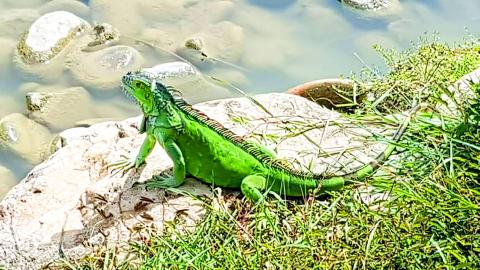
Photo: Chen Wen-chan, Taipei Times
Green iguanas do not have any natural enemies in Taiwan, as no native lizard species can reach their size, the bureau said, adding that adult green iguanas have huge appetites, feeding on insects as well as crops.
In groups, they threaten native species, the bureau said, adding that their “dragon-like” appearance can startle people.
Since 2014, authorities have removed more than 7,000 green iguanas from the wild, Chen said.
From 2014 to 2017, they caught fewer than 100, but this year alone they have caught more than 3,000, he said.
Green iguanas move through ditches and water channels, such as the Fongshan River (鳳山溪), the Caogong Canal (曹公圳) or the Love River (愛河) in Kaohsiung, he said.
The lizards prefer to live in parks that have access to water, he said, adding that they can be spotted in Dadong Park, Weiwuying Metropolitan Park, Chengcing Lake (澄清湖), the Heart of Love River (愛河之心), and Kaohsiung Metropolitan Park in Nanzih District (楠梓).
The crowds at Weiwuying Metropolitan Park make it more difficult to catch the lizards, he said, adding that the iguanas dive into the park’s pond when they sense danger.
Recent heavy rains in southern Taiwan have driven the lizards into towns along the coasts of Kaohsiung and Pingtung, he said.
The Agriculture Bureau said it has discovered breeding grounds in Kaohsiung’s Niaosong (鳥松) and Renwu (仁武) districts, and would step up efforts to catch the lizards — especially fully grown ones.
More than 500 green iguanas were caught in the city this year with outside help, the bureau said.
It urged residents to call the 1999 hotline if they see green iguanas, adding that releasing them back into the wild would not only hurt the environment, but also create extra costs for the government.
The Council of Agriculture said it would draft regulations on the purchase, sale and breeding of green iguanas.
Owners of green iguanas would be required to register their pets, the council said.
Chen said the measures would help control the number of green iguanas in the nation.

Considering that most countries issue more than five denominations of banknotes, the central bank has decided to redesign all five denominations, the bank said as it prepares for the first major overhaul of the banknotes in more than 24 years. Central bank Governor Yang Chin-lung (楊金龍) is expected to report to the Legislative Yuan today on the bank’s operations and the redesign’s progress. The bank in a report sent to the legislature ahead of today’s meeting said it had commissioned a survey on the public’s preferences. Survey results showed that NT$100 and NT$1,000 banknotes are the most commonly used, while NT$200 and NT$2,000

The Centers for Disease Control (CDC) yesterday reported the first case of a new COVID-19 subvariant — BA.3.2 — in a 10-year-old Singaporean girl who had a fever upon arrival in Taiwan and tested positive for the disease. The girl left Taiwan on March 20 and the case did not have a direct impact on the local community, it said. The WHO added the BA.3.2 strain to its list of Variants Under Monitoring in December last year, but this was the first imported case of the COVID-19 variant in Taiwan, CDC Deputy Director-General Lin Ming-cheng (林明誠) said. The girl arrived in Taiwan on

South Korea is planning to revise its controversial electronic arrival card, a step Taiwanese officials said prompted them to hold off on planned retaliatory measures, a South Korean media report said yesterday. A Yonhap News Agency report said that the South Korean Ministry of Foreign Affairs is planning to remove the “previous departure place” and “next destination” fields from its e-arrival card system. The plan, reached after interagency consultations, is under review and aims to simplify entry procedures and align the electronic form with the paper version, a South Korean ministry official said. The fields — which appeared only on the electronic form

The Ministry of Foreign Affairs (MOFA) is suspending retaliation measures against South Korea that were set to take effect tomorrow, after Seoul said it is updating its e-arrival system, MOFA said today. The measures were to be a new round of retaliation after Taiwan on March 1 changed South Korea's designation on government-issued alien resident certificates held by South Korean nationals to "South Korea” from the "Republic of Korea," the country’s official name. The move came after months of protests to Seoul over its listing of Taiwan as "China (Taiwan)" in dropdown menus on its new online immigration entry system. MOFA last week


 RSS
RSS